





Ganashakti@60: ‘Torchbearer of Masses’ Amid Shifting Political Currents
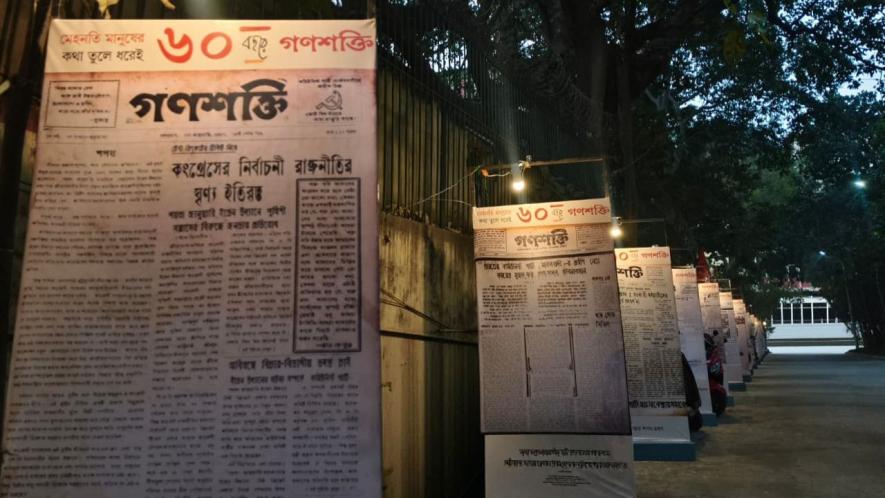
Meeting in pdg auditorium on account of 60 th year og Ganashakti
Kolkata: The 60th anniversary of Ganashakti Daily, the long-standing mouthpiece of the Communist Party of India (Marxist) in West Bengal, was celebrated at the PDG Auditorium in Kolkata recently. What unfolded was not merely a commemorative gathering but a reaffirmation of the newspaper’s ideological moorings and its role as a people’s organ in times of turbulence,
shaping the Left’s worldview.
From Evening Paper to ‘People’s Movement’
Founded in 1967 as the state’s first evening daily, Ganashakti transformed into a morning newspaper in 1986. Over the decades, under the stewardship of editors like Saroj Mukherjee, Anil Biswas, and Avik Dutta, the paper evolved into what it terms as the “torchbearer of the toiling masses.”
The newspaper’s current editor, Shamik Lahiri, in his address, underscored the resilience of the paper through the “ups and downs” of 57 years. “It is not only a daily newspaper, but a movement which caters to the larger people’s movement perspective. It will never surrender to reactionary forces,” Lahiri declared, stressing that Ganashakti had never allowed advertisers to dictate its editorial policy. “We believe in separation of advertisement and news,” he added, a pointed reminder of the paper’s commitment to integrity amidst financial constraints.
Biman Basu: Critique of Imperialism and State Policy
Presiding over the celebrations, Left Front chairman Biman Basu delivered a critique of US imperialism, noting that the dollar’s global hegemony now faces challenges from China’s expanding role in trade. He accused both the Bharatiya Janta Party (BJP) and the Trinamool Congress (TMC) of pursuing divisive politics rooted in caste and religion.
Basu’s speech drew historical parallels, citing the relocation of a mosque near Cairo Airport after the Bandung Conference of the Non-Aligned Movement. “Not a single penny was spent from the Egyptian exchequer, and the Moulvis abided by it. But now in our country such examples are rare,” he lamented.
Speaking of West Bengal, Basu criticised the TMC government’s decision to fund temple projects—the Durga Angan in Rajarhat New Town and the Mahakjaal temple in Siliguri—through HIDCO, the nodal authority for urban development. “HIDCO has been turned into a cash cow, and with its hard-earned money these temples are being built,” he said, terming it as “misuse of public resources”. He alleged that TMC’s political birth was facilitated by the Rashtriya Swayamsevak Sangh (RSS), a claim meant to underline ideological contradictions in Bengal’s ruling dispensation.
Surjya Mishra: Contradictions of Imperialism and Socialism
Former CPI(M) polit bureau member Surjya Kanta Mishra reinforced the Marxist lens of global contradictions. “The main contradiction in the world still is the contradiction between imperialism and socialism,” he said, pointing out that even developed countries had expressed reservations about US policies, particularly during the Donald Trump era.
He linked the housing bubble burst of the early 2000s to the strengthening of crony capitalism, arguing that neoliberalism and neo-fascism thrived amidst economic turmoil. He situated Ganashakti within a broader struggle against systemic forces that perpetuate inequality and authoritarianism.
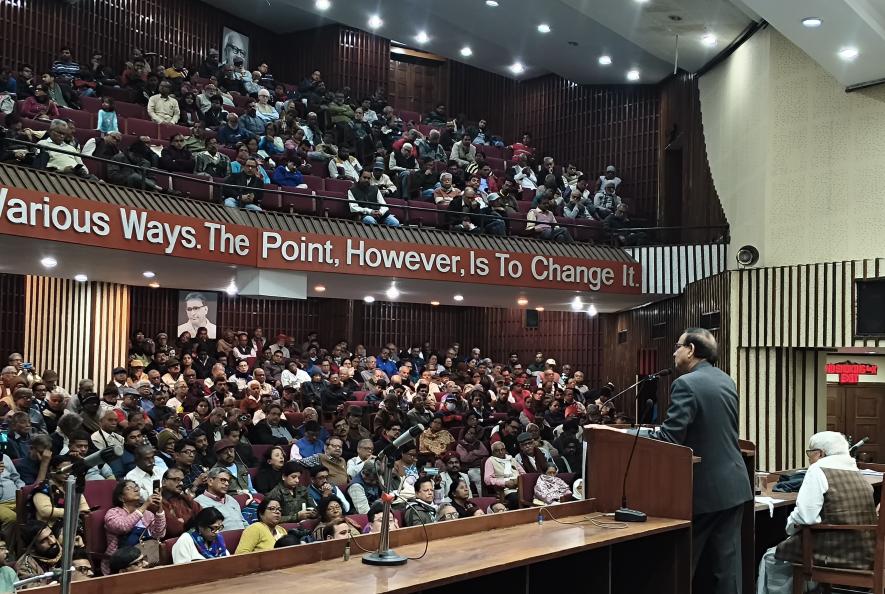
Mohd Salim: Resistance -- From Vietnam to Venezuela
CPI(M) state secretary Mohd Salim, in his speech, invoked historical and contemporary examples of US imperialism. He reminded the audience that nearly 58,000 US soldiers perished in the Vietnam War, many due to the devastating effects of Agent Orange.
Turning to the recent attack on Venezuela, he accused the US of launching a “hybrid war” against Caracas for over 25 years. He condemned attempts to topple elected president Nicolás Maduro, framing these as part of America’s quest to plunder Venezuela’s gold, oil, rare earth materials, and lithium. “So long as Maduro and (Hugo) Chavez were there, they will be unable to meet this target,” he said, drawing parallels with interventions in Palestine, Iraq, Libya, and Afghanistan where “democracy bombs” were dropped from F-16 jets.
Closer home, Salim warned of US interests in South Asia, citing the “Af-Pak vision” and alleged regime change operations in Bangladesh. He recalled Wikileaks revelations that the US Embassy had sought to “cultivate” Mamata Banerjee (now Wwest Bengal Chief Minister) when she was still a Congress leader, suggesting that rainbow forces of RSS, Naxalites, BJP, and Congress had converged to effect regime change in Bengal.
Ganashakti a ‘Diamond’ in its 60th Year
Salim’s speech also carried an organisational roadmap. He announced that 15,000 mohalla (neighbourhood) meetings would be held across West Bengal by the end of January to strengthen CPI(M) ahead of the Assembly elections next year.
Terming Ganashakti a “torchbearer of the masses,” he likened its 60th year to a “diamond” anniversary. “Diamonds are known for their shape and cuts. In its 60th year, Ganashakti must have cutting-edge technology so that it brightly outshines all others,” he said, urging modernisation without compromising ideological clarity.
The programme began with performances by 22 members of the children’s wing of Indian People’s Theatre Association, who rendered songs of maestro Salil Choudhury in his centenary year. The songs, carrying the legacy of people’s music, set the tone for the evening. Later, people’s artiste Arka Mukherjee and IPTA’s Kalakar Unit added to the cultural vibrancy, reminding the audience that political struggle and cultural expression remain intertwined in Left traditions.
Rallying Against Imperialism
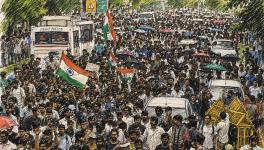
The celebrations culminated in a call to action. Salim, cheered by the crowd, declared that “this is not the time to lecture but for stringent protest coming to open roads.” He unveiled the route charter of an anti-imperialist rally that would march from PDG Auditorium to Sealdah railway station.
Overall, the 60th anniversary of Ganashakti was more than a celebration of the newspaper’s longevity. It was a reaffirmation of its role as a political instrument in Bengal’s contested terrain. At a time when mainstream media faces accusations of corporate capture and ideological dilution, Ganashakti has positioned itself as a counter-hegemonic force—one that insists on editorial independence from advertisers and fidelity to the struggles of workers, peasants, and marginalised communities.
As Ganashakti enters its seventh decade, it faces the dual challenge of financial sustainability and technological modernisation. In an era of shifting political currents and global contradictions, the newspaper’s vision of a people-centric future calls for further sharpening its edge in amplifying the struggles ahead for an equitable world.
Get the latest reports & analysis with people's perspective on Protests, movements & deep analytical videos, discussions of the current affairs in your Telegram app. Subscribe to NewsClick's Telegram channel & get Real-Time updates on stories, as they get published on our website.