





In Gaddar’s Name, But Not in His Spirit
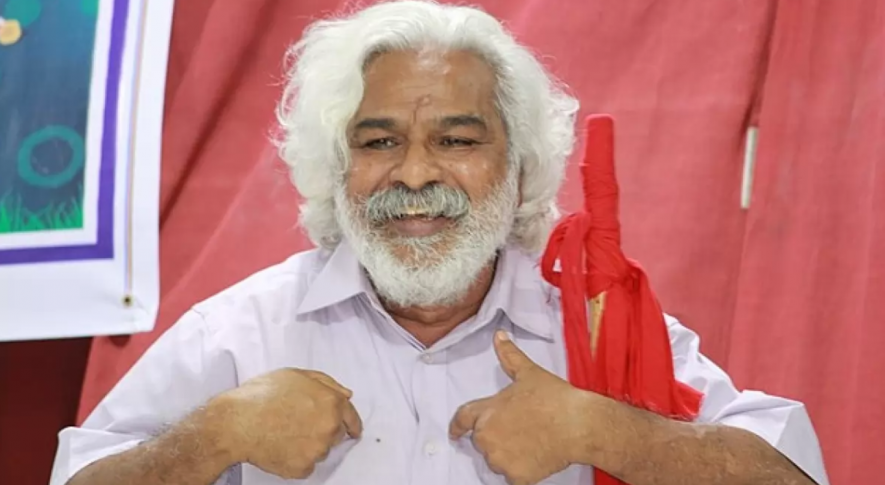
Image credit: Wikimedia Commons
Revolutionary folk singer Gaddar’s name continues to be used by a variety of political forces in Telangana and beyond. The issue is not that Gaddar (he passed away in 2023) is being forgotten, it is that his legacy is being used in multiple, competing ways. His name travels easily across political platforms, but the harder question is still often avoided: what does Gaddar actually mean to Telangana society? That question cannot be answered by ceremonial praise, symbolic recognition, or selective invocation. It requires a deeper engagement with the cultural and political world he came from and the role he came to play within it.
From Union Home Minister Amit Shah’s mentioning Rahul Gandhi's meeting with Gaddar to politically attack Congress while speaking in Parliament, to Prof. Kancha Ilaiah Shepherd’s suggestion that Gaddar, not KCR, be officially recognised as Telangana’s "Jatipita", to the Telangana government naming the state film awards "Gaddar Film Awards (TGFA)", the ambiguity persists. His name is being used in very different ways, for very different purposes. And yet the same question remains unsettled: what does it mean to invoke Gaddar in Telangana?
Read Also: Gaddar Film Awards: Symbolic Legacy or Commodification of Revolutionary Politics?
In Telangana, a song has rarely been just a song. It has long been a way of questioning power, sharing grief, understanding politics, and bringing people together, in unison. Across peasant rebellions, anti-caste movements, rights movements, and the movement for Telangana statehood, culture did not stand outside political life as decoration or entertainment. It worked from within it. Song and dance often functioned not as art in the detached aesthetic sense, but as a medium of consciousness formation — shaping memory, emotion, political understanding, and collective will in the service of mass mobilisation.
What gave these songs their strength was not individual authorship or exclusivity. Their power came from being shared. These were songs meant to be sung by many people, repeated in meetings and marches, carried from village to village, and passed down through memory. They did not belong to one singer alone. They belonged to the people and to the movements that kept them alive. That is why they were not simply performed for an audience. They were meant to be joined, repeated, and lived through together.
In this way, the cultural life of Telangana’s movements was never neutral. Song and dance educated people about exploitation, caste, labour, land, inequality, and betrayal. They persuaded, agitated, mourned, and mobilised. They could stir anger against domination, but they could also fill people with deep sorrow for those who had died in struggle. They turned scattered suffering into shared feeling, and shared feeling into public action. In most movements, they became strong instruments of ideological transmission. They shaped not only participation, but consciousness itself.
It is within this context that Gaddar needs to be understood. He did not simply sing inside movements. He wrote and sang about what moved him as he understood the world around him. He became one of the strongest modern expressions of this tradition. This expression, combined with anguish, could travel where theory could not. It could reach people who were outside elite spaces, outside formal education, and outside political institutions. It could carry memory, anger, sorrow, dignity, and resistance in a form ordinary people could immediately feel and remember.
He sang with a rare democratic attention. He sang about women, farmers, farm labourers, workers, police personnel, the poor, and the neglected. He could even sing about a dustbin. That was not novelty; it came from the belief that nothing in social life was beneath notice. The neglected, the ordinary, the cast aside — everything deserved attention. In his songs, the everyday world of common people did not sit outside history or politics. It was where both began.
Gaddar was important not only because of what he sang, but because of the place he came to occupy in public life. In many movements, the role of explaining politics to the poor has often been taken by upper-caste and upper-class leaders who speak on behalf of the oppressed. Gaddar changed that pattern. He took the place of a mass ideologue among the poor themselves. He did not stand above them and speak for them from a distance. He spoke in a language that was already close to their lives, emotions, and memories. That gave him a different kind of command. This is also why official honouring can become shallow so quickly.
The problem is not only that Gaddar may be reduced to a harmless icon, but that he can be made to serve very different narratives at once. What gets claimed is the figure; what gets bypassed is the difficult substance of what he disrupted - hierarchy, representation, caste power, state violence, and the question of who gets to speak for the people.
His greatness was not just in his radicalism. He also had a quality that many Telangana people immediately recognised and felt close to: a kind of innocence. Not innocence as ignorance, but innocence as openness. He had a simple and direct way of being. He had empathy. He had courage. He did not seem cynical or calculating. He seemed like a man who could feel deeply, think clearly, and still remain human. He was large enough to admit his faults, open-minded enough to study different ideas, and honest enough to change his stance when he felt it was necessary. That is what gives this innocence its real meaning. It was not a weakness. It was a moral strength.
Gaddar emerged from the People’s War tradition and the militant cultural world around it. Later, he moved toward the idea of the Constitution and increasingly drew from Ambedkarite thought. But he never gave up his power to question the establishment. He did not stop being critical just because his language changed. Until the end of his life, he kept challenging domination, injustice, and humiliation. He was not loyal to a rigid doctrine. He was loyal to the oppressed.
The attempt on his life made this even more powerful. He was shot, survived, and came back stronger. The violence against him was meant to silence him, but instead it made him an even bigger moral force in Telangana’s public imagination. His survival became part of his meaning. He was not just a singer of resistance; he became living proof of how much power feared such a voice. When he returned, he did so with even greater legitimacy, and during the Telangana movement that presence mattered deeply.
Any genuine attempt to invoke Gaddar or his legacy must go beyond symbolic usage. To speak his name honestly is to engage with what he represented in Telangana’s public life, and why that representation still carries force.
He stood at the focal points of culture and politics, sorrow and resistance, memory and mobilisation. He belonged to a tradition in which questioning power was not an abstract habit of debate, but a lived social instinct. Telangana’s history shows again and again that resistance here has often taken musical, performative, and collective form. To invoke Gaddar while emptying the essence is to reduce him to a symbol that can be used by anyone and answered to by no one.
The real question is not who claims Gaddar, but who is willing to take seriously what he stood for. That means looking into the worlds he sang about, the people he gave attention to, the dead he helped communities mourn, and the structures of power he never stopped questioning. Without that, the repeated use of his name becomes a way of containing him rather than understanding him.
Understanding Gaddar matters because his name is now everywhere, but his meaning is not. Many are willing to use him, very few are willing to sit with what he asked of Telangana society. The issue is not whether Gaddar is remembered, but how he is remembered, and what is being done in his name.
The writer is an AI-ML entrepreneur, researcher with TGSEEEPC (Telangana Caste Census), and social observer working at the intersection of technology, caste, and politics. The views are personal.
Get the latest reports & analysis with people's perspective on Protests, movements & deep analytical videos, discussions of the current affairs in your Telegram app. Subscribe to NewsClick's Telegram channel & get Real-Time updates on stories, as they get published on our website.