





Does English-Medium Education Hold Key to Power & Wealth?
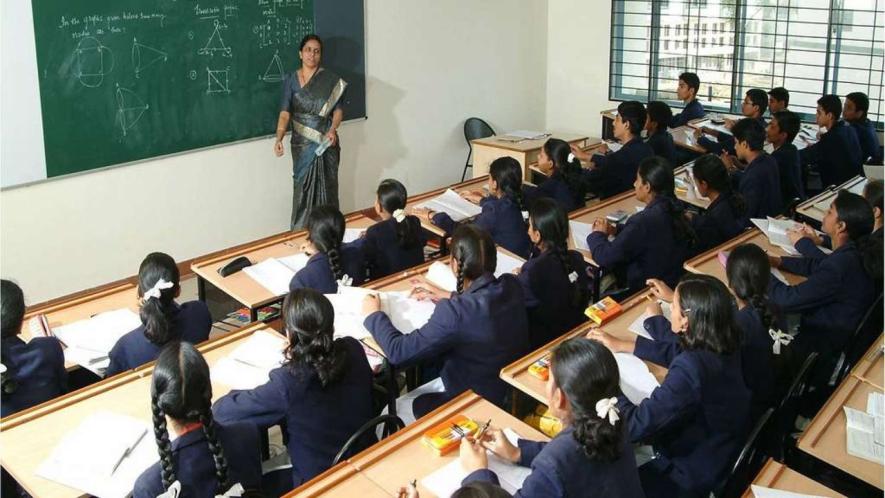
Representational image. Image Courtesy: PICRYL
The Telangana Socio, Economic Education, Employment, Political and Caste (SEEEPC) survey report has shown the real picture of the role of English-medium education and upper caste power and wealth control.
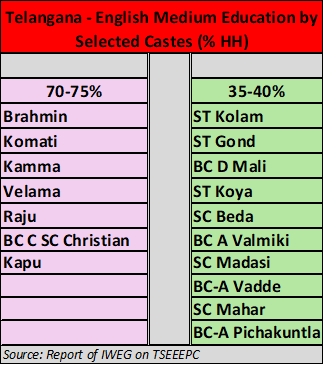
The Independent Working Expert Group studied the role of English medium across the spectrum of 56 castes. The left-hand column of the chart below shows that Brahmins, Komatis (Vysyas) Kammas, Velamas, Rajus, Reddys (all General Castes) are in the top layer of English-medium educated people of the state. The only BC community that ranked next to these six castes are BC-C, SC Christians. They all are above 75% English-medium educated and mostly in the private sector school education.
One common character of these seven highly English-medium educated caste groups is that they are small in number and highly urbanised.
LEAST ENGLISH EDUCATION
The least English-medium educated is shown on the right-hand column in the chart. The top 10 castes that never seem to have got into English-medium education are ST Kolam, ST Gond, BC-D Mali, ST Koya, SC Beda, BC-A Valmiki, SC Madasi, BC-A Vadde, SC Mahar, and BC-A Pichakuntla. All other castes have only marginal English-medium education. Their urban migration levels are very much linked to English-medium education of the youth from those castes.
In all other 42 parameters that the IWEG has computed to rank the Comprehensive Backwardness Index (CBI) of the six highly English educated social groups shows that they are in a very good socio-economic position in many other parameters. For example, 0.9% Brahmins of Telangana own 16.4% cars that run on the state roads. In owning three-bedroom houses, refrigerators, less loan from money lending market, employment in government and private sector, the data shows that they are on the top.
Of course, Dalit Christians do not match the Hindu top five upper castes in several other parameters. But they do well in overall living standards when compared to Hindu Dalits and also many other OBC (Other Backward Classes) castes that live in the agrarian economy.
One of the major differences between the Dalit Christians and Hindu English-educated upper castes is that the Hindu upper caste do not take up jobs like nursing, small paramedical operations, safai karamchari (sanitation) work and so on. But Dalit Christian women and men take up any work that pays without bothering about indignity and low social respect consideration. Because they are converts to Christianity from most labouring Dalit castes like Madiga, Mala, Relli, Dekkali and so on, they do not carry the cultural baggage of indignity of labour. Any wage-earning job for them is good enough. Perhaps the church also remains a constant educator to them about the value of work and dignified life.
Many OBC castes that suffer poverty and unemployment would not like to take up nursing jobs in government or private hospitals. We find the other five well-educated English castes prefer to be doctors, engineers, civil servants, teachers and politicians.
In the Hyderabad software and hardware industry, the five English educated castes work as CEOs, other high officials and, in fact, they own many industrial units. But at the same time, though they own a substantial amount of land as family units, their family members are not in the labouring tasks. For example, in MGNREGA (rural job guarantee scheme) work among these five castes is almost non-existent.
Most start-up companies are started by these sections, as they have bureaucratic connections in the government, both Central and state. They also manage bank loans very easily because of their caste and class connections with bank managers. In all these dealings, English language plays a key role. The overall CBI score of these five highly English educated upper castes is Brahmin (22), Velama (19), Komati (25), Kamma (19) Raju (17) Reddy (28) BC-C Christians (23). This CBI score must be seen alongside the last most backward caste CBI score of SC Dakkala at 116.
GOVERNMENT ENGLISH MEDIUM SCHOOLS
Even though the Telangana government has adopted English as a medium of teaching in government school education without undermining Telugu language teaching from class one, the private school system, mostly in the hands of the same highly English educated upper castes, is trying to pressure the state government to push for Telugu medium in government schools. If the Telangana government yields to their pressure, it will be a major setback. Private schools have seen a sharp drop in student intake, particularly in small towns, where they were drawing mostly middle farmer and artisan OBC caste English education aspirants from neighbouring villages.
There is also a concerted campaign by some intellectuals from the very same castes that English-medium education in government schools would not help in acquiring cognitive skills, as teaching in the mother tongue (Telugu in this caste) helps.
The same message comes from the Delhi rulers, such as Home Minister Amit Shah, packaged as nationalism. English-medium education is being projected as colonial but the upper castes get to retain their hegemony over the system through the same English medium education. They know that the SC/ST/OBCs living in rural areas cannot get it.
In the English-medium education chart, we can see just above these seven castes, the OC Kapus and Jains are more English educated. Jains run several English-medium schools. Most of the Jains live in Hyderabad and are very recent migrants.
What the Telangana SEEEPC survey lays bare is that English-medium education is the silk route to prosperity and human quality. The only way to provide every child in the country the opportunity to compete on an equal basis in life is to provide the same medium of education—English- in government schools.
The writer is a political theorist, social activist and author. His latest book is ‘The Shudra Rebellion’. The views are personal.
Get the latest reports & analysis with people's perspective on Protests, movements & deep analytical videos, discussions of the current affairs in your Telegram app. Subscribe to NewsClick's Telegram channel & get Real-Time updates on stories, as they get published on our website.