





Direct Talks With Israel Spark Outrage Across Lebanon
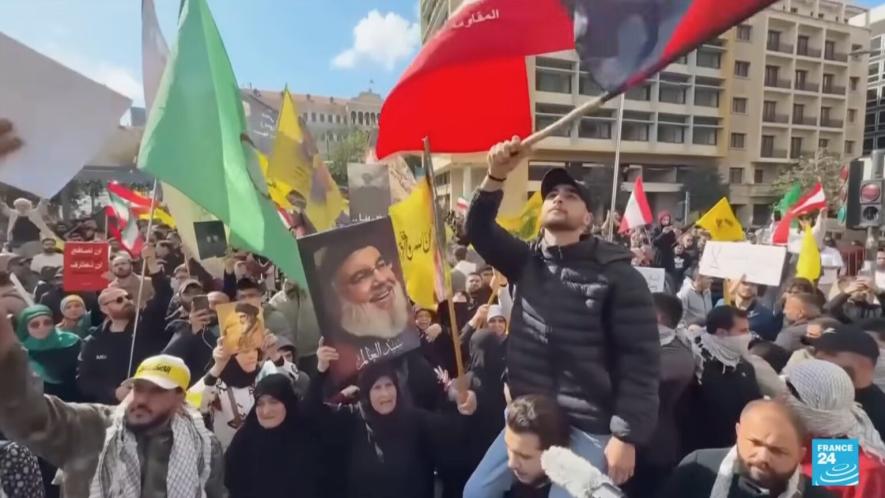
Lebanon protests talks with Israel. Photo: screenshot
Thousands of people took to the streets of Lebanon’s capital, Beirut, over the weekend to protest the Lebanese government’s decision to engage in direct talks with Israel.
The negotiations between Beirut and Tel Aviv will be mediated and sponsored by the United States and were scheduled to begin in Washington on Tuesday, April 14, according to the Media Office of the Lebanese Presidency.
The Lebanese grassroots have always opposed direct talks with Israel because they represent a form of normalization, which has for decades been popularly and officially rejected in the country.
The rejection of the talks has become firmer in the last two and a half years due to Israel’s non-stop aggression on the country, which has continued despite the US-mediated ceasefire deal with Hezbollah that was reached in November 2024.
Moreover, the announcement of the talks provoked the indignation of the Lebanese people as it came two days after Israel committed multiple massacres across Lebanon, leaving hundreds of people killed.
Lebanese people have also rejected their government’s decision to separate the ceasefire talks from the US-Iranian talks on the pretext of preserving Lebanon’s sovereignty. Iran has already set a ceasefire in Lebanon as a condition in its 10-point proposal to end the regional war with the US and Israel.
Separating Lebanon from Iran talks
Analysts argue that by insisting on separate talks, the Lebanese government puts the country in a weak position as it has no leverage against Israel.
Lebanese Foreign Minister, Youssef Raggie, wrote a statement about discussions he had with his German counterpart outlining the government’s approach to the matter.
“I received a phone call from the German Foreign Minister, Johann Wadephul, who expressed his country’s firm support for the efforts being made by the Lebanese government to extend its sovereignty and achieve stability, emphasizing that Germany is working to reach a ceasefire. He also informed me of the allocation of humanitarian aid to the Lebanese people worth 45 million euros.
On my part, I thanked him for his country’s humanitarian and political support, and I clarified to him that Lebanon is seeking, through direct negotiations with Israel, to reach a ceasefire, stressing that establishing this path has effectively enshrined the separation between the Lebanese file and the Iranian track. I also affirmed that the Lebanese state alone monopolizes the decision to negotiate on behalf of Lebanon, in a clear message that reestablishes the principle of national sovereignty at the heart of Lebanese diplomacy.”
Lebanese-American journalist, Rania Khalek, criticized Raggie’s argument about Lebanon’s sovereignty, saying:
“This is the Lebanese Foreign Minister telling the Germans that he rejects folding Lebanon into a broader US-Iran ceasefire, under the guise of Lebanese sovereignty and the desire to negotiate directly with Israel.
He has zero leverage with the Israelis. The behavior of Lebanese officials like him puts us all in greater danger by extending the war on Israel’s terms.”
“It is better to say nothing than to actively oppose Lebanon being part of a regional ceasefire.” She added.
Khalek also pointed out that Raggie is a member of the Lebanese Forces party, which she said “has historically collaborated with the Israelis.”
Although the Lebanese government is rushing to hold direct talks with Israel, the latter has not stopped its airstrikes on Lebanon till the moment of writing this article, which means that Netanyahu’s government is applying the strategy of “negotiations under fire”.
A genocide supporter is leading the negotiations from Israel’s side
It seems that the negotiations were already initiated with a phone call between Israel’s ambassador to the United States, Yechiel Leiter, and his Lebanese counterpart, Nada Hamadeh Moawad, on Friday, April 10.
Both Leiter and Moawad are expected to lead the next stage of the talks. While there is scant information about Moawad’s background, the available information on Leiter’s history has raised controversy.
Leiter is a far-right ultra-nationalist Israeli politician, who has been affiliated to parties and movements complicit in massacres, illegal settlement and annexation of Palestinian lands in the occupied West Bank, including the Likud Party and Kach Party.
As a youth, he was involved in the Jewish Defense League (JDL), which was classified by the United States as a “terrorist organization” for being linked to several violent attacks carried out in the US, including the assassination of Palestinian-American activist Alex Odeh in California in 1982.
The Israeli diplomat has also been known for his support for Israel’s genocide in Gaza, and for hailing the Israeli aggression on the Qatari capital, Doha, which was launched against the Arab country last September to assassinate Hamas negotiating team.
Furthermore, he served in the Israeli Occupation Forces (IOF) during Israel’s invasion of Lebanon in 1982, which left thousands of people killed.
Leiter is also a proponent of normalization between Israel and Arab countries under the Abraham accords, and he believes that the ongoing conflict will enhance the opportunities for more Arab states to join the process.
Hezbollah urges the Lebanese State to cancel direct talks with Israel, threatens to capture IOF soldiers
Hezbollah Secretary General, Sheikh Naim Qassem, called on the Lebanese state to adopt a “heroic stance” and cancel the direct negotiations with Israel, in a televised speech on Monday, April 13.
Qassem described the decision as “part of a series of free concessions” made by the Lebanese government to Israel, warning it to stop “disavowing and antagonizing the resistance, at a time when it should be supporting it and benefiting from its capabilities.”
He also threatened that Hezbollah fighters will capture IOF soldiers “whenever the opportunity arises”, affirming that they “engage in hit-and-run tactics, using various means of resistance.”
Courtesy: Peoples Dispatch
Get the latest reports & analysis with people's perspective on Protests, movements & deep analytical videos, discussions of the current affairs in your Telegram app. Subscribe to NewsClick's Telegram channel & get Real-Time updates on stories, as they get published on our website.