





Development Vs. Disaster Risk: Jammu's Tawi Riverfront Sparks Debate
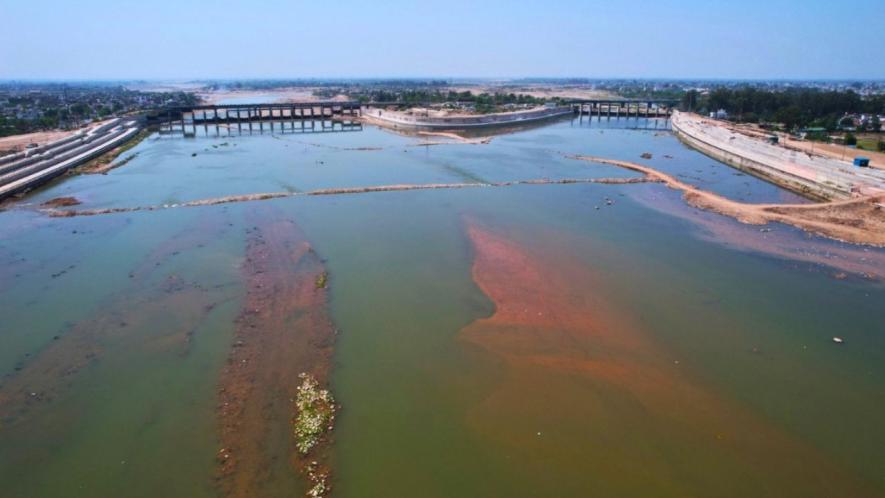
Tawi river project ( Photo - Khushi Jaiswal, 101Reporters )
Jammu Tawi, Jammu and Kashmir: On the evening of January 28, 2026, crowds gathered along the banks of the Tawi river as Jammu Smart City Limited (JSCL) inaugurated Phase 1 of an artificial lake, a key component of the long-delayed Tawi Riverfront Development Project. Visitors queued for boat rides, families walked along the newly developed stretch, and officials hailed the project as a milestone in Jammu's urban transformation.
From the festival stage came repeated calls to "Save Tawi", part of an awareness campaign organised around the inauguration. A short distance away, a group of five or six people echoed the same slogan, but with a very different message.
For the administration, the riverfront project represents development, tourism and urban renewal. For many environmental activists and residents living along the riverbanks, however, it represents a project they fear could alter the river's natural character and increase vulnerability during floods.
The 2025 floods
Concerns about the project intensified after the severe floods that affected Jammu in August 2025. Historical records show the Tawi reached a water level of 31 feet during floods on September 29, 1998. During the floods of September 6, 2014, the water level rose to 33 feet. On August 26, 2025, the river reached 34 feet, exceeding previous recorded levels and causing significant damage in riverside settlements.
For residents who experienced the floods, the riverfront project has become closely linked to questions about safety. Bharat Das Man, a priest at the Mahakal Shakti Peeth temple, said part of the temple was washed away during the floods.
"When the flood came, the Smart City structures made of RCC had already been built," he said. "Earlier, the area was open, but now it has become more closed. As the river was narrowed, the water flow intensified, causing damage here."
Ruksana Begum, 38, who lives along the riverbank, said floodwaters entered her home and the effects continue to be felt months later. She said access to clean drinking water remains a challenge and expressed concern about future floods.
"Because of the lake, the water didn't get a proper outlet and caused more damage behind," she said. "If the flood had come at night, it would have been worse."
Begum said she wants the project stopped as she fears another flood would wreck havoc in the area. Mumtaz Khan, 35, another long-time resident of the riverbank, also suffered losses during the floods."This is the first time after the project that such flooding has happened," he said. "The water flow increased on this side and caused damage to our homes."
For many residents, the floods transformed what had been presented as a development project into a source of anxiety.
A river transformed?
While the administration described the project as an effort to improve and beautify the Tawi, environmental activists argue that it is fundamentally changing the river.
Among them is Anmol Ohri of the Climate Front Foundation, who says the project's original objectives were substantially different from what is being executed today.
"Initially, the project focused only on building a green pathway and placing boulders for flood control. But in its current phase, it has completely changed," he said. "The introduction of an artificial lake and barrages has obstructed the river's flow. This is harming the ecology and creating obstructions during floods, altering the river's hydrology and increasing its intensity."
Ohri said the project was significantly redesigned after it came under the Smart City framework.
"When the Smart City plan came in, the project was redesigned on the lines of Sabarmati, with the river being narrowed by about 50 metres on both sides. That was not part of the original plan. This cannot be justified as flood protection," he said.
Environmental activist Bhushan Parimoo questioned the broader purpose of the project and whether it serves public needs beyond tourism. "Is this environmentally sustainable?" he asked. "Apart from tourism, what benefit does it offer people? We do not want this 'unsmart' project." He also questioned the purpose of the artificial lake. "What is the benefit of the artificial lake? Will it help irrigation? Will it benefit people, or is it only for tourism? Even Sabarmati has its drawbacks—it involves diversion, whereas Tawi has not been diverted."
Environmentalists argued that narrowing rivers and constructing permanent structures along floodplains can interfere with the way rivers behave during heavy rainfall by restricting the natural movement of water, potentially increasing flood risk in surrounding areas.
However, Dr Ravindra Vitthal Kale, a scientist at the National Institute of Hydrology (NIH) who was involved in the project's hydrological studies, disagreed.
According to him, the Tawi is a highly sensitive Himalayan river basin where extreme rainfall events have become more frequent due to climate change. Given these conditions, he said, scientifically designed flood protection measures are essential for a city like Jammu.
He noted that during the 2014 floods, the Tawi recorded a discharge of approximately 13,365 cumecs. On August 26, 2025, the river witnessed a discharge of 14,458 cumecs, around 6.5% higher than in 2014. The riverfront project, he said, was designed for a flood discharge of 15,047 cumecs, while the check flood considered in the design was 16,278 cumecs.
Dr Kale described the 2025 floods as the project's "real test".
"The flood that occurred was very close to the design flood considered during planning, and the structure remained intact. From an engineering perspective, the project has successfully passed its test," he said.
Responding to allegations that the project has increased flood risk by reducing the river's width, Dr Kale said the river had not been narrowed but channelised. According to him, channelisation increases the river's carrying capacity by improving flow velocity.
"When a river is scientifically channelised, water flows faster, allowing the same volume of water to pass at a lower water level. Therefore, the river appearing narrower does not necessarily mean that flood risk has increased," he said.
He added that the project underwent not only hydrological studies but also geomorphological assessments before construction began. Historical studies, he said, showed that the river's main channel had remained stable at the project site and that the location was selected based on scientific investigations.
Addressing concerns over the 2025 floods, Dr Kale said flooding in some areas could not be attributed solely to the riverfront project. Factors such as the low gradient in downstream stretches, sedimentation and encroachments also contributed to flood spread and required separate flood management measures.
He also highlighted the project's economic potential, saying nearly 55 acres of land had been reclaimed through the development, creating opportunities for tourism and other economic activity. However, he maintained that flood protection remained the project's primary objective, while beautification and tourism were additional benefits.
Jammu Smart City officials also reject allegations that the project has harmed the river or increased flood risks.
Dr Devansh Yadav, chief executive officer of Jammu Smart City Limited and commissioner of the Jammu Municipal Corporation, described the riverfront as one of the city's most significant development initiatives.
"Jammu needs more opportunities. Youth need new avenues for employment," he said. "The riverfront project is not just about cement and concrete. It includes green spaces and public areas where families can spend time."
According to Yadav, several drains that previously discharged directly into the Tawi have been diverted to sewage treatment plants as part of the project.
Responding to concerns over flooding, he said the riverfront walls function as protective barriers.
"In August 2025, we saw how these structures acted as shields during floods," he said.
Rejecting claims that the project had increased flood risk by altering the river, Yadav said hydrological mapping conducted by the National Institute of Hydrology showed that the surrounding areas had become safer.
"Warehouses, Gandhi Nagar area, the stadium on the right bank… these areas have been protected because of the project," he said. "We have not reduced the river's area; we have made the surrounding regions safer."
Four decades in the making
The Tawi Riverfront Development Project was first approved in 1986 during the tenure of Governor Jagmohan at an estimated cost of Rs 23 crore. However, it remained largely confined to official files for nearly two decades.
The project was revived during the tenure of former Chief Minister Ghulam Nabi Azad between 2006 and 2008, when it underwent significant revisions. The foundation stone was laid in December 2009 by then Chief Minister Omar Abdullah. By then, the estimated cost had risen to ₹69.70 crore under a 90:10 Centre-State funding model.
The project site also changed over time, from the original Nagrota-Nikki Tawi stretch to the Bahu Fort-Sidhra Bridge stretch in 2008, and finally to the Bhagwati Nagar-Gujjar Nagar Bridge stretch, where construction formally began in July 2010.
Initially expected to be completed within two years, the project repeatedly missed deadlines announced between 2012 and 2024. More than ₹58.19 crore was spent while large portions remained incomplete, and the estimated cost eventually rose to around ₹130 crore.
After multiple review meetings and deadline extensions, the project was brought under Jammu Smart City Limited and relaunched in January 2022, with construction under the Smart City initiative beginning the following month. Inspired by the Sabarmati Riverfront model in Ahmedabad, the project aims to develop about 3.5 kilometres of the Tawi riverbank with promenades, public spaces, recreational facilities and tourism infrastructure.
Despite decades of planning, the project only began taking visible shape this year, when its first phase was opened to the public.
The other Jammu
Not everyone shares the concerns raised by environmentalists and riverside residents. The administration has projected the riverfront as a public space that can improve the city's image, attract visitors and provide new recreational opportunities. At the inauguration and festival, many visitors welcomed the project.
Suhana Jamwal said the artificial lake offered residents and visitors something new, describing the initiative as innovative and capable of attracting more tourists.
Usha, another visitor, said people previously had to travel to Mansar to enjoy boating. Having a similar attraction within the city, she said, was convenient and likely to encourage tourism. Simran Baloch, who took a boat ride on the lake, said tourism-oriented projects help showcase local culture, encourage public participation and contribute to the city's development. She also said the project had drawn positive media attention.
Khushi Jaiswal is a freelance journalist and a member of 101Reporters, a pan-India network of grassroots reporters.
Get the latest reports & analysis with people's perspective on Protests, movements & deep analytical videos, discussions of the current affairs in your Telegram app. Subscribe to NewsClick's Telegram channel & get Real-Time updates on stories, as they get published on our website.