





Demolitions Undermine the Nation
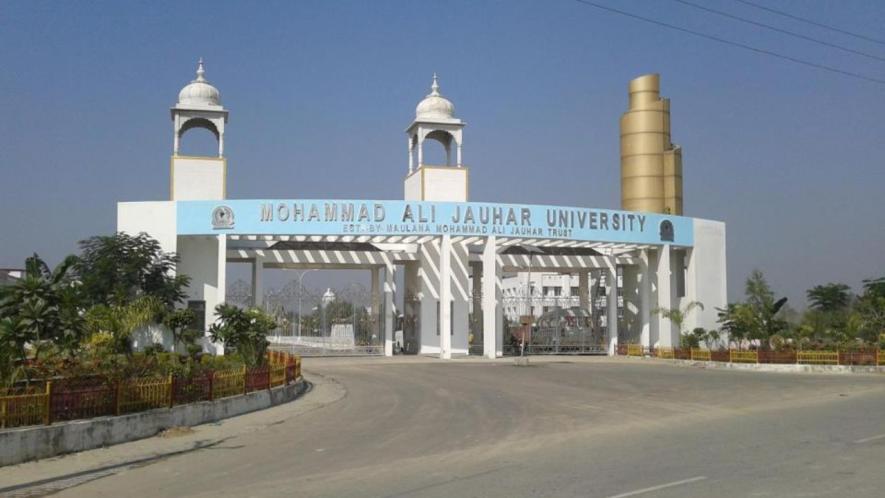
Jauhar gate. Image Courtesy: Wikimedia Commons
Currently, a sit-in is going on in front of Mohammed Ali Jauhar University in Rampur, Uttar Pradesh. Azam Khan, a leader of Samajwadi Party, who is in jail at present, is the chairman of the trust running the university. The students are staging a sit-in to oppose a notice by the Rampur Development Authority (RDA) that has asked for 38 of the 40 buildings of the university to be demolished. This will tantamount to the closure of the university.
As per Indian Express (July 20, 2026), Mehroza Khan, a law student at the university, said: “Our career and future are at stake. We have decided to stage this sit-in because we want the government to reconsider its decision to demolish the university. We would not be able to continue our studies elsewhere, especially at colleges located far away.”
“The biggest thing that we get here is the fee concession. Students from SC/ST backgrounds receive a 50% concession. Students who have lost their parents also get concessions. There are professional courses like B.Pharma and D.Pharma, which many of us would not be able to pursue elsewhere,” the student added.
The foundation stone of Mohammad Ali Jauhar University in Rampur was laid on September 18, 2006. The campus was developed over several years by the Mohammad Ali Jauhar Trust. However, the exact construction timeline for various structures has become a subject of intense legal and administrative dispute.
According to RDA, while the university's Medical College and one academic block had valid approved plans, 38 other buildings across the campus were constructed without obtaining mandatory permissions from the competent civic authority. The university administration has maintained that these buildings were constructed years earlier—at a time when their location (Singankhera village) did not fall under the RDA's jurisdiction—and were previously approved by the local zila panchayat.
Because of these unapproved constructions and alleged land-use violations, according to RDA, it ordered the removal or demolition of these 38 buildings. The students and many social activists and politicians are pleading that this demolition is unwarranted, as the university is rendering a valuable service for students of various marginalised categories, and more so Muslims and Scheduled Castes and Tribes. They claim that the primary aim of the state government is to undermine education for Muslims in particular. As such, education is one of the major areas neglected by the present regime, as the current upsurge of students and youth across the country shows. As for minority educational institutions, more obstacles are being created.
The other aspect is the demolition of structures identified with Muslim identity. The Jauhar University is the latest in the line of demolitions, mosques in Kashi, Mathura, Sambhal, Ajmer Dargah and Saharanpur are already in the queue. Recently, we saw the Kamaal Maula Masjid being handed over to Hindu side on the grounds that it was a temple of Vagdevi. Other mosques face the axe on the lines of the Babri Mosque.
These claims resemble the tactics used during the Ram Janmabhoomi movement to weaponise medieval history for political and communal objectives. These mosques and similar disputes are based on the wrong premise that temples were destroyed to build mosques. These claims often rely on exaggerated or distorted interpretations of history, frequently citing questionable colonial-era footnotes. Permitting these claims to be entertained directly challenged the ‘Places of Worship (Special Provisions) Act, 1991’, which was designed to maintain the religious status quo as it existed on August 15, 1947, except in the case of the Babri Mosque.
The pattern began with the Hindu Right wing’s success in demolishing the Babri Mosque, where the claim was that Babar had destroyed the Ram Temple to build the mosque. Despite court judgements being based on ‘people’s sentiments’ and ‘God coming in dreams’ of an Honourable Judge, the judgement did regard installation of Ram Lalla idols in 1949 as a crime.
The demolition of the Mosque on December 6, 1992, by Hindutva forces, was also regarded as a crime. This demolition paved the way for the exponential rise of the electoral strength of the Bharatiya Janata Party (BJP), which in due course came to power in the Centre, first in 1996 and then in 1999 and then, of course, in 2014.
But the rewards of the Babri Mosque demolition were very mouth-watering for Rashtriya Swayamsevak Sangh aka RSS-BJP and the series continues with a claim being made here and there which the legal system ignores. The 1991 Act permits it to be investigated etc. but religious polarisation is being intensified, benefitting Hindu Nationalism.
The creative mind of thinkers of the Hindu Right is now aiming at a university. This proposed demolition will serve an additional purpose; that of defaming the Muslim community and pushing it in a corner by depriving education for the minority community, which is a dire necessity.
On similar lines, an old mosque in a small area in Saharanpur, Uttar Pradesh, has also been served notice to vacate on the grounds of not having adequate permissions. The law of adverse possession does not exist for the Hindu Right as regards Muslims. So, to somehow prove the illegality of the Muslim structures, and try to get them demolished is their continuous effort.
The reckless use of bulldozers is yet another way of pushing the Muslim community into a corner. Demolition seems to be their way of ‘Building the Nation’. The huge loss of social wealth through demolitions on one or the other ground is immaterial to RSS-BJP.
Building the nation had an entirely different meaning in the aftermath of Independence. The first Prime Minister of India had the idea that building IITs, AIIMS, the public sector and facilities for irrigation were the infrastructure on which we could overcome our deprivations to some extent. With the rise of the Hindu Right, this direction seems to have been reversed and we are now searching for temples underneath mosques, looking for illegality of Muslim structure, all of which serves as fodder to their politics of promoting hate and polarisation of the society.
Can good sense prevail, and can we come back to the path of ‘nation building’ through following values of the Indian Constitution, shun bulldozers and keep claiming the illegality of Muslim structures by stretching some little point here or there?
The writer is a human rights activist, who taught at IIT Bombay. The views are personal.
Get the latest reports & analysis with people's perspective on Protests, movements & deep analytical videos, discussions of the current affairs in your Telegram app. Subscribe to NewsClick's Telegram channel & get Real-Time updates on stories, as they get published on our website.