





Democracy vs. Intervention: Honduras Votes Amid US Pressure Campaign
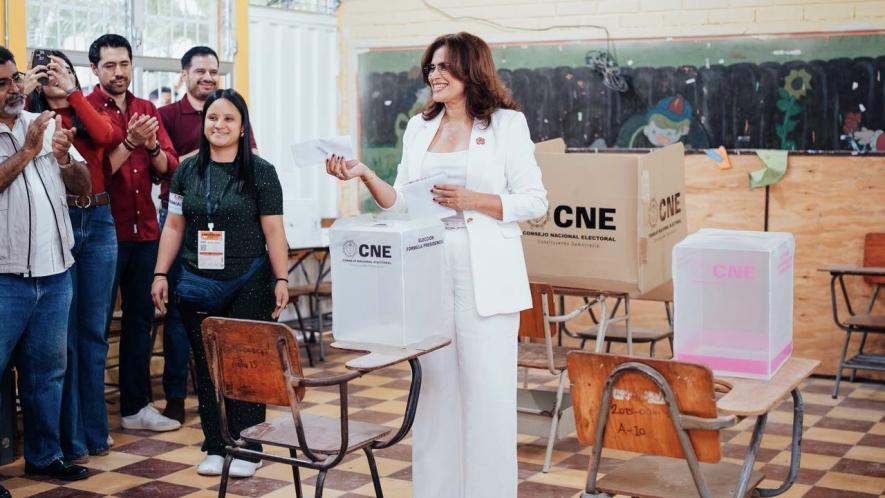
Progressive candidate Rixi Moncada voting on Sunday, November 30, 2025. Photo: LIBRE Party / X
The people of Honduras are voting in general elections to decide their next president, 128 deputies to the Honduran Congress, 20 deputies to the Central American Parliament, 298 mayors, and more than 2,000 councilors. Most of the attention has been focused on the presidential election, which will be decided in a single round. The three frontrunners for the presidency are progressive candidate for the LIBRE Party Rixi Moncada; right-wing Liberal Party candidate Salvador Nasralla; and far-right National Party candidate Nasry Asfura.
Six million Hondurans are eligible to vote in these general elections which have become the subject of debate of far-right figures from across the world, who are all warning about the possible “triumph of communism” in the Central American country. However, the external intervention in the elections has gone beyond comments on social media about the “danger” represented by progressive candidate from the LIBRE Party Rixi Moncada.
In a move shocking many, on Friday, November 28, US President Donald Trump announced that he would pardon former Honduran president Juan Orlando Hernández (JOH), adding, “according to many people that I greatly respect, [he has been] treated very harshly and unfairly. This cannot be allowed to happen, especially now, after Tito Asfura wins the Election, when Honduras will be on its way to Great Political and Financial Success.” In the message, Trump reiterated his support to National Party candidate Tito Asfura and declared that if he doesn’t win the US will “not be throwing good money after bad, because a wrong Leader can only bring catastrophic results to a country.”
Is communism really on the ballot? Why has the electoral process in the Central American country become a focus of the right wing internationally? Peoples Dispatch spoke to Camilo Bermúdez, the Director of Strategic Litigation and Management of the Civic Council of Popular and Indigenous Organizations of Honduras (COPINH) about what is at stake in this political moment in the country.
Beyond who, what is on the ballot?
As previously mentioned, the candidates polling the highest ahead of the elections are Rixi Moncada, Salvador Nasralla, and Tito Asfura. For Bermúdez, while there are three candidates, there are “clearly two political models in confrontation”.
He explains that at the base of the political project represented by LIBRE veteran Moncada is “a strong criticism of the economic system and the economic elites in Honduras”. Moncada, he emphasizes, “has been very open in criticizing, from her positions as Finance Minister and other roles she has held, the control of the country’s economy by ten families and about 26 economic groups that have [historically] controlled the main sectors of the country’s economy. She has criticized this control, the lack of tax justice, and the lack of economic democratization.” In addition to her critiques of the neoliberal economic model dominant in the country, Rixi represents “a project of continuity with President Xiomara Castro’s social program and LIBRE Party, who are heirs to the resistance and opposition to the 2009 coup d’état that overthrew Manuel Zelaya Rosales.” It is a progressive project which calls itself socialist, but mired with “many internal contradictions due to the same contradictions in LIBRE Party’s composition,” Bermúdez adds.
The other model is represented by Asfura and Nasralla, who, despite running with the country’s historically opposed parties, represent a very similar political project. This is “a traditional project of the Honduran right” which is one aligned with “private enterprise, aligned with the interests of large landowners, of large national and international corporations, and that seeks the approval of the United States Embassy in order to govern.”
The difference, Bermúdez underscores, is that Asfura is “more related to the post-coup regime, an authoritarian regime very linked to organized crime and drug trafficking. He’s from the party of President Juan Orlando, who was extradited and sentenced to 45 years in prison in the United States for drug trafficking.”
Meanwhile, Nasralla, while maintaining similar political and economic proposals to the National Party, has attempted to distance himself from organized crime, declaring himself “clean” and corruption free. Nevertheless, the COPINH organizer warns, “the political support and backing for candidate Nasralla clearly also comes from that background – for example, from business groups, corporate media groups, and also financial companies like Banco FICOHSA, which is linked to the assassination of Berta Cáceres and also to money laundering from drug trafficking.”
Under the National Party rule following the coup d’état in 2009, an all out neoliberal offensive was unleashed in the country to accelerate natural resource plundering in Indigenous and Garifuna territories, establish Special Economic Development Zones ( ZEDES) to favor international investment with the suspension of labor laws, and the privatization of state companies. Rolling back this model, which caused environmental devastation, social conflict, territorial breakdown, deep inequality and poverty, and the extraction of the country’s wealth by national and international private companies, was a cornerstone of Xiomara Castro’s 2021 campaign.
This effort has been the basis of much of the opposition she faces both by Honduran elites and international capital that, for years, had heeded the call of “Honduras is open for business” and profited immensely from the country’s cheap labor, natural resources, and relaxed labor and environmental laws. In 2017, the National Party committed outright electoral fraud, recognized even by the Organization of American States (OAS) in order to maintain their grasp on power.
Is fraud or non-recognition on the table?
The 2017 fraud is fresh in people’s minds, not only for how US President Donald Trump provided the necessary stamp of approval to his ally Juan Orlando Hernández to consolidate the fraud, but also how the event provoked mass protests and unrest across the country and the death of at least 35 protesters, with dozens imprisoned.
This time around, the possibilities for the right wing to influence the outcome of the polls are different. The leading scenario that analysts predict is an attempt by the right wing to orchestrate a non-recognition in the case of Moncada’s victory, which for Bermúdez has the sole purpose of “triggering a process of instability”. Suspicion has already been raised both within Honduras and outside the country by right-wing actors questioning the effectiveness of the electoral system for the mere reason that there is a progressive government in office. Some analysts warn that right-wing media and figures may seek to heavily promote exit polls and any results from the rapid count that would contradict the official results that will take some time to be released. Some may remember this formula from the 2019 Bolivian elections which were followed by a month of right-wing street protest against “fraud”, and ended with the overthrow of Evo Morales. Last year’s elections in Venezuela, saw a similar formula implemented: right-wing fraud allegations, echoed by the United States, which fed and fomented violent street protests a day after the elections, yet popular mobilization by Chavismo was successful in defeating this coup attempt.
Bermúdez explains, “We believe this could be what the opposition wants, with the backing of the United States government: a process of instability in which they seek to delegitimize Rixi Moncada’s victory and try to apply pressures similar to what has happened in Venezuela, trying to destabilize a progressive project, a possible progressive government project like Rixi Moncada’s.”
In this scenario, the COPINH organizer underlines, “The position taken by the Honduran Armed Forces will be very important, since they are supposedly called upon to defend the electoral process – but in 2009 they carried out the coup.” Notably though, “the current Xiomara Castro government has had a very close relationship with this Armed Forces sector.”
Bermúdez highlights that the streets will become the most important scenario in coming days if actions of non-recognition and attempts to destabilize the country after a Rixi Moncada victory go forward. In this case, “the Libre Party militants will take to the streets, because this is a militancy that emerged in the streets, from the post-coup resistance movement, and it’s a party and militancy accustomed to social protest. So we foresee that faced with any such action, there will also be a response of popular mobilization.”
“What will be very important won’t really be election day itself, because there isn’t an immediate vote counting system – moreover, it has been denounced as a system that could have been hacked or is unreliable. So the results won’t come on the same day; results will possibly come the following day, a couple of days later, after all the tally sheets from the polling stations have arrived at a location for manual counting of each sheet, and then that becomes the official result,” Bermúdez emphasizes.
US interference
A constant in Honduran politics, has been the outsized role of the United States leaders, in shaping the country’s present and future. Yet, Trump’s recent statements and actions have gone a step further.
“There is great concern in the country about that statement from the United States government…Obviously the US Embassy and State Department have great influence in Central American countries and great influence in Honduras, but we’ve never seen such blatant and interventionist pronouncements, which demonstrate the nature of US government policy,” Bermúdez remarks.
This in reference to the pardon of JOH couched in the endorsement of National Party candidate Asfura.
JOH was arrested on February 16, 2022, by Honduran police following an extradition request from the United States for conspiring to traffic drugs in the US. Two months later, on April 21, 2022, Hernández was extradited to the United States. In June 2024, JOH was sentenced by a US judge to 45 years in prison for the crime of exporting more than 400 tons of cocaine to the United States and for the possession of “destructive devices”. At the time, the judge, Kevin Castel, called Hernández “a two-faced politician” because, on the one hand, he claimed to fight drug trafficking in his country, while, on the other hand, he supported the drug cartels. Prosecutors alleged that the former president built a “Narco-State” in which he personally received millions of dollars in bribes from drug traffickers.
Bermúdez believes that the explicit support from Trump and other US officials for Asfura, and the explicit rejection of Moncada and LIBRE, “has to do with an international campaign to fight against any kind of progressive perspective in Latin America, under the outdated discourse of communism linked to a supposed fight against drug trafficking and what they call ‘narcoterrorism.’” “Narcoterrorism”, he explains, “is the policy the United States government develops to attack Venezuela, to enter into deep contradiction with the governments of Colombia, Mexico, and Brazil. So we believe this fits within this dynamic of the growth of the right-wing that we are seeing internationally, of these authoritarian and extreme-right discourses that seek shelter in this narcoterrorism discourse, attempting to link it to the revolutionary processes in Venezuela and Cuba.”
Yet, the outright violations of Honduran sovereignty and rule of law by the US president and their potential to sow chaos, are also telling. Bermúdez said, such actions show “the fear they have of a progressive project that could be executed by candidate Rixi Moncada, and also the expectation and perspective they have that she could be the candidate favored by the popular vote – because if that weren’t the case, we believe they wouldn’t take such a decisive, forceful, and strong position like that of the US president, who, it goes without saying, very possibly doesn’t even know where Honduras is, yet is speaking in favor of one of the candidates.”
Bermúdez states that at the end of the day, “no matter how blatant this interference is and no matter how powerful Donald Trump’s government is, the decision lies with the people. And I think it’s also a call to awareness for the people to take the reins and make decisions about their future.”
Courtesy: Peoples Dispatch
Get the latest reports & analysis with people's perspective on Protests, movements & deep analytical videos, discussions of the current affairs in your Telegram app. Subscribe to NewsClick's Telegram channel & get Real-Time updates on stories, as they get published on our website.