





Delhi: Seminar Voices Need for Organised Resistance Against Imperialist Aggression
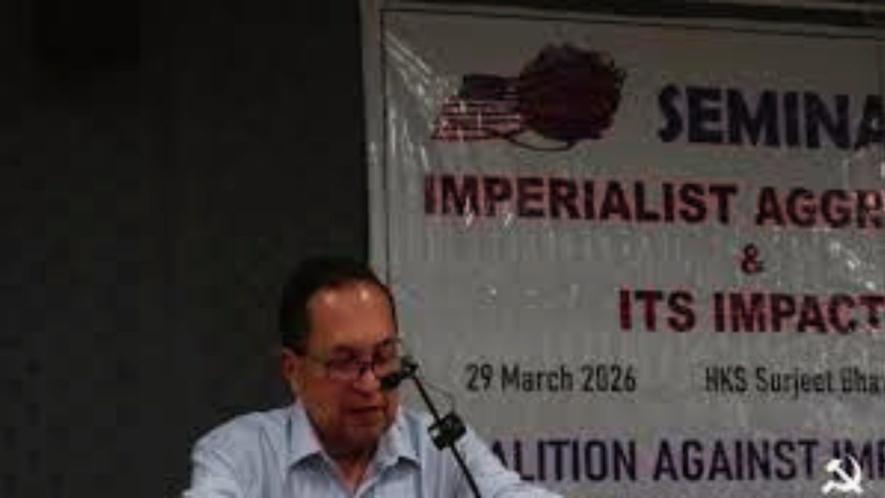
Image Courtesy: CPIM Facebook
New Delhi: As tensions continue to escalate in West Asia after US-Israel attacked Iran, a seminar held in New Delhi expressed deep concern over the rapidly evolving global situation, the expanding role of imperialist powers, and the deepening humanitarian and economic crises that accompany such interventions. Speakers at the seminar voiced their shared concern about intensifying militarisation, the erosion of international norms, and the cascading impact of wars on everyday life.
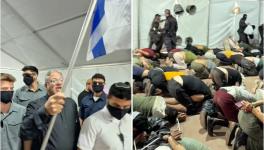
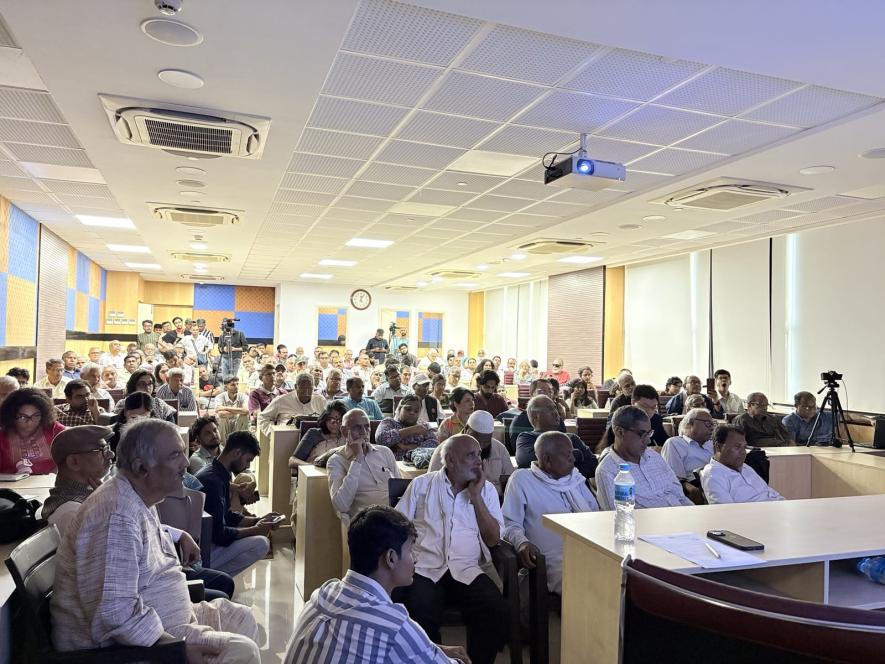
Titled “Imperialist Aggression & Its Impact”, the seminar, organised under the banner of the Coalition Against Imperialism, was held at Harkishan Singh Surjeet Bhawan on Sunday, drawing a packed audience. The event brought together a wide spectrum of participants — activists from Left mass organisations, academics, journalists, diplomats, and notably, a large number of youths.
The presence of a substantial youth audience stood out. Their engagement, attentiveness, and participation reflected the growing concern among India’s young generation about global conflicts, imperialist interventions, and their consequences. If anything, the composition of the gathering underscored a broader political message: that opposition to imperialism is not confined to older ideological traditions but is finding resonance among contemporary youth.
A World in Turmoil
Opening the discussion, Communist Party of India (Marxist) politburo member R. Arun Kumar set a sombre tone, placing the seminar within what he described as a “deeply unstable global moment.”
“The genocidal attack on Palestine carried out by Israel with the active support of the US… though there is only a namesake ceasefire, attacks are still continuing in Gaza and the occupation in the West Bank has increased,” he said.
Reflecting on the broader international climate, Kumar added: “We are living in what is called ‘interesting times’, but these are not hopeful times—these are very difficult times marked by wars, aggression and instability across regions.”
He pointed to the continuity in US foreign policy, arguing that interventions in countries such as Iraq, Iran, and Venezuela reveal a pattern rather than isolated events. Recalling the 2003 invasion of Iraq, he noted that wars justified on dubious grounds have had long-lasting consequences, destabilising entire regions.
Media, War and Public Opinion
Among the prominent speakers was N. Ram, senior journalist and former Editor-in-Chief of The Hindu, who placed a sharp critique of US foreign policy and the narratives that accompany it.
“This seminar is designed to focus on the current military attacks violating the sovereignty of numerous countries. As far as we know, President Trump has bombed at least seven countries during his time in office. He came to the White House promising to end endless wars, but we know what actually happened.”
Highlighting contradictions within dominant global narratives, Ram observed: “Today, even conservative publications like The Economist are pointing out the contradictions—claims of destroying 100% of Iran’s capabilities, while the remaining 0% is enough to disrupt the global economy by choking oil supply.”
He characterised the ongoing escalation as a “war of choice” and drew attention to dissent within the US itself: “We are also seeing mass protests across the the US under the ‘No Kings’ movement… It is very important to pay close attention to the mood of the American people.”
In a strongly worded intervention, Ram described the attacks on Iran “a totally unprovoked, brutal and fascistic attack,” adding that such actions violated international law and the UN Charter. He also pointed to the global economic ripple effects, particularly through disruptions in oil supply routes such as the Strait of Hormuz — consequences that directly affect countries like India.
Turning to India’s foreign policy, Ram was critical: “In total contrast, the BJP government’s response has been shameful… its actions created an impression of complicity at a very critical moment.”
He further argued that India’s strategic alignment with the US and Israel marked a significant departure from its historical commitment to non-alignment and anti-colonial solidarity.
‘Age of Stupid Evil’: Reframing Imperialism
Journalist Seema Chishti began her remarks with a short video illustrating Iran’s military response — a deliberate attempt to challenge dominant perceptions.
“We are living in what I would call the ‘age of stupid evil’—a time where the most absurd things coexist with the most horrifying realities,” she added.
Rejecting contemporary euphemisms, she argued “We can stop using the word ‘neo’. What we are witnessing is not neo-imperialism—it is colonialism 101.”
For Chishti, the driving force behind current conflicts is unmistakable “This is fundamentally about resources—oil, lithium, precious metals.”
She also emphasised the dehumanisation inherent in such conflicts, noting how populations in Palestine, Lebanon, and Iran are reduced to abstractions within geopolitical calculations.
A striking dimension of her analysis focused on technology “What we are witnessing very clearly is the role of Big Tech—not just as information platforms, but as active enablers of war.”
She highlighted the convergence of economic power, data control, and military interests, arguing that this nexus had made the political economy of war more visible than ever.
Voices from Global South
Adding an international perspective, diplomat Juan Carlos Marsan Aguilera, representing Cuba, spoke about the wider implications of US and Israeli actions.
“Every day we wake up to the news of the US and Israeli war against Iran… which generates tragedies and human suffering and impose instability on oil markets,” he said and warned of a pattern: “Yesterday it was Palestine, then Venezuela, now Iran. Tomorrow it may be Cuba.”
Aguilera strongly condemned economic blockades, describing their impact on everyday life in Cuba — from healthcare to food production — and called for global solidarity.
Building Unity Against Imperialism
CPI(M) politburo member Nilotpal Basu said the “central question before us today is—are we prepared?”
He emphasised the direct connection between global events and domestic realities, “Rising prices—especially of essential goods like cooking oil and fuel—have made global imperialist actions a domestic issue.”
Basu argued that building broad anti-imperialist unity requires translating these connections into political understanding among the masses.
“Unless we explain how these global developments affect daily lives, we cannot build a meaningful movement.”
He proposed the idea of a wider platform — “World Against Imperialism” — to bring together diverse sections in a coordinated campaign.
A Question of Sovereignty and Resistance
Political leader Rajaram Singh reiterated the continuity of imperialism as a system: “Imperialism has not disappeared—its form may have changed, but its character remains the same.”
He stressed that the struggle is not about religion or region, but about control over resources and markets “A handful of powerful nations and corporations want to dominate the world’s natural resources. This monopoly is unacceptable.”
Calling for unity, he added“Workers, farmers, and all sections of the working people must unite to defend their rights.”
A Clear Message
The seminar concluded with a shared understanding of urgency for some kind of broad organised resistance against imperialism and war and its tangible consequences — rising prices, economic instability, erosion of democratic norms, and human cost.
The call for solidarity — across nations, movements, and social groups — was presented as a political necessity in an increasingly polarised world.
(Note: This report, written in Hindi, has been translated with AI assistance.)
Get the latest reports & analysis with people's perspective on Protests, movements & deep analytical videos, discussions of the current affairs in your Telegram app. Subscribe to NewsClick's Telegram channel & get Real-Time updates on stories, as they get published on our website.