





A Crumbling Examination System
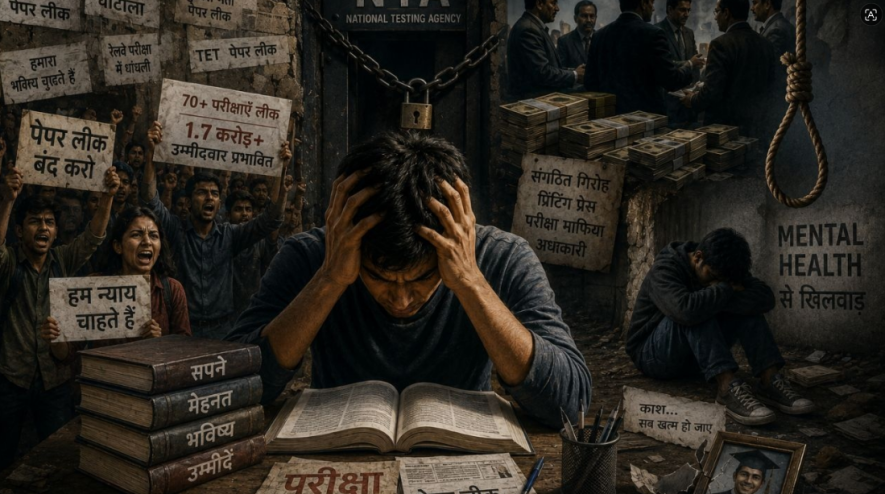
Image Credit: Aalok Bajpai
India is often described as the youngest country in the world. The nation's demographic dividend is considered its greatest strength. However, the bitter reality today is that a large section of this young population is passing through a phase of deep depression, uncertainty, and mental stress because of the country's crumbling examination system.
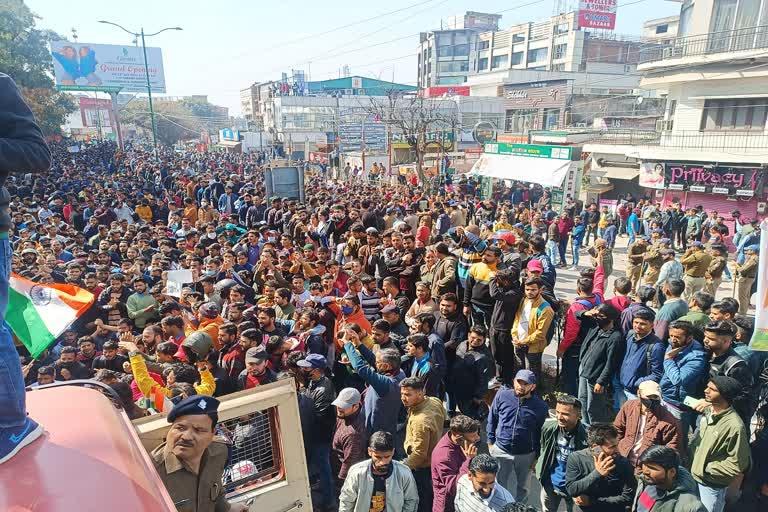
From Lucknow's Eco Garden to cities across India, young people taking to the streets is proof that the situation has crossed all limits. From national-level examinations to state recruitment tests, an organised "industry" of fraud and paper leaks has emerged, that has completely hollowed out India's examination system.
Paper Leaks: A National Crisis and ‘Organised’ Crime
In the past few years, hardly a month or a year has passed without reports of a major competitive examination being leaked or manipulated. From NEET and NET to police recruitment examinations, railway recruitment tests, Teacher Eligibility Tests (TET), and State Public Service Commission examinations, breaches are occurring everywhere.
This is not administrative laxity or an occasional lapse. It has become a multi-billion-rupee organised crime. Governments complete the formality of making new laws or cancelling examinations after a paper leak is exposed, but they have completely failed to strike at the roots of this organised network.
Alarming Numbers: The Expanding Web of Paper Leaks
According to media reports, more than 70 major examinations across different states have been leaked over the past seven to eight years. These scandals have left the future of more than 17 million candidates hanging in the balance. The manner in which organised gangs have infiltrated examinations, such as NEET-UG, UGC-NET, UP Police Recruitment, Bihar Teacher Recruitment (TRE), Railway examinations, and State Public Service Commission examinations, has demonstrated that an impregnable nexus of examination mafias, printing presses, private examination centres, and administrative officials has emerged. In exchange for huge sums of money, this nexus is openly trading away the future of millions of honest students.
System Failure and Weak Accountability
When an examination is leaked or cancelled due to malpractice, it is not merely a question paper that gets cancelled. Along with it are destroyed years of hard work by students, the hard-earned savings of poor parents, and the hopes of entire families.
The most shameful aspect is that even after such large-scale national disasters, accountability is never fixed. From top institutions, such as the National Testing Agency (NTA) to state recruitment boards, no official appears willing to accept moral responsibility for these failures. Waiting for months for new examination dates, making endless rounds of courts, and getting trapped in prolonged legal procedures have become the destiny of Indian students.
Mental Health of Youth: An Invisible Epidemic
The decay in the examination system is directly making young people mentally ill. The first source of stress is uncertainty about the future. The golden years between the ages of 20-30 years, which should have been spent contributing to nation-building, are instead being consumed by the endless maze of competitive examinations. Family and social pressure make the situation even worse. After spending years preparing for a single examination, when that examination is cancelled due to a paper leak, young people begin to see themselves as failures in the eyes of their own families.
Severe depression is the most common collective outcome of this situation. Reports of student suicides from coaching hubs, such as Kota, Prayagraj, and Mukherjee Nagar, have now been reduced to mere statistics. This examination system is no longer testing the merit of students; it is sacrificing their mental health.
Student Suicides: Institutional Killing
The National Task Force (NTF) constituted by the Supreme Court has also described the rising number of student suicides in the country as an "Institutional Crisis." Data from the National Crime Records Bureau (NCRB) shows that more than 13,000 students die by suicide in India every year. In other words, more than 35 young people are ending their lives every single day. Spending years preparing for one examination, locking away the most important five or six years of one's youth in a room, and then seeing the examination cancelled due to a paper leak, ultimately breaks many young people from within.
Accountability: Why Has Dharmendra Pradhan Not Resigned?
Accountability is one of the most fundamental principles of democracy, yet this word has virtually disappeared from India's examination system. Even after massive evidence emerged of historic irregularities and paper leaks in some of the country's biggest examinations conducted under NTA, Union Education Minister Dharmendra Pradhan did not resign from his position. Despite widespread anger among Opposition parties and millions of students, the government not only refused to accept moral responsibility but remained busy covering up the extent of its failure.
When politicians and policymakers at the highest levels of power refuse to acknowledge their failures and vacate their positions, it amounts to rubbing salt into the wounds of India's youth. This attitude sends a clear message that, for the government, the chairs occupied by politicians are far more valuable than the future of the country's young people.
No Major Culprit Has Ever Been Punished
Whenever a paper leak occurs, governments rush to announce strict laws, hand over investigations to the CBI, or arrest a few middlemen and dummy candidates. Yet, history shows that not a single major player—whether a powerful politician, a senior bureaucrat, or the chairman of an examination board—has received a punishment severe enough to serve as a deterrent.
Cases are pushed into cold storage for years in the name of investigation. Strict laws continue gathering dust because no law on paper can cure this disease unless the entire examination process and data security architecture are made transparent and the politically protected examination mafias are dismantled.
A 17-Year-Old Child Versus Investigative Agencies
The hollowness of this decaying examination system was exposed in an even more embarrassing manner when a 17-year-old student from Ranchi, Sarthak Siddhant, accomplished what major investigative agencies could not. After discovering irregularities in the evaluation of his Class XII answer sheets, Sarthak did not stop at filing a complaint. He assumed the role of an investigator himself. He analysed hundreds of pages of documents related to CBSE's On-Screen Marking (OSM) tender and found that the tender rules had allegedly been altered 15 times in order to benefit a tainted company, Coempt Edu Teck, while clauses relating to poor performance were removed.
Sarthak’s report was so substantial that he was invited to appear before the Parliamentary Standing Committee on Education, Women, Children, Youth and Sports. On June 2, 2026, inside Parliament Annexe, when a schoolboy in uniform presented a seven-page dossier before senior officials and Members of Parliament and tore apart the claims of the system, it became evident that India's examination structure is not merely inefficient but morally hollow.
Structural Reforms Are Essential
An independent and technologically capable National Examination Security Authority should be established to oversee the entire process—from question paper creation to evaluation. Special fast-track courts should be constituted to deal with paper leak cases and recruitment scams so that cases do not remain pending for years. If an examination is cancelled due to administrative failure or security lapses, candidates should be compensated for their travel, accommodation, and preparation expenses.
Recruitment processes should be legally bound to fixed timelines, and counselling as well as mental health support mechanisms should be developed for young people preparing for competitive examinations. Until the system values the time, labour, and mental well-being of candidates as much as it values its own institutional reputation, reforms will remain incomplete.
Conclusion: Stop Testing the Patience of India's Youth
As a nation, we cannot continue expecting our young people to repeatedly suffer the consequences of institutional failures and yet keep chanting slogans of patriotism and nation-building. If India truly wants to become a global superpower, it must first make its examination system leak-proof and transparent.
The erosion of trust in public institutions among young citizens is one of the greatest threats to any vibrant democracy. The government must stop the cover-ups and eliminate this rot from the examination system at its roots, because this battle is not merely about an examination. It is about protecting the future of the nation and safeguarding the mental health of an entire generation.
The author is an independent journalist and a researcher in economics. The views are personal.
Get the latest reports & analysis with people's perspective on Protests, movements & deep analytical videos, discussions of the current affairs in your Telegram app. Subscribe to NewsClick's Telegram channel & get Real-Time updates on stories, as they get published on our website.