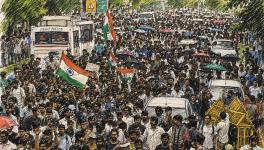






A Celebration That Should Never Have Been Necessary
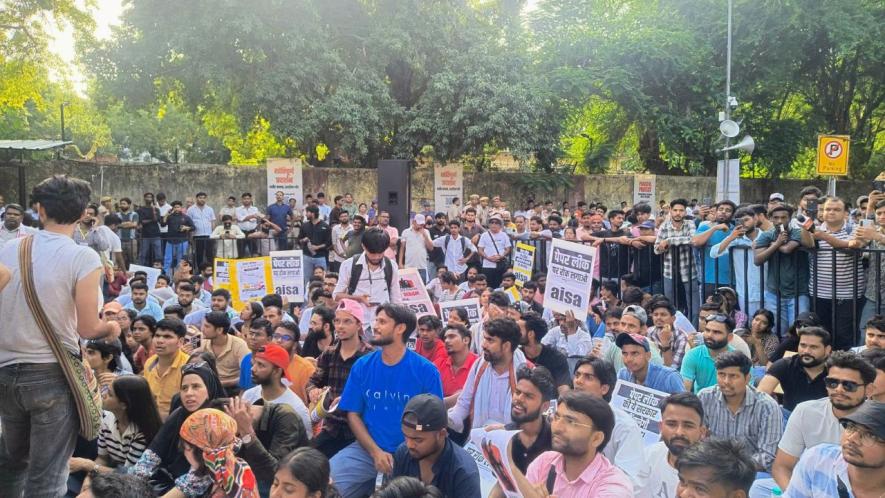
Image Courtesy: AISA Facebook
Students embraced one another at Jantar Mantar. Slogans filled the air. Flags were raised. Sweets were distributed. There was relief, joy and celebration. A Union Minister had resigned.
Yet nothing extraordinary had happened.
The resignation came after nearly 34 days of sustained nation-wide protests, widespread public outrage, reported loss of lives linked to the examination controversy, repeated police action against demonstrators and the deployment of coercive state power against students demanding accountability. What should have been an institutional response became the outcome of a prolonged political confrontation.
That this resignation became an occasion for celebration is itself an indictment of the present state of democratic accountability. In any functional democracy, ministers are expected to accept political responsibility for serious institutional failures. Democratic accountability is not a concession or a favour that must be extracted through prolonged public struggle. It is an ordinary constitutional expectation.
The question, therefore, is why the resignation was anything to celebrate at all.
The picture is much larger than the resignation of a minister. It reflects a deeper crisis in the relationship between the State, public institutions and India’s youth.
For years, young Indians have been told that education remains the principal route to economic mobility. They have been urged to acquire more qualifications, develop new skills and prepare for an increasingly competitive economy. At the same time, access to quality public education has failed to expand in proportion to demand. Public investment has remained inadequate, recruitment in public institutions has slowed and the growing dependence on private educational institutions and the coaching industry has shifted an increasing share of the financial burden on families themselves.
The consequences of this shift extend well beyond the education sector. Families have accepted rising private expenditure on schooling, university education and coaching because they believed these were investments rather than expenses. Students have accepted years of uncertainty, intense competition and delayed entry into the labour market because they believed the system, however demanding, would remain fundamentally fair.
Competitive examinations, therefore, perform a function far greater than selecting candidates for jobs or university admissions. They sustain the belief that effort, ability and perseverance continue to provide a legitimate route to social and economic mobility. Repeated examination irregularities begin to erode this belief. A paper leak undermines confidence in the institutional mechanism through which opportunity is allocated.
Every compromised examination, every delayed recruitment and every cancelled selection process weakens the credibility of the promise that merit will ultimately be recognised. The immediate consequence is the loss of a job or an admission. The deeper consequence is the erosion of trust in public institutions themselves.
Further, a paper leak is not one single grievance, it is a compendium of complaints. An examination controversy ultimately evolves into a discussion about unemployment because delayed or cancelled recruitment postpones employment. Unemployment, in turn, raises questions about the State’s developmental priorities, the shrinking availability of secure public employment and the increasing precariousness of labour markets.
What begins as a demand for a fair examination soon becomes a wider interrogation of governance, institutional accountability and democratic responsibility. Students connect these issues because they experience them not as separate policy failures but as different manifestations of the same broken promise. One that stifles their aspirations and hopes.
This is why student movements possess a distinctive political significance. They speak not only for the candidates but also for their families who have invested their savings, their aspirations and years of sacrifice in the belief that education remains the most reliable pathway to a better life. When confidence in that pathway begins to collapse, the crisis is no longer confined to the education system. It becomes a crisis of developmental legitimacy itself.
History shows that this transformation is neither unusual nor accidental. Student movements rarely remain confined to campuses because they articulate anxieties that extend far beyond students themselves. The movement led by Jayaprakash Narayan drew much of its initial energy from students before developing into a nationwide challenge to political authority. The May 1968 protests in France began in universities before spreading to workers and eventually becoming one of the largest general strikes in modern history.
Student activism played a decisive role in South Korea’s democratic transition during the 1980s. More recently, protests over public recruitment in Bangladesh evolved into a much broader questioning of state legitimacy. Across countries and historical periods, the pattern is remarkably similar. Student movements become politically significant when society begins to recognise its own anxieties in the demands of its youth.
This is also the point at which governments face a choice. They can respond by restoring confidence in institutions through transparency, accountability and reform. Or they can seek to restore order through policing, restrictions and coercion. Political economist Antonio Gramsci described this as the distinction between governing through consent and governing through coercion. Democratic governments derive their legitimacy primarily from consent, from citizens believing that public institutions remain fair and responsive.
Coercion becomes increasingly prominent when that confidence begins to erode. It cannot resolve the underlying crisis. It merely suppresses its immediate expression.
The significance of Jantar Mantar, therefore, lies not in the resignation itself but in everything that preceded it. A ministerial resignation, which should have followed naturally from institutional failure, came only after weeks of sustained protests, public anger, police action and mounting political pressure. Accountability became something that had to be wrested from the state rather than something the state willingly embraced.
That is why the celebrations at Jantar Mantar deserve to be remembered. They were expressions of relief, not triumph. Citizens were celebrating the eventual arrival of something that should have been routine in any constitutional democracy.
The paradox is difficult to ignore. The more jubilant the celebration, the more serious the failure that made such a celebration necessary. Democracy has not performed an extraordinary act. It has merely delivered, after enormous resistance, what should have happened in the ordinary course of democratic responsibility.
The writer is Associate Professor at Zakir Husain Delhi College, University of Delhi. The views are personal.
Get the latest reports & analysis with people's perspective on Protests, movements & deep analytical videos, discussions of the current affairs in your Telegram app. Subscribe to NewsClick's Telegram channel & get Real-Time updates on stories, as they get published on our website.