





Bhagat Singh: Remembered Too Loudly, Understood Too Little
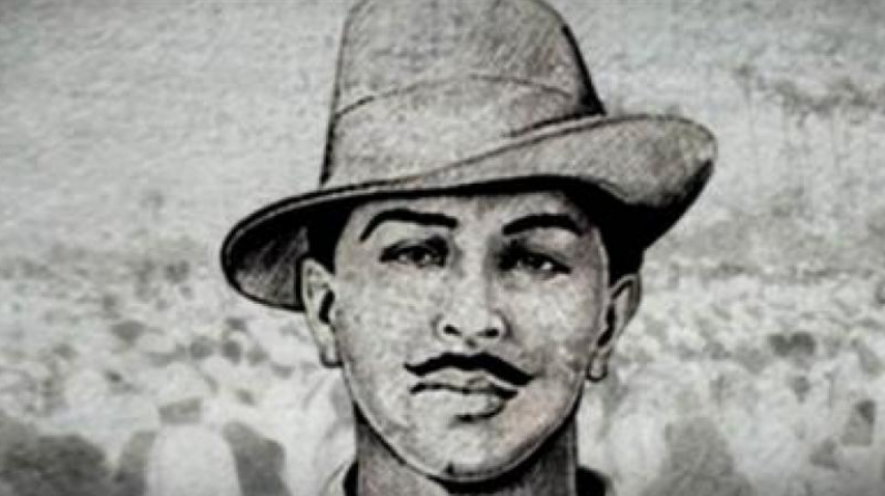
Where has Bhagat Singh disappeared today from public consciousness and who has quietly and systematically pushed him out of the public memory, especially in the Hindi heartland? The revolutionary leader, who was hanged by the British colonialists at the age of 23, was a figure who captured the imagination of youth in our country. But now he has become only a memory that only survives mostly in controlled institutionalised ceremonies, reduced to few slogans and hegemonically structured remembrance.
Why does Bhagat Singh’s name come back in full intensity only on March 23 and September 28 (his birthday)? The question is that it is these same political parties who once used to shout his name from every rally to win over the youth, so why are they so quiet now and seem more comfortable keeping a distance from his image and real political discussion?
Just think about the current scenario of India and think where the ruling party would put a young man who used to say: “Anything that cannot tolerate free thought must be destroyed.”
Every time we read about Bhagat Singh, we learn something profoundly contradictory about the way in which he exists in the memory of the people today. We see him on T-shirts, in speeches, in posters, in symbolic gestures, but not the places that matter -- in our thoughts, in the minds of the youth, in arguments, in the questions he encouraged us to ask -- as if it has been a deliberate decision of the country to agree to remember his death and forget his thoughts and ideas. And this forgetting does not come from nowhere but reflects the conscious action of the ruling classes of our society.
In their own ways, both the Congress tradition and the Sangh Parivar (Rashtriya Swayamsevak Sangh or RSS) tried to sanitise Bhagat Singh soon after the country’s Independence, to redesign his revolutionary dissent in a form that is easier to consume – of a young nationalist and heroic martyr who gave up his life for the nation. They have done so because this version is safe for them, it asks nothing of us, except our admiration and is so easy to fit into the patriotic narrative.
But Bhagat Singh and his comrades' revolutionary spirit was never safe for them and was never meant to be. This is because, at that time, he was not only fighting colonialism but the entire imperialist and exploitative system of the Britishers as well as Indian society. This is the reason he said that political freedom without ending class oppression would be incomplete.
Bhagat Singh was not writing to seek anyone's admiration, he was writing to disturb sectarian minds, to provoke them, to make the masses think about what freedom really means. He understood the Indian freedom struggle through the lens of historical materialism.
If we try to read the revolutionary leader seriously, not through any schoolbook versions or quotes and misquotes, but through his letters, through his jail diary, through his essays and articles, we get a very different picture of the man. He did not reduce the British to a ‘Company’ (East India Company) that took over our political power, but in terms of the Marxist perception of looking into the totality of things, and termed it as British “Imperialist power”.
Bhagat Singh also argued that the true enemy of the Indian working class was not just British imperialism alone, but the whole imperialist-feudal-capitalist system that stands on the pillars of “unfreedom” and “exploitation” of the Indian working class and peasants. He warned of a situation in which the “gore sahab” (White British colonial rulers and their capitalist allies) would be replaced by “bhure sahab” (Indian bourgeoisie, landlords and Congress-type leaders) who would let the exploitation of Indians and production relations remain as they are.
This is only a small glimpse of Bhagat Singh to understand that he was not only a nationalist figure, but a nationalist figure who does not quite fit into the nationalist category today.
Bhagat Singh, at the age of 23 years, was thinking about the long journey of India's freedom struggle by terming it a “false conscience” provided by the Congress system that freedom would only mean the British leaving India. For him, that was only the beginning and the surface of a much longer journey. He was thinking of what kind of society would emerge when the British left India. He was thinking of what kind of people would benefit from the popular path of freedom. He predicted India's future problem of class inequality, communalism and religious fundamentalism way before anyone else – all of which we are facing today.
This is where Bhagat Singh started subverting almost all dominant political ideologies of his and our era. He continued to ask questions, such as what does our concept of freedom mean for the landless peasant who continues to be in debt, what does it mean for the workers who continue to sell their labour, not for their own prosperity but for the surplus value for landlords and industrialist class? And what does it mean for our society where exploitation will only change form in terms of ruler to leader, but will not cease?
These questions were not mere passing concerns for Bhagat Singh and his comrades in Hindustan Socialist Republican Association or HSRA, but had a crucial role in their understanding of the idea of freedom. They were not interested in hoisting one flag in place of another or one oppressor in place of another. They were fighting for a cause that would make people uproot the entire system of exploitation and tear it down for their own freedom and justice.
Once we read Bhagat Singh in this light, it is never possible to position him comfortably alongside the mainstream ideas of RSS and Congress, but clearly opposite them.
Bhagat Singh’s disagreement with Gandhi is often reduced to a difference between violence and non-violence, but misses the depth of the contradictions. Bhagat Singh was not rejecting mass politics, in fact, he believed deeply in the power of mass mobilisation. What he was questioning was the direction in which that mobilisation was being taken without any real justice for them, and the limits that were being set on that mobilisation by a narrow elite group (Congress & Muslim League), mainly in their own favour.
The revolutionary leader could see that the leadership of the Congress movement under Gandhi’s influence was not socially neutral nor was it asking to uproot the socio-economic inequality of society. Rather, it was in the hands of upper class barristers, who were carrying the interests of landlords, emerging capitalists and leaders and had no intention of dismantling the status quo because they were benefiting from it. For them, political power was enough.
But, for Bhagat Singh, political power without social transformation was nothing but a form of bourgeois deception. Before Bhimrao Ambedkar, it was Bhagat Singh who understood that Gandhi's idea of creating freedom and democracy among Indians was much influenced by ‘voluntarism’ and was not directly confronting the State power of British Imperialism, nor did it use revolutionary movements to end it. This idea of ‘Voluntarism’ was purely based on the ruling class idea of capitalism, which we later see in Gandhi's idea of Trusteeship and Bhoodan, which was brought to suppress class struggle and class unity.
So, when the movement was withdrawn in crucial areas, when compromises were made, when the anger of the ordinary people was not respected but dulled, Bhagat Singh did not see these as isolated acts of Congress. He described the struggle of Gandhi and Congress as merely an economic and administrative pressure to get a few reforms and a few more concessions for the Indian capitalists class. He saw an underlying reluctance and refusal of Congress and Hindu Mahasabha to face the real source of exploitation. Yet, he continued to try and get at the source with increasing clarity through his essays, letters, and articles throughout his struggle. He had clearly written to the revolutionary class of India that they had to snatch political power to build a new society on an idea of “Marxist basis.”
What is considered a move toward socialism is not a sudden shift. It is a gradual development in his reading, writing and thinking. One can feel the shift in his thinking as Bhagat Singh read Marx, Engels, Lenin, Trotsky and other European literature. He attempted to understand the history of revolutions, movements in Europe, and how power operates and how society changes and how exploitation continues in the form of class. If we look at this way, we can see a significant shift in Bhagat Singh’s thinking from Romantic Nationalism to Anarchism then to Scientific Socialism.
Many a time, Bhagat Singh is criticised for not being aware of the social construct of Indian society. He is accused of having neglected the issue of caste inequality among the Hindu community. He did write about the issue of caste inequality among the Hindu community in his article in June 1928 in the Kirti Magazine under the heading “The Questions Of Untouchables” by criticising the Hindu Mahasabha founder Madan Mohan Malaviya. He also attacked Brahminism and Aryanism by saying “They destroyed the humanity of humans.They destroyed the feelings of self-confidence and self-reliance. They committed a lot of oppression and injustice. Today is the time to atone for all that.”
But he didn't understand that what he called a central problem as class, is also internalised with the Indian enclosed class system, called caste.
There was a limitation of his knowledge due to several reasons and one of the biggest reasons was his age. Nevertheless, it is possible to comprehend why his idea of revolution is misconstrued most often and deliberately neutralised and simplified into the image of freedom from the Britishers. As he himself writes, revolution is not about bombs and pistols, yet he is most often associated with the image of a pistol in his hand. The incident of the assembly makes it obvious, as he and Batukeshwar Dutt noted, it was not meant to kill, it was meant to interrupt, to make people listen.
Both the leaders allowed themselves to be arrested and this was because they knew that the trial, the prison, the hunger strike may be a way to reach people directly, to reach people politically, to make HSRA’s voice heard and read in the whole country through the newspapers with the court proceedings. These were not the actions of heroes, of men in pursuit of some heroic spectacle, as Congress and RSS wanted to portray them, but actions of revolutionaries who knew politics as a process of shaping the consciousness of masses.
Inside the prison walls, Bhagat Singh’s writings took a sharp turn. There was less romanticism, more dialectical and ideological clarity. He started speaking in clear and direct terms about class struggle, organising and long-term transformation through his writings. And it is here that we see the political importance of his atheism. This is not a matter of personal belief. His atheism was linked with his opposition to blind faith and forced acceptance.
Bhagat Singh was rejecting God and all ideas of social inequality and development of a perspective in which change was not seen to come from outside the efforts of humanity. He challenged religion, saying that the responsibility for revolution and complete overthrowing of the existing social order was in the hands of humanity.
In a society where religion often reinforces the hierarchy of caste, this position was deeply radical. And it is precisely why it was inconvenient later on, as it could not be assimilated into a narrative of cultural or religious identity or as a moderate nationalism.
It is, therefore, not surprising what happened to Bhagat Singh and his comrades after death. They have been reduced for use as ‘Nationalist heroes’ and diffused as socialist revolutionaries. Their image has been retained, but their ideas are depoliticised and erased purposefully. The RSS cannot accept Bhagat Singh’s atheistic thoughts and opposition to religious fundamentalism and his strong stand on socialist revolution based on the eradication and replacement of caste and religious identities by class identities. But they cannot disagree with him and ignore him for his contribution either. Hence, they hail him for his courage in maintaining the image of a nationalist organisation and ignore and suppress his thoughts and ideology completely. The Congress cannot highlight his criticism of its leadership and his commitment to Marxism. That's why they only keep him in a boundary for a nationalist hero where there is no conflict.
In both cases, what we lose is essential. Not only history, but a manner of viewing freedom too. For, if we look at Bhagat Singh seriously, we cannot afford to be comfortable with the status quo. We are compelled to think whether our Independence has solved the issues that Bhagat Singh was preoccupied with, or whether we merely have new forms of inequality. We are compelled to think that exploitation, poverty and hunger is not merely an accident of birth, but a necessary aspect of the capitalist system as a mode of production too.
This makes the BJP and Congress uncomfortable. Hence, it is far easier for them to remember Bhagat Singh symbolically than to remember him politically and academically. It is far easier to light candles, raise slogans and post his pictures. To think of Bhagat Singh requires us to think, to read. The world knows Bhagat Singh was greatly inspired by Vladimir Lenin and was reading Lenin (The State & Revolution) on his last day before martyrdom.
Indian youth need to learn what Lenin was stressing in his letters for “Task For Youth League” written in 1920, where foremost among the responsibility of youth, as Lenin told them, was to “learn” and told them to “assimilate knowledge critically”.
Bhagat Singh, in his letters “To Young Political Workers” outlines a plan for building a communist party for the struggle of revolution to build socialism. And, as he writes, he also teaches young revolutionaries to accept that there were contradictions, within the freedom struggle that not all visions within it were the same, that some were revisionist, like Congress, much more surrendering, much more friends to existing structures. And that means, as he writes, these visions were not only for the British, but also for those within the struggle for freedom itself.
This is why it is not enough to remember Bhagat Singh as a martyr, as it may even become a way of shying away from what he actually stood for. He did not wish to be remembered as a symbol, detached from what he believed in.
You can see it in his writings, there is no desire for glorification, only a constant push toward understanding, clarity, building something greater than himself. This is what gives his life a kind of intensity, not because it was short, but because of how much he thought within that time.
Bhagat Singh is relevant at this point in time, not just through statues or ceremonies, but through the questions he left behind. And the message he conveyed through his work, "to crush our individuality first," if we wish to work for justice, for liberty. And “Then start to work. Inch by inch you shall have to proceed. It needs courage, perseverance and very strong determination. No difficulties and no hardships shall discourage you. No failure and betrayals shall dishearten you. No travails imposed upon you shall snuff out the revolutionary will in you. Through the ordeal of suffering and sacrifice you shall come out victorious. And these individual victories shall be the valuable assets of the revolution.”
The writer is a student in Zakir Husain College, Delhi University. The views are personal.
Get the latest reports & analysis with people's perspective on Protests, movements & deep analytical videos, discussions of the current affairs in your Telegram app. Subscribe to NewsClick's Telegram channel & get Real-Time updates on stories, as they get published on our website.