





Bengal’s Birbhum: Sand in Their Hands, Blood on the Riverbank
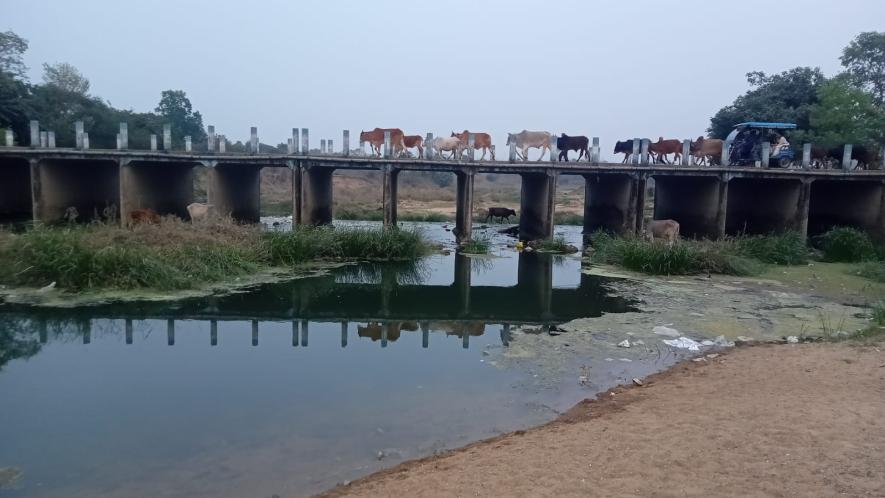
Before the first truck reaches the Ajay river embankment at Illambazar in Birbhum, and before the JCB engine starts rumbling pre-dawn, a girl can be seen already at work. She is about 11 years old. Her job is to stand waist-deep in the shallow river, scooping out loose sand into a woven basket, which she then hauls to the stockpile near the river bank. She does this for six hours, sometimes eight, and earns between Rs 30-40 a day. The contractors who employ her do not term it child labour. They say she’s “helping the family.”
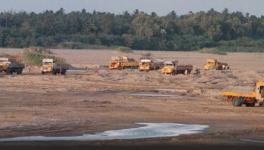
The girl is part of a vast, invisible labour pool -- mostly Santhal and other Adivasi children and women from the river-dependent villages of Birbhum -- on which the district's Rs 35-40-lakh-a-day illegal sand economy rests its foundations. The machines, the trucks, the permit racketeers, the political fixers—are all visible enough to journalists and investigators. But, the children and women at the river's edge are not.
'Helping Family': Child Labour That Nobody Counts
The sand mafia's power, as documented in The Wire's December 2025 investigation, comes from a single, cynical strategy: weaponising poverty. Poor villagers -- overwhelmingly Santhal and OBC (Other Backward Classes) families from the Rampurhat, Nanoor, Illambazar, and Dubrajpur blocks -- are drawn into the trade through wage offers that no farm economy in this rain-starved district can match. Adult males earn Rs 1,000-1,500 a day as diggers, machine operators, loaders, and night-watchmen. This is two to three times the MGNREGA (rural job guarantee scheme) wage. For families in chronic debt, it is an offer they cannot refuse.
But the adult wage is only the visible part of the labour arrangement. In village after village along the Ajay and Mayurakshi rivers, children accompany their parents to the riverbeds and are absorbed into the lower rungs of the sand extraction chain.
Boys as young as 10 years old are deployed as lookouts -- stationed along approach roads to whistle warnings when a police vehicle is spotted. Girls carry sand in headloads from the river's edge to the stockpile, doing work that the law classifies as hazardous and that the state government is constitutionally obligated to prevent.
Teachers from primary schools in blocks near Illambazar and Nanoor privately acknowledge that attendance drops during the dry season months of November through March -- precisely when the river levels fall, exposing the sand bars, and when the ghats are most active.
"The children don't miss school because they are lazy or indifferent," said a primary school teacher from a village near the Ajay river, requesting anonymity. "They miss school because there is money at the river. The family owes a debt to the moneylender, and the father is already at the ghat. The mother sends the child too. Nobody thinks of it as a crime. It has become seasonal work," the teacher added.
"The child doesn't know she is destroying the river. The man who owns the JCB does. He employs the child precisely because he knows no one will prosecute a family that is merely trying to survive," said the school teacher.
The Birbhum Adivasi Gaonta movement, which has strongest presence in the stone quarry and sand mining belts of Rampurhat block, has long documented this pattern. Research into the quarrying and extraction industries in Birbhum's Santhal-dominated villages confirms that the extraction economy systematically recruits from the most economically precarious households, with children constituting a significant proportion of the informal labour force. No state government survey has ever counted this workforce. No district labour department has ever filed a case of child labour in connection with sand mining in Birbhum. The children are, officially, invisible.
Women at Ghat: Exploitation Without a Name
If a child's exploitation is invisible, the exploitation of women in Birbhum's sand economy is suppressed. The women who work at the river's edge -- carrying sand, sieving it, loading it onto tractors -- earn much less than the men. They are paid piece-rate, not daily wages: a sum calculated per basket or per tractor-load, which keeps their earnings below Rs 200 for a full day's work in many reported instances. They have no contracts, no safety gear, no recourse if injured.
In the Darbarpur village area, where the 2017 massacre over sand bed control left at least eight dead and several wounded -- including women who happened to be present -- residents recall that rival mafia groups routinely use women as human buffers during territorial disputes. Women were sent to occupy riverbanks or man checkposts precisely because the calculation was that police crackdowns would be less brutal if women were in the front. This calculation proved lethally wrong.
The sand mafia's harassment of women who dare to resist is systematic and documented. When the alliance between the river and its dependent communities occasionally sparks resistance -- a group of villagers blocking a sand truck, a woman refusing to vacate her farmland as it is eaten by a migrating river channel -- the response from the syndicate is swift and gendered.
Allegations of molestation, public humiliation, and threats of violence against women family members are the standard tools of intimidation, said some villagers. A 2020 report on East India by South Asia Network on Dams, Rivers and People on riverbed mining documented precisely this pattern: "Allegations of sand mafia misbehaving with womenfolk of villages going to the river have been levelled, resulting in escalation of tension in the area. Locals who dared to raise their voice against illegal sand mining are threatened with dire consequences."
Research into the stone quarry and crushing belts of Rampurhat block -- which share both geography and labour pools with the sand ghats -- confirms what academics have described as “systematic targeting of Santhal and Adivasi women by extraction operators. “
Studies on the Birbhum Adivasi Gaonta movement document how the extractive economy has corroded the traditional structures that once offered women some protection within Santhal village life. The gram sabha has lost its authority. The space it once held has been occupied by the mafia and, behind it, is a political party.
Bogtui Lesson: Sand Economy Kills Whole Family
The 2022 Bogtui killings, in which eight people were burnt to death in a revenge attack following the killing of ruling Trinamool Congress strongman Bhadu Sheikh, are remembered primarily as a political atrocity, as also an instance of the sand economy consuming women and children in the most literal possible way. The victims who were burnt alive included women from the households of men accused of opposing the local sand and extortion syndicate. The CBI, which subsequently took over the investigation, identified control of sand mining revenues as the motive underlying the chain of violence.
Sheikh's alleged killing was said to be rooted in his reluctance to share the revenues from the riverbeds. The people who died in the subsequent reprisal had no agency in any of this. They were not sand miners. They were the families of men who had, one way or another, come into conflict with the people who controlled the sand. The sand economy did not just exploit their labour. It killed them.
"For the local mafia and the powers that be, it's a team game," said Krishnapada Pal, who lives near the Baidhara bridge on the Brahmani river, about 15 km from Rampurhat. "The workers at the bottom -- the women carrying sand, the boys on lookout -- they have no team. They are just used," he added.
Ajay and Mayurakshi Under Siege
The scale of what is happening to the Ajay and the Mayurakshi rivers is not merely a matter of criminal statistics. It is a geological event. Peer-reviewed research published in January 2025 in Science of the Total Environment, documented the impact of riverbed sand mining on the planform and cross-sectional morphology of the Mayurakshi -- the changes in the river's shape, its course, and the way it interacts with the land.
The findings were unambiguous: extraction creates an imbalance between river discharge and sediment load, disrupting channel slope and producing vorticity during monsoon flows that carves entirely new paths across floodplains.
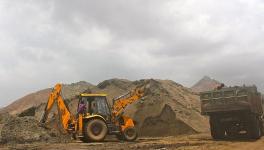
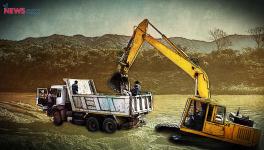
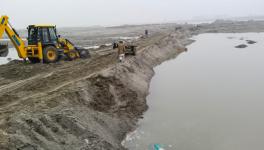
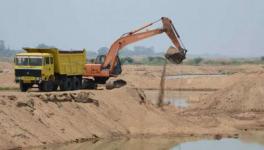
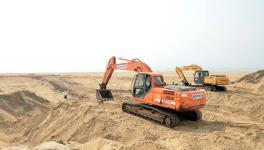
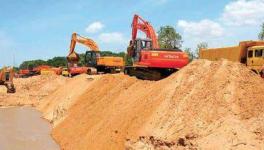
Along the Ajay river, researchers have documented channel degradation, rapid bank erosion, local gradient changes, and increased turbidity. Excavation pits -- dug by machines that the sand syndicate owns -- reach 15 to 30 feet in depth, destabilising the entire fluvial system.
The Illambazar bridge and the Nutanhut bridge have both been assessed as being a structural risk. Groundwater is degrading: water samples from the Ajay-Mayurakshi corridor show elevated salinity, with a significant proportion falling into hazardous conductivity categories. The water is increasingly unsafe for drinking and agriculture. Extraction rates along these rivers far exceed the annual rate of natural sediment deposition.
By September 2025, the district had registered 928 illegal sand extraction cases, 727 arrests, and 1,506 vehicle seizures -- a near four-fold increase from the 245 cases of 2023. In almost none of these cases have offenders faced meaningful punishment.
The pattern is structurally identical to what this reporter has documented in other sectors of Bengal's informal economy: enforcement as performance, prosecution as exception, and the machinery of the state functioning, ultimately, to stabilise the trade rather than end it.
Approximately, 80 illegal sand mines operate along the Mayurakshi, Ajay, and Brahmani river systems in the district. Only two or three of the 16 operational sand ghats are reflected in official papers, a TMC MLA reportedly said. The Enforcement Directorate's arrest of Kolkata businessman Arun Saraf -- whose G.D. Mining company allegedly generated fake QR-coded electronic permits to legitimise illegal extraction, leaving Rs 60 crore unaccounted -- offered a glimpse of the financial architecture at the top. What it did not reveal was the labour architecture at the bottom: the children at the water's edge, the women carrying loads for Rs 150 a day, the Santhal families bound to the trade by debt and the absence of any alternative.
Children of Contaminated Rivers
Koley Kisku is 11 years old. He studies at the primary school in Ranipur village, Rampurhat block, the same block where the Bogtui killings happened and where the sand and stone extraction economy has reshaped every aspect of daily life. He has a thyroid condition that has partially affected his ability to speak. His classmates say he could speak normally until a few years ago. His school draws its cooking water for the midday meal from a village pond contaminated by run-off from nearby quarrying operations. Reportedly, around 86 pupils at the school regularly miss classes due to waterborne illness. The headmaster confirmed that the water was not purified before being used in the kitchen.
Koley's story is about what happens when an entire district's natural resource base is handed over to an extraction economy. The Mayurakshi -- Mor in Santali, the peacock river -- is the lifeline of Birbhum, which receives among the lowest annual rainfall in West Bengal. The state has constructed the Massanjore Dam, barrages, and canals to regulate its flow. None of this infrastructure can compensate for the destruction being wrought on the river's own morphology by extraction pits that alter its velocity, divert its course during monsoon flooding, and breach thin sand walls to carve new channels across floodplains.
"The fish are gone," said a fisherman from a village near the Ajay in Labpur block. "The river bottom has been scooped out. The children used to swim here. Now there are holes you cannot see until you are already in them. A boy drowned in one such pit some years ago. The contractor who dug the pit is still working. The boy is still dead."
At Sainthia, temporary roads have been built across the Mayurakshi to ease sand transport, at times almost completely blocking the river course. The river's tributaries -- the Brahmani, Dwaraka, Bakreshwar, and Kopai -- have all been affected by extraction along their banks. Rates of lateral bank erosion in comparable rivers in the Rarh region have been documented at up to 150 metres in a single season. Farmers whose fields once lay safely distant from the river's edge are finding their lands collapsing into migrating channels. Foundation cracks have appeared in riverside homes. The irrigation department's embankments are being undermined from below.
Politics Protects, Law Fails, Trade Goes On
In November 2024, West Bengal's Special Task Force intercepted an SUV in Bolpur and recovered Rs 5 crore in cash -- part of a routine delivery chain funnelling sand revenues from Birbhum to powerful figures in Kolkata. The ED’s investigation traces this underground revenue system upward through layers of political protection and administrative complicity.
The West Bengal Minor Minerals Rules, 2002 stipulate that no mining shall occur within 5km of a river. "Forget such rules," said BJP leader Subhasish Chowdhury, adding "Those are for legal miners. Here we have dreaded criminals backed by political heavyweights."
The political protection enjoyed by the sand operators is quite visible: 928 cases, 727 arrests, and a prosecution rate that nears zero.
"The people who do this have protection," said a farmer from Mongalkot block, who has been filing complaints about sand trucks for three years. "Everyone knows. The panchayat knows. The police know. The block office knows. Nothing changes because the people who run the sand ghats and the people who run the government are, in many places, the same people," he adds.
What would meaningful change look like? Environmental scientists and activists are clear: mandatory scientific assessments of sustainable extraction limits; independent monitoring of active ghats by bodies not answerable to the district administration; a moratorium on extraction in geomorphologically vulnerable stretches of the Ajay and Mayurakshi; and serious investment in manufactured sand as an alternative. None of this is beyond the technical capacity of the state, but seems beyond its current political will.
What the River Cannot Say
The girl at the Ajay's edge does not know what a morphological channel shift is. She does not know that the pit three metres to her left was dug last month and that the monsoon, when it comes, may breach its wall and send water across the floodplain. She does not know that the sand she carries is reducing the groundwater table that her family's handpump draws from. She knows Rs 30 is better than nothing. She knows that the JJCB will shout at her if she stops. She knows that her father has a debt.
The Santhal and Baul traditions of Birbhum -- the same traditions that drew poet Rabindranath Tagore to establish Santiniketan here, that produced the sculptor Ram Kinkar Baij -- are rooted in the rivers. The degradation of the Ajay and Mayurakshi is being seen not merely as an environmental setback by the communities who depend on them, but as a second dispossession. This time without a revolt, because the people who control the guns are also the people who file police complaints.
"The river is not just water," said an activist from Suri who has tracked the Mayurakshi for a decade. "It is our well, our field, our market, our God. When you mine it like this, you are not taking sand. You are taking everything. And the people who have nothing left have no way to make you stop."
Get the latest reports & analysis with people's perspective on Protests, movements & deep analytical videos, discussions of the current affairs in your Telegram app. Subscribe to NewsClick's Telegram channel & get Real-Time updates on stories, as they get published on our website.