





Bengal: A Silent Revolution Revives Lost Rice Strains in Ranbahal
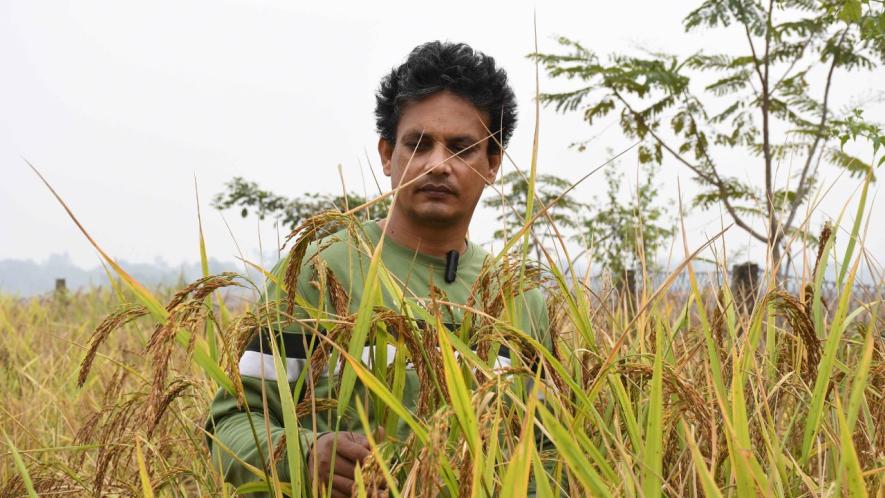
Prof Anjan Sinha in his field at Ranbahal village of Bankura.
An extraordinary feat in agricultural development is taking place at Ranbahal village under Gangajalghati Block of Bankura district in West Bengal’s Jangalmahal. As many as 240 varieties of disappearing traditional rice strains are being cultivated here. This incredible achievement has been made possible at the initiative of Anjan Kumar Sinha, a resident of Ranbahal village, who is a professor in the botany department at Raghunathpur College in Purulia.
Significantly, this effort is setting a national example, as nowhere else is such a large number of diverse rice varieties being cultivated across the same contiguous area. This is because Sinha has not confined his academic knowledge only to teaching in classrooms. He has disseminated his knowledge among the poor and marginalised farmers of nearby villages. He practically demonstrated to them how to cultivate traditional paddy varieties in dry, unirrigated land, thereby restoring a legacy that has been lost for years.
This initiative is not merely about the nostalgia of preserving heritage, farmers stand to gain more profit from cultivating these traditional crops than from current paddy strains. Furthermore, they require no synthetic fertilisers, thus maintaining the natural character of the soil.
The allure of the aromatic rice also attracts many unknown bird species, which, in a wider sense, leads to the enhancement of local biodiversity.
Ranbahal village is located within the Gangajalghati Block area of Bankura district, 210 kilometres to the west of Bengal capital city, Kolkata. There are no irrigation facilities in Ranbahal and surrounding villages, including Amarkanan, Gobindadham, Gangajalghati. The soil is mostly barren, and cultivation is dependent only on rainwater.
“Our land is infertile here, and there is no provision for any irrigation facility. We have been cultivating paddy for generations, relying solely on rainwater. Until now, we only cultivated the Lal Swarna variety of rice, but farming it was not profitable. Now, we are cultivating traditional rice varieties, such as Kalamkathi, Dudheswar, Bhutmuri and Gobindobhog that have been lost,” Amar Bauri, a marginal farmer from Ranbahal village, told this reporter.
Bauri said Sinha, a resident of their village, provided them seeds for these rice varieties free of cost. “We are now cultivating these aromatic and nutritious rice varieties. We are also getting a good price for it,” he added.
He said the professor showed them how to cultivate these traditional varieties of rice in the fields with his own hands. “He taught us everything, from planting rice seedlings, taking care of them during growth to harvesting. We benefited from learning and implemented it”, he added.
About one km before entering Ranbahal village from Amarkanan, the mixed fragrance of several varieties of aromatic paddy is enchanting. Currently paddy harvesting is in full swing. The captivating aroma has brought back the essence of ancient Bengal, say old timers.
In Ranbahal village, over 200 traditional varieties of rice are either lying harvested in the fields or swaying in the breeze. The fields are also teeming with the arrival of various species of birds. One would not want to go back after a visit to the area. The atmosphere is so pleasant.
How Was This Incredible Transformation Possible?
“I was born and raised in Ranbahal village. I am a farmer’s son and I have witnessed the immense hardship faced by the local farmers”, Prof Sinha told this reporter, standing in a lush paddy field. For generations, the primary crop in this region has been the common Lal Swarna paddy variety. However, due to the inherent nature of the rough soil and chronic lack of adequate irrigation, paddy yields were consistently low. “The farmers were not making profits, yet, out of sheer dedication, they never left their land fallow, " he recalled.
Driven by a desire to use his educational knowledge to uplift his community, Sinha began an ambitious project 15 years ago. He introduced new, traditional varieties of rice to the village. His initiative started small -- on just two bighas of land. Today, his efforts have blossomed into a silent revolution. The successful cultivation of these traditional paddy varieties now spans over a 100 bighas across the area, ensuring better yields and opening a path to prosperity for the struggling farmers of the region.
“Through my studies in botany and my experience as a college teacher, I realised that even this barren land could produce good yields. There was only one way to achieve this – by growing traditional rice varieties that had disappeared over time”, said Sinha.
The professor recalled that he collected these seeds from different parts of the country and initially began cultivating around 80 varieties of rice, planting them in small plots. Success followed. The harvested rice was then preserved as seeds for future use.
He said the initiative began as early as 2008. The following year, a seed bank was established at the site. During the cultivation season, seeds are distributed free of cost among farmers.
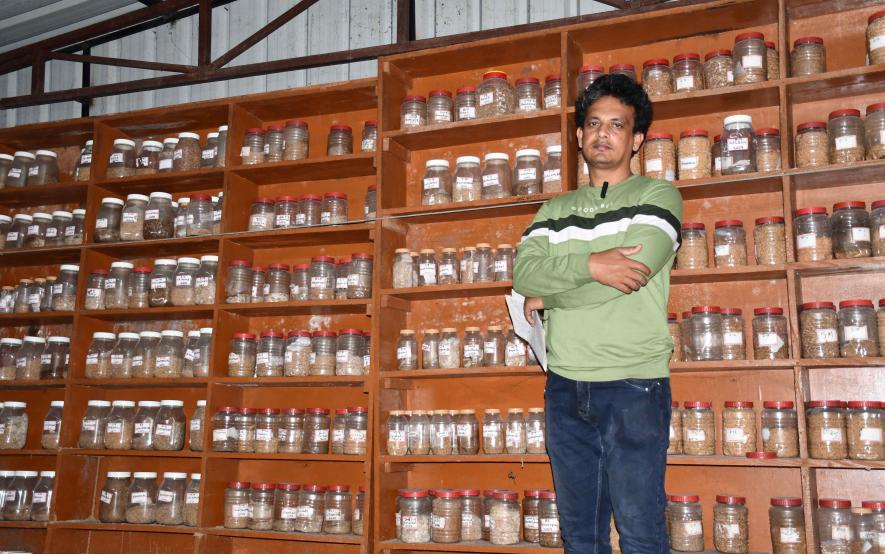
Professor Sinha in his seed bank store near the fields.
An organisation named Amarkanan Rural Socio Environmental Welfare Society has been formed with the participation of local farmers. At present, nearly 50 farmers are directly associated with the initiative. This year, more than 200 farmers are cultivating traditional varieties of paddy in their land, he added.
A total of 240 varieties of traditional paddy has been cultivated in the Ranbahal and surrounding villages this year. Among the notable varieties are Kalo Nunia, Kanakchur, Bahurupi, Tulsi Mukul, Sindurmukhi, Boroni, Jamainaru, Sitasal, Dudheswar, Dudhkalam, and Badam Saru. These varieties were widely cultivated in Bengal many decades ago, but had gradually disappeared over time.
“The main characteristic of these traditional varieties is that most of the rice grains are long and aromatic. Only Kerala Sundari produces slightly thinner grains. While Kalo Nunia is distinctive for producing black coloured cooked rice”, said Sinha. He said each of these varieties was known for high nutritional value, making them both agriculturally and nutritionally significant.
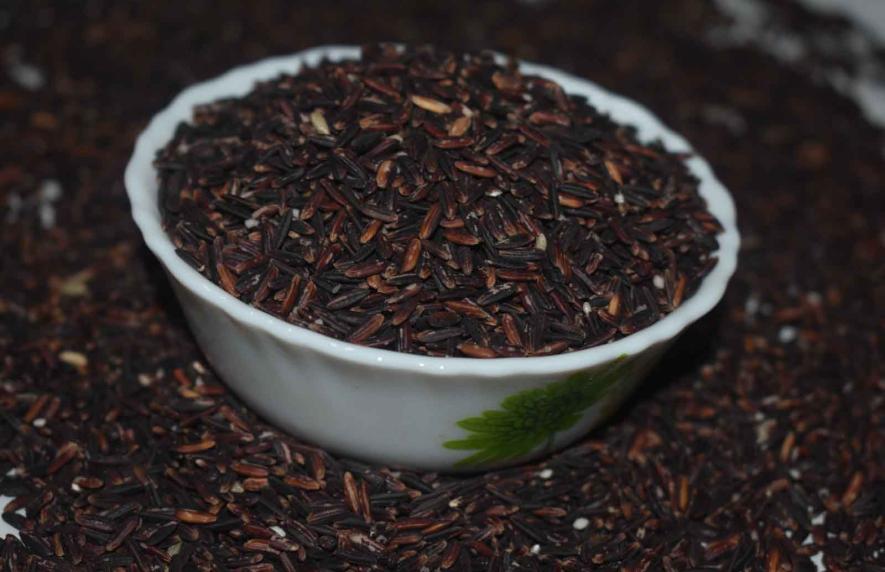
Kalo Nunia paddy
Farmers Joy Bauri and Dilip Ghose of Ranbahal village told this reporter that traditional varieties of paddy require significantly less water for cultivation. No chemical fertilisers are used, instead, only organic manure is applied. The cost of cultivation was approximately Rs 1,000 per bigha, while the yield ranged between 4-5 quintals per bigha. They added that the market price of this rice was much higher than that of the commonly cultivated Lal Swarna variety, making it economically viable for farmers.
The initiative is no longer confined to Ranbahal. Farmers from Gobindadham, Gangajalghati, Kapistha, Amarkanan, and several other villages have begun visiting the Ranbahal seed centre to collect seeds and take up cultivation. Farmers from other districts of West Bengal are also coming here to obtain seeds of traditional rice varieties, said Sinha.
He added that one of the primary objectives of conserving these seeds was to enable the development of improved-quality varieties from traditional rice in future, and efforts were currently underway toward achieving that goal.
For his contribution to this initiative, Sinha has also been recognised by the government of India’s agricultural authorities. He received the Protection of Plant Varieties and Farmers Rights (PPV&FR) Authority Award in 2024, and the prestigious Plant Genome Saviour Community Award in 2019.
Commenting on the cultivation of traditional paddy varieties in the Ranbahal region, Subit Pal, an agricultural expert and director of Bankura District Central Cooperative Bank, described the initiative as a “highly commendable effort”. He hoped farmers from other parts of the district would also be encouraged to adopt cultivation of traditional rice varieties.
The writer covers the Jangalmahal region for ‘Ganashakti’ newspaper in West Bengal.
(All photographs by Madhu Sudan Chatterjee)
Get the latest reports & analysis with people's perspective on Protests, movements & deep analytical videos, discussions of the current affairs in your Telegram app. Subscribe to NewsClick's Telegram channel & get Real-Time updates on stories, as they get published on our website.