





Bengal Polls: Left Campaign Reflects Quiet Change in 5 Murshidabad Seats
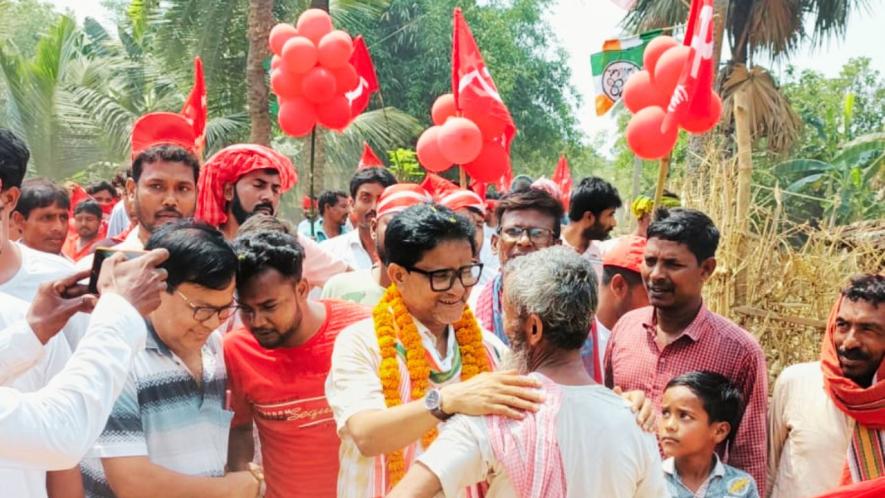
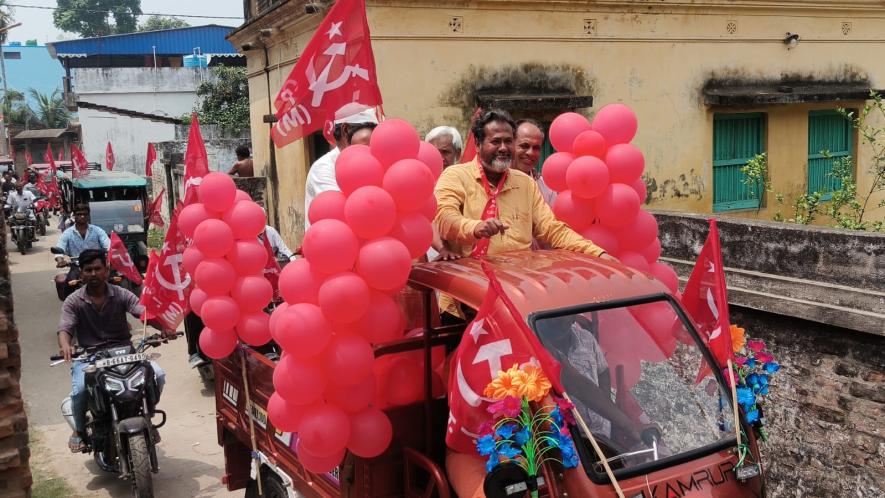
CPI(M) candidate from Domkal, Mostafijur Rehman Rana, on the campaign trail.
Murshidabad: There is a particular sound that defines Murshidabad in the election season. It is not the loudspeaker in processions. It is not the socket bombs — crude, homemade explosive devices that have become as much a fixture of this district's electoral calendar as ballot boxes and party flags. The sound that defines Murshidabad this April is quieter, more intimate, and more consequential: it is the sound of people voices, who have been lied to one time too many. They are sharing their woes and listening to a political party they had written off – the Left Front.
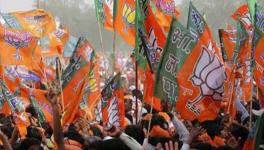
Across five Assembly segments of this river-laced district, something is gradually shifting. In Hariharpara and Domkal, in Khargram and Raninagar, in Jalangi tucked along the Bangladesh border, and in the lanes and brick kilns and handloom workshops that connect them all, the CPI(M)'s red flag can be seen moving through neighbourhoods where it was not welcome for a decade. Whether this will translate into votes on April 23 and 29, is a question nobody can answer with certainty.
But the conversations happening along the roads — between candidates and weavers, between Left party workers and migrant families, between organisers and women who have been waiting far too long for a water tap to work —are the story of quiet change in these elections.
Hariharpara: Rs 40/Day and a Loom That Never Stops
Mallika Bibi, 35, sat at her loom all morning in a narrow lane off the state highway in Hariharpara, weaving a gamcha — the simple cotton towel that has been Murshidabad's handloom pride for generations — when Jamir Mollah, the CPI(M)'s candidate and the party's district secretary, walked up to seek her vote. She did not greet him with a promise. She greeted him with a complaint.
"Four days of spinning and I take home Rs 140. That is Rs 40 a day. How am I supposed to run a household with that?" she says.
Mallika's is not an isolated grievance. It is voice of an entire economic ecosystem collapsing. The cooperative weaving network that once gave Murshidabad's handloom workers a dignified income has been hollowed out over 15 years of Trinamool Congress (TMC) rule. Looms have been sold for scrap. Weavers who once had institutional support, now deal with middlemen who set their own prices. Many have simply left for distant cities because even an uncertain wage elsewhere beats Rs 40 a day at home.
About 25 kilometres from the district headquarters of Baharampur, near Dharampur, Abbasuddin Sheikh, 25, works as a fireman at a brick kiln. A father of two, he spends long hours tending a roaring furnace. The damage to his health is visible even before he opens his mouth — the skin around his ankles cracked and discoloured from years of heat exposure, rubber slippers that last barely 10 days. He earns Rs 15,000/month, but only for six months. When the monsoon arrives, the kilns shut, and so does his income. "This is what fire does to a man's feet over years," he says.
For Abbasuddin, the anger is not only about wages. In Dharampur, residents allege that the local primary school is running with inadequate teachers for years — they allege teaching posts have been left deliberately unfilled, pushing families toward private schools that charge high fees. "We don't want Niyamat Sheikh (TMC) to win again," said a worker,” adding "We are hapless parents. Our children have no future under this government."
What makes Hariharpara a constituency worth watching is not merely the economic distress — but who is expressing it. Roughly 80% of the segment's population is Muslim. For decades, the demography was a reliable bedrock of anti-Left voting in the district, first behind the Congress, then consolidating firmly behind TMC. The CPI(M) was seldom welcome in these mohallas. That calculus is shifting. Jamir Mollah carries a simple message: “forget the politics of temple and mosque; vote for the ideology that has always stood with the poor.” His local roots give the appeal an authenticity that outsider candidates do not.
Hariharpara is also part of Murshidabad, one of the districts worst hit by the Election Commission's Special Intensive Revision (SIR) of voter rolls — a process that deleted nearly 91 lakh names statewide, with Murshidabad accounting for a disproportionate share. That anxiety about disenfranchisement has added another layer of political charge to an already volatile contest.
Mallika Bibi, after the brief exchange, returns to her loom. She makes no promise. But she listens. In a constituency where political loyalties had for long seemed fixed, that quiet listening reflects a quiet change.
Domkal: When Bomb Becomes Calendar
About 20 miles from Baharampur lies Domkal — a town that wears its violence quietly. A hospital technician at a local superspeciality facility, who asked not to be named, put things in a chilling matter-of-factness: "The majority of patients that come during election time are bomb victims every year,” adding "They haven't started yet this time. But they will."
For decades, Domkal was a Left stronghold. With each passing election, the Left’s influence faded a little more, replaced by TMC. Yet, even in 2021, when TMC swept the state, CPI(M) held over 30% of the vote here. That is not the number of a party gasping for air, but waiting for the tide to turn.
The TMC's choice of candidate has also deepened local anger. This year, the ruling party has dropped its sitting MLA Humayun Kabir — a former IPS officer who served as Superintendent of Police in Murshidabad from 2016 to 2018. For CPI(M) workers in Domkal, Kabir’s name carries a specific and personal sting. They allege that it was during Kabir's tenure that false drug cases were registered against Left youth organisers — a systematic use of State machinery to dismantle the party's ground organisation. Now the man they hold responsible for that campaign of intimidation is asking for their votes. One Left worker's response was blunt: "Our fight this time is amne samne — face to face. The torturer will get a befitting reply. The masses have not forgotten."
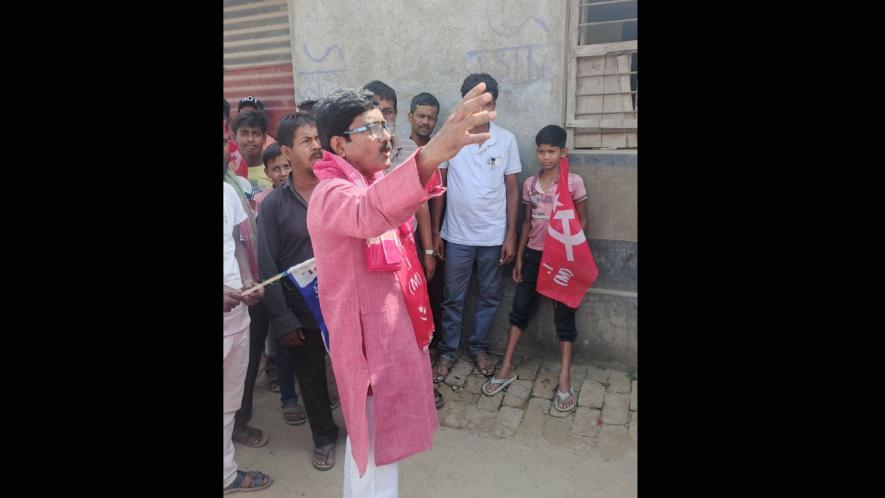
Against Kabir stands Mostafijur Rehman, known locally as Rana, who is young, energetic, and accessible. On a warm April afternoon, the CPI(M) candidate led a large rally through Sheikhpara, the crowd was loud and patient, the kind that actually wants to hear leaders speak. "Not a party worker, not a local functionary — I am personally knocking on doors," Rana tells NewsClick, said, wiping sweat from his forehead. Over 50,000 migrant workers from this Assembly segment are currently in Kerala and other Southern states. They are calling to ask what they can do, whether they should come home to vote. The ones who are on the rolls are with us, he adds.
As the rally moves, a hospital technician's words stayed with us -- “Not yet, he had said. The bombs haven't started yet.”
There is a grim scenario embedded in that sentence —of people who have seen this before, who know what is coming, and have decided to show up anyway.
Khargram: Bridges That Were Never Built
In Khargram, silence has settled across the constituency that has been promised too much and delivered too little. The list of unmet needs reads more like a charge sheet: two critical river bridges — the Jhilli-Puradanga and the Yadavpur-Jafarpur over the Brahmani river — remain either unbuilt or shuttered, severing villages from markets and hospitals.
The Murshidabad silk industry, a centuries-old legacy, approaches extinction for want of support. Dairy farmers sell milk below cost with no veterinary hospital within reach. Irrigation canals have silted into irrelevance. Junior high schools have not been upgraded, leaving adolescents with no option but to travel long distances or drop out. MGNREGA, the rural employment guarantee that should provide a floor beneath the most vulnerable, exists largely on paper.
Khargram's electoral history tells its own story of disillusionment. In 2021, on a wave of anti-TMC rage, the Bharatiya Janata Party (BJP) surged to 32.64% vote share— a sixfold increase in five years. The people who voted for them wanted change. What they received instead was the SIR purge and a campaign built on communal division rather than development. That fury now has nowhere to go. In meeting after meeting, voters who backed BJP in 2021, can be seen engaging with CPI(M) candidate Dhrubajyoti Saha, that has surprised even seasoned Left workers.
Saha campaigns on an unglamorous plank — bridges, classrooms, irrigation, wages, dignity. He invokes the Left Front era not as nostalgia but as evidence: the schools, the colleges, rural electrification — these were built under Left governance. What followed was not development but stagnation dressed up in promises. In a constituency that has been lied to for 15 years, that argument is getting traction.
Raninagar: The Card That Was Stolen
The road into Raninagar is full of scars. Cracked asphalt, sudden drops, stretches where tarmac once was. Locals say accidents happen almost every day. And yet, since the Assembly election schedule was announced, repair crews have appeared in select patches. Nobody here is surprised, or fooled.
Beneath Raninagar's banners and loudspeaker processions lies a community carrying the weight of systematic betrayal. Families handed over between Rs 50,000 to Rs 1 lakh to local intermediaries, and were promised homes under the Pradhan Mantri Awas Yojana. Many received nothing — neither houses nor refunds. Drinking water infrastructure laid during the Left Front years has been left to decay since 2011. Women still walk to manual pumps. Children still drink water that no government official would touch.
Most viscerally, MGNREGA employment has been effectively strangled. Job cards — the documents that give workers access to the employment guarantee — have been confiscated by local TMC-linked agents, allege multiple residents. High Court orders directing resumption of work have been largely ignored. The money meant for village wages has disappeared into other hands.
Ikbal Haque, the district CPI(M) leader, put it starkly: "Labourers from Bengal are being targeted in BJP-run states, branded as Bangladeshis or Rohingyas, and brutally attacked. Some have been murdered." Men who left home for work are coming back in coffins — or not at all, he adds.
CPI(M) candidate Jamal Hossain campaigns 12-15 kilometres each day on foot. On one such walk, a cluster of elderly farmers stops his procession. Their endorsement was blunt and unsentimental: "We are with the Left from the beginning. They tried to frighten us. We don't bother. They are nothing but a gang of looters — and we don't like dalbadloos (turncoats)." The last word — a term for switch between TMC and BJP— draws knowing nods from people around.
Jalangi: Man the Constituency Never Stopped Calling MLA
It was past noon, the mercury at a punishing 38°C, when Tahmina Bibi cut this correspondent short at Sahebnagar More — a dusty crossroads in Jalangi, one of West Bengal's most underdeveloped assembly segments along the Bangladesh border. "Please don't ask questions," she said, with quiet authority. Then: "Ianus MLA will be elected again. Just wait and watch." She was one of the 15 people standing in the heat, holding sweets and marigold petals, waiting.
About 30 minutes later came the distant throb of drums. Then the crowd — more than 2,000 people, many of them dancing, red flags of the hammer and sickle swaying in the hot air — and at its head, in a bright yellow kurta and a thick marigold garland, was the tall, composed figure of CPI(M)’s Ianus Ali Sarkar.
Jalangi's story is one of profound institutional abandonment. Government schools crumbling from neglect. Young people travelling hours to the nearest college in town, burning their family savings. Healthcare here faces an incremental crisis — understaffed, under-equipped, women delivering without proper facilities, children losing school days to illness that a functioning primary health centre could have caught early. In Jalangi, the absence of the State is felt in the human body.
Against this backdrop, the return of Sarkar carries enormous symbolic weight. He served as Jalangi's MLA for four terms. It was during his tenure that Jalangi Mahavidyalaya came into existence — the only college in the entire Jalangi block. For a generation of young people from the poor, often minority families in this border region, that institution was, and remains, a lifeline. Sarkar did not contest the last election. Yet for five years, his house stayed open with villagers thronging with land disputes, medical emergencies, daughters' marriages, sons' job applications. He sorted what he could, turned nobody away. "MLA or not, people go to his house for everything," says Tahmina Bibi.
Once the election rally had dissolved into a kind of celebration — slogans overlapping drumbeats, young men hoisting flags, elderly women ululating from the roadside, Sarkar told NewsClick, "BJP and TMC — what have they given Jalangi? Corruption. Sectarianism. Empty promises." He said approximately 15,000 people and their families have already switched allegiance — from TMC, from BJP — taking up the red flag. "Nobody is forcing them. It is happening on its own," he claimed, adding "That is the only kind of victory that lasts," walking back into the crowd.
The Shape of the Moment
Taken together, these six constituencies outline something that is not a wave, but not mere wishful thinking either. What is visible across Murshidabad in this election season is a grounded disillusionment — not with politics in the abstract, but with two parties in particular: one that has governed for 15 years and delivered “managed patronage instead of rights”, and the other that rode into power promising transformation and instead delivered SIR.
Amid this disillusionment, the Left is walking — not with the swagger of a party that commanded the ground once, but with credibility that has stayed in people’s minds -- in brick kilns and handloom lanes, in schools without teachers and the villages without bridges, in border constituencies, among communities, among migrant workers. Whether this translates into power will be known on May 4, when the votes will be counted.
Get the latest reports & analysis with people's perspective on Protests, movements & deep analytical videos, discussions of the current affairs in your Telegram app. Subscribe to NewsClick's Telegram channel & get Real-Time updates on stories, as they get published on our website.