





Bengal Polls: Democracy Suffers from ‘Softwarecracy’
Technology, say software, may well be necessary but insufficient for everything and everywhere. When a decision demands serious human judgment in response to answering what ought to be done—that is, deontological consideration—technology must not override it. Enlightened human judgement demands reasonings behind an event from various fields of knowledge—epistemological consideration—as well as its possible consequences, for which machine-made predictive findings are grossly insufficient.
The need for human judgments is inescapable for any perceivable social engagement, let alone for constitutional matters for any nation. Entertaining a baby, say, a few months old, who is yet to utter the first word, ought to be served by human judgment capable of selecting the lullaby or gestures suitable for the age, time of day, season, language, culture and so on. Should attending a child be advised by or relegated to a “time-saving” and “cost-efficient” software? The jury is out in the age of AI!
Leaving childhood entertainment aside—not as a non-issue but for the sake of time and space of this article—consider the seriousness while deciding on a decision on the citizenship rights or voting rights of an adult individual.
An adult franchise is a non-negotiable ideal—a history that shaped the Indian Constitution, perhaps gathering dust in Indian libraries at this time—of any liberal democracy based on the allegiance to the rule of law and grounded on constitutional morality. Voting rights come along with being a living adult citizen.
This right to vote is not for once in five years to say ‘yes’ or ‘no’ to elect a political party to govern per se. It is a sense of entitlements that empower one’s national identity, equality, liberty, and importantly, a sense of dignity.
As citizenship questions are being raised over the past several years in India—along with many Western countries —the underprivileged and minority communities bear the brunt of administrative apathy and judicial neglect because of lack of their social capital and economic resources. If their citizenship right of adult franchise is questioned, it set off psychological panic, if not a life and death situation. Unquestionably, therefore, decisions on an adult’s voting rights demand serious human judgment.
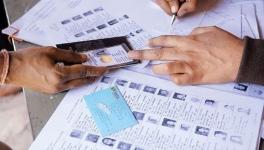
In this context, a case of considerable importance at this moment of Indian constitutional history is that 27 lakh living adults with past official records have been disenfranchised from their constitutional right in the Assembly election of West Bengal held in April 2026. While these are living, flesh and blood people, a “smart” but mindless software code programmed for the Special Intensive Revision (SIR) technologically found some specific “logical discrepancy”.
The software is programmed to detect spelling mismatch in names—a linguistic question—or parent-children age gaps—a biological and socio-cultural question—most of which would obviously go beyond the comprehension of software programmers and their bureaucratic advisors. The fact is that digital technology is built with little to no consideration of their impact on democracy in the first place; it is not being designed to support democracy.
This technocratic ‘logic’ was questioned and alerted in a timely manner by civil society, and the top judiciary intervened successively, but the time was too short to counter the intentionality of the mighty Election Commission of India (ECI) that worked dutifully as intended by its political masters. In hindsight, the Bengal Assembly poll results were not surprising: illogically “logical discrepancies” detected 27 lakh living voters and sent them for further hearings, in an overwhelmingly impossible short timeframe of a month or so, just before the election began.
This is not to deny the election results where the 45.8% of the 646 lakh total eligible electorate voted for the Bharatiya Janata Party of BJP vis-a-vis 40.8% which voted for the Trinamool Congress or TMC; this means, about 296 lakh and 264 lakh votes went to these two major political parties, respectively. This gap of just 32 lakh votes (5% of total eligible electorates), however, resulted in 207 seats (around 70% of the total Assembly seats) for BJP vis-a-vis 80 seats (around 27% of the total Assembly seats) for TMC. This 5-percentage point difference in vote share contributed to a disproportionate gap of 127 seats between BJP and TMC, which was enough to change the incumbent TMC government in a 294-seat Assembly.
Until this point, nothing is in doubt if these numbers are seen without the 27 lakh living voters disenfranchised in a short period of the SIR process, and without feasible scope of adjudication. Many questions, depending upon whom you ask, might follow from this historical omission of constitutional obligations of the vanguard institutions, especially the Supreme Court. This event would, perhaps, be marked as a reference point of lawlessness, injustice, and an escape from constitutional morality. Answering some questions, if not all, are not only uncomfortable but inherently difficult.
Could the adjudication of living voters be taken as constitutionally sacrosanct, and therefore, allowing postponement of the election, especially in this extraordinary circumstance? Or, could the election indeed be timely held, as it happened, by allowing the 27 lakh voters—who faced software judgement of “logical discrepancies”—to vote without adjudication for this extraordinary case? Since the Indian judiciary is afflicted with lack of adequate judicial officers, insufficient resources, and overburdened with cases, it is expected that judicial adjudication of these 27 lakh individuals would inherently take time.
It is not surprising, therefore, that the speed of adjudication is low—1,621 cases took 8-10 days for disposal—even at the time of heightened public and institutional attention. At this rate, 27 lakh cases would take about 40 years of continuous judicial engagement to adjudicate these cases of “logical discrepancies” found from a time-saving software!
This is an unconscionable constitutional deadlock cultivated from what I call “softwarecracy”, when death would become as guaranteed proof of the living status of the citizens of this nation. Kadambini, the hapless widow protagonist in Rabindranath Tagore’s short story Jibito o Mrito, had to prove at her home that she was indeed alive before drowning into the pond. Tagore could perhaps foresee Kadmabini's then social reality with its far-reaching possibilities even after a century or so.
Is timely election constitutionally non-negotiable for ensuring the participation of all electorates for whom election is guaranteed in the first place? An election without electorate—however negligible that might be—seems like the rituals done on the dead are more sacrosanct than caring for living beings. These are uncomfortable questions indeed.
Putting the moral choices of the constitutional authorities aside for a moment—deontological questions—let us turn to some consequentialist and legitimacy questions. What would have happened in the election result determined from the gap of 32 lakh votes between BJP and TMC, had the 27 lakh living voters who faced “logical discrepancies” been allowed to exercise their franchise?
Initial investigation shows that the current gap of 127 seats between BJP and TMC would have been actually much lower—lower enough for the TMC government to continue in power. This is not to debate or make projections whether “franchisee politics” of TMC would be better vis-a-vis majoritarian Hindutva politics of BJP, but the legitimacy of this election in the first place.
Answering this question inevitably invites a plethora of hypotheses, depending upon whom you ask the question. For instance, what would have been the possible distribution of voting preferences of these 27-lakh living voters? Herein lies the legitimacy question in the broader public mind about the new BJP regime in West Bengal. This not a state-specific question that concerns only the people of West Bengal, but an important national question.
The neoliberal economic regime has reduced the ideals of universal welfare provisions to “target group” developmental “schemes”, supposedly for budget management, economic growth and economic sustainability. As the neoliberal project has made the public provisions as “targeted” and supply constrained—as opposed to universal and demand-driven—this has inevitably vitiated social cohesion within the citizenry.
Capital accumulation of the capitalist class is saturated enough to control the lives and liberty of the working class—as economic inequality has reached to an unconscionable level—it now obviously aims for further dominance (and surveillance) by limiting the political liberty of targeted citizens, mostly the underprivileged sections. Thus, transitioning to a neo-fascist project, the neoliberal regime is embarking on a targeted electoral scheme where citizenship questions are now being pressed, and the constitutional ideals of universal adult franchise are being compromised, if not being forgotten.
Of course, capitalists would love to control the government that serves the interests of their power through unhindered capital accumulation rather than giving agency to the citizens to decide their own destiny. The question, however, is: will any democracy sustain its legitimacy if the integrity of the election process is questioned and authenticity of the election results are suspected with multiple hypothetical possibilities?
The legitimacy question around the 2026 West Bengal Assembly elections should not be a precedent for Indian democracy when people start perceiving the election just as a mere bureaucratic ritual without worshiping constitutional ideals. There are ample examples around the world to learn from where elections slipped into symbolic constitutional ritual and openly lost public legitimacy. One hopes that enlightened human judgment will prevail over “softwarecracy” to pull Indian democracy out of a dark tunnel.
The writer studied economics from University of Calcutta and Jawaharlal Nehru University. He taught at Tata Institute of Social Sciences. The views are personal.
Get the latest reports & analysis with people's perspective on Protests, movements & deep analytical videos, discussions of the current affairs in your Telegram app. Subscribe to NewsClick's Telegram channel & get Real-Time updates on stories, as they get published on our website.