





Bengal: How BJP, TMC Built Electoral Empires on Corporate Cash; LF Fought on Small Donations
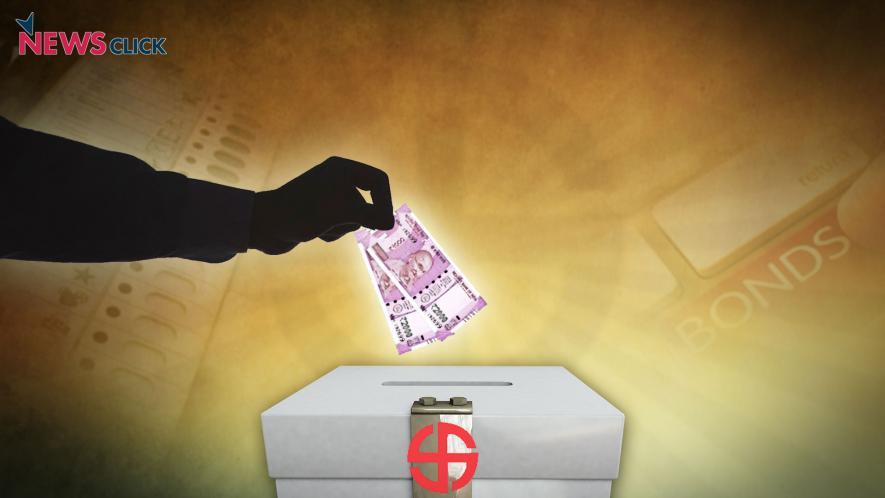
KOLKATA / NEW DELHI: Every election season, Indian voters are told that democracy is about choices. What they are rarely told is that these choices are shaped, long before polling day, by something far more decisive than public opinion: the flow of money into party coffers.
A report by the Association for Democratic Reforms (ADR), released on March 10, 2026, reveals the financial architecture that determines who can campaign, who gets heard, and who is drowned out.
The numbers are not merely unequal. They describe a different order of political existence. The Bharatiya Janata Party (BJP) — incumbent at the Centre — collected ₹62,680 crore in funds during the 2024 General Election cycle alone, more than twice the total collected by all other national parties combined. The All India Trinamool Congress, ruling West Bengal, received ₹17,054 crore in now-struck-down electoral bonds. The Indian National Congress drew ₹19,516 crore from the same source. The Communist Party of India (Marxist) received zero rupees from electoral bonds. Its total election fund collected across three general elections — 2014, 2019, 2024 — amounts to ₹1,828.8 crore. BJP's figure for the same period is ₹1,09,031 crore. The ratio is roughly 60:1.
The Electoral Bond Scandal
From March 2018 to January 2024, ₹1,63,080 crore in electoral bonds flowed into political party accounts through a scheme the Supreme Court of India would eventually declare unconstitutional. These were anonymous — a corporate house, a mining baron, a pharmaceutical company with pending government approvals could purchase bonds in any denomination and direct the money to any party, with no public disclosure required.
The ADR report documents what this produced: a system of institutionalised political corruption in which corporate donations purchased policy influence, regulatory indulgence, and government contracts.
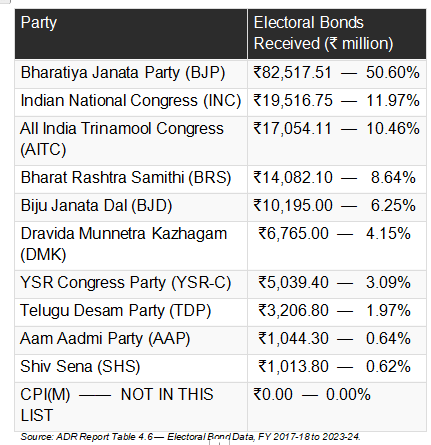
The top 10 recipients of this anonymous money reveal the stark hierarchy of Indian politics:
Investigative reports cited in the document found that companies raided by Central tax and enforcement agencies made large bond purchases — and that a majority of such donations went to ruling parties. Seven pharmaceutical companies that failed drug quality tests donated via bonds. At least 16 of the top 200 bond-purchasing firms were running at a loss for three consecutive years. The sectors most invested in anonymous political giving: mining, real estate, power generation, infrastructure contracting, pharmaceuticals, and the lottery industry. The report concludes this was not philanthropy. It was a market in political access.
The TMC's position in this hierarchy deserves particular scrutiny. The party that governs West Bengal — that controls the state's police, its panchayat system, its public sector employment, and its regulatory machinery — received the third-largest share of electoral bond money in the entire country.
At ₹17,054 crore, TMC’s bond haul exceeds the combined receipts of BJD, DMK, YSR-C, TDP, and AAP. For a party that frequently describes itself as a bulwark of the poor and the marginalised, the identity of its corporate benefactors — hidden by the bond scheme — would be among the most politically significant disclosures in Bengal's recent history.
A Decade of Explosive Growth: Who Got Left Behind?
The contrast between the two decades covered by the ADR report captures the transformation of Indian political finance after 2014. In the 10 years between FY 2004-05 and 2013-14, when Congress was in power, party incomes were unequal but not wildly so. INC declared ₹33,888 crore, BJP ₹23,022 crore. CPI(M), then still a significant parliamentary force, declared ₹7,691 crore — a meaningful third-place figure.
The decade after 2014 is a different country. BJP's income in FY 2014-15 to 2023-24 reaches ₹1,90,070 crore — 65.10% of all national party income. INC falls to 18.44%. And CPI(M), a party with a century of organisational history and mass roots in Kerala, Bengal, and Tripura, declares ₹13,386 crore — 4.58% of the total. Not a trivial sum, but a fraction of what is now required to run a competitive national campaign in a media environment saturated with paid political advertising.
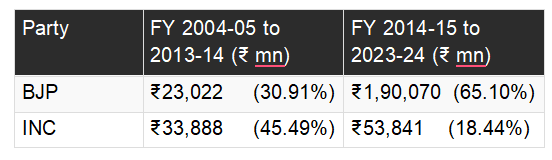
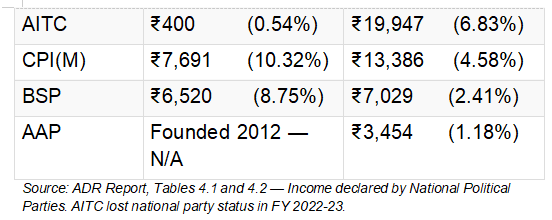
The CPI(M)'s absolute income did rise between the two decades — from ₹7,691 crore to ₹13,386 crore. But its share of the total collapsed from 10.32% to 4.58%. This is the mathematics of money power in elections: even holding your ground is losing ground when your political opponents multiply their resources.
The ADR report is explicit about the political consequence — the financing gap "exacerbated" by the electoral bond scheme creates a system in which smaller parties "may not have the funds to campaign in more than a few constituencies."
‘People's Money’: How CPI(M) Actually Funds Itself
The ideological contrast between the Left's funding model and that of its rivals is not incidental — it is structural, and it shows up in the data. The ADR report tracks what it calls 'unknown sources' of income: donations below ₹20,000 (where party does not need to disclose the donor), sale of coupons, contributions from meetings, and similar grassroots collections. These are the channels through which a party funded by workers, not boardrooms, raises money. The CPI(M)'s, which leads the Left Front in West Bengal, declared income from these 'unknown sources' over the period 2004 to 2024 amounts to ₹10,367.70 crore — 9.66% of the national total across major parties.
The figure is significant not because it is large, but because of what it represents. While BJP's unknown-source income (₹39,929 crore) and INC's (₹48,484 crore) are inflated by coupon sales and multiple small-denomination repeat donations from the same corporate sources exploiting the ₹20,000 threshold, CPI(M)'s equivalent figure is understood by political finance researchers to reflect genuine mass contributions: party levies on elected representatives who return a portion of their salaries to the party fund, membership fees, trade union collections, and small donations from supporters.
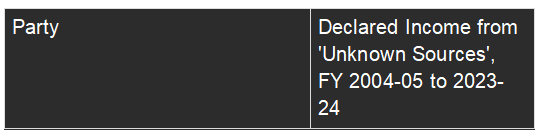
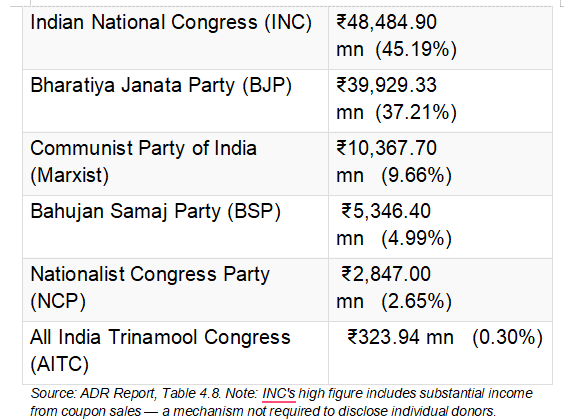
The ADR report notes that the ₹20,000 threshold for mandatory disclosure has been extensively gamed. A single corporate donor can write multiple cheques each below the threshold, effectively donating large sums without triggering disclosure. BSP has for 17 consecutive years declared receiving no donations above ₹20,000 — a statistical improbability that the report treats with visible scepticism. The report recommends slashing the threshold from ₹20,000 to ₹2,000. The Election Commission itself has made this recommendation.
For CPI(M), the “unknown source” figure has a different character from BJP or INC. The party says it has a constitutionally mandated internal discipline — elected representatives at all levels contribute a portion of their salary to the party, and this 'party levy' is one of the most distinctive features of Left party finance globally. This money does not come from mining companies or real estate developers. It comes from the salaries of municipal councillors, MLAs, and MPs — public servants who are required, by their own party's rules, to remain financially accountable to the organisation that fielded them.
Corporate Capture: Direct Donations & Quid Pro Quo
Electoral bonds were a most opaque route to corporate political donations, but not the only one. The ADR report tracks direct corporate donations and donations channelled through registered electoral trusts from FY 2013-14 to 2023-24. Here again, the hierarchy is severe. BJP received ₹66,076 crore in direct corporate donations — 84.65% of the total across national parties — and ₹27,615 crore through electoral trusts (71.67%).

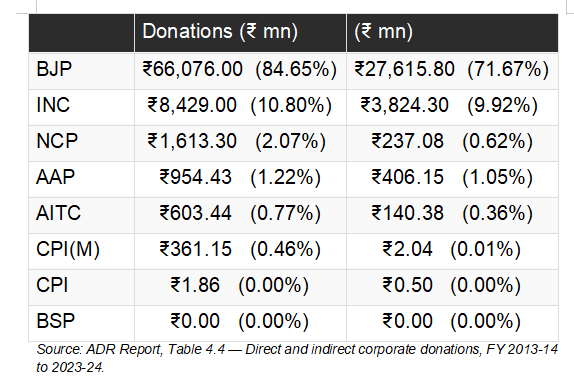
The ADR report is precise about what sectors drive these corporate donations: mining, real estate, power, infrastructure contracting, pharmaceuticals — every industry in which government approval, regulatory clearance, and contract award is a routine part of doing business. The report states plainly: "Big corporations voluntarily fund political parties, especially the government in power, to essentially use their clout to shape laws, policies, regulations and contracts in their favour. This exchange between corporates and political parties comes at the cost of public interest."
The CPI(M) says its corporate donation figure (₹361 crore direct, ₹2 crore via trusts over a decade) is consistent with the party's formal position of not soliciting corporate funds. As per the party, what little it receives in this category comes from smaller business contributions that fall within declared parameters, not from the conglomerate-scale giving that defines BJP's and, to a lesser extent, INC's financial base.
Campaign: 60:1 Ratio Defines Modern Indian Elections
Access to money determines not just whether a party can contest, but how it contests. The ADR report's compilation of funds collected and expenditure declared across the 2014, 2019, and 2024 General Elections reveals the full gulf between money-power politics and a mass organisation attempting to fight on a principled shoestring.
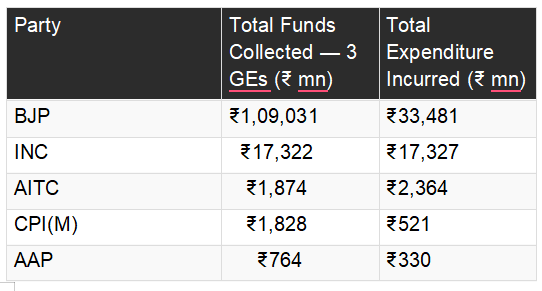

The BJP collected ₹62,680 crore in the 2024 General Election cycle alone — more than twice the combined collections of every other national party. CPI(M)'s collection for 2024, including simultaneous state elections in Andhra Pradesh and Odisha where it contests seats, was ₹627.5 crore. The BJP collected one hundred times this amount in a single electoral cycle.
The report notes with a caution that the declared expenditure figures understate reality. The EC’s own former chief has said that most winning candidates report only 40 to 80% of actual expenses. For BJP and TMC, with their vast infrastructure of paid campaign managers, digital war rooms, and surrogate advertising networks, the true spending gap is almost certainly wider than the declared figures suggest.
In 2024, CPI(M) declared a total election expenditure of ₹26.33 crore — 67 times less than BJP's declared spend of ₹1,778.70 crore. For context: BJP's declared spend on virtual and social media campaigns alone (₹187.69 crore) is more than seven times CPI(M)'s entire declared election budget.
Digital Battleground: BJP's ₹853 Cr Bengal Machine
The digital campaign finance data in the ADR report is where the story of political inequality in West Bengal becomes most concrete — and most disturbing. During the 2024 General Election, West Bengal was a primary target of the BJP's national digital advertising operation. CPI(M) was, by the numbers, almost completely absent from the digital battlefield.
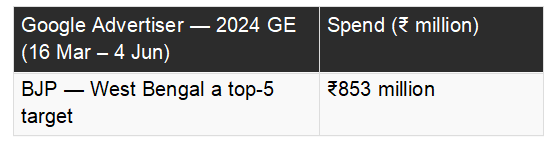
Between March 16 and June 4, 2024, the BJP spent ₹853 crore on political advertising across Google's platforms — the highest spend of any political advertiser in the country. West Bengal was listed among its top five target states alongside Maharashtra, Odisha, Uttar Pradesh, Delhi, and Telangana. The party ran 1,71,228 advertisements. 76.7% were video ads (₹654 crore); 23.3% were image ads (₹199 crore). Spending peaked in May — the crucial final stretch of the campaign.
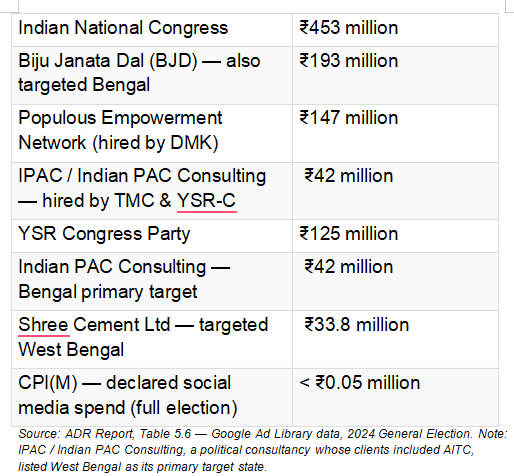
The Indian PAC Consulting Private Limited — a political consultancy firm with West Bengal as its primary digital advertising target — spent ₹42 crore on Google ads during the campaign period. The ADR report identifies this agency as having been hired by parties, including TMC and YSR-C. That a private agency, not the party itself, ran TMC's Google campaign is itself part of the opacity problem: such third-party spending does not always appear in parties' official expenditure declarations.
Even a cement manufacturing company — Shree Cement Limited — ran political advertisements on Google targeting West Bengal, among other states. A regulated industrial house with business interests that extend into government-approved construction projects had a stake, it appears, in the political outcome in Bengal.
The Facebook advertising data is, if anything, more revealing about the ecosystem of proxy and surrogate spending in West Bengal. The ADR report's analysis of the top 25 political advertisers on Facebook during the 2024 election period — covering March 8 to June 6 — includes a page that directly targets Bengali voters: 'Amaar Sonar Bangla' (My Golden Bengal), written in Bengali script in the report.
This page, identified as a third-party / proxy account in the ADR analysis, spent ₹74,96,469 on 170 political advertisements during the election period — placing it among the top 25 political Facebook spenders in the entire country. The page's official disclaimer does not list any registered political party. It lists 'Ulta Chashmaa' — an alias, not a legal entity. The ADR report's classification of pages with non-party disclaimers as proxy accounts points to a broader pattern: political parties run coordinated influence campaigns through accounts that are designed to escape ECI monitoring.
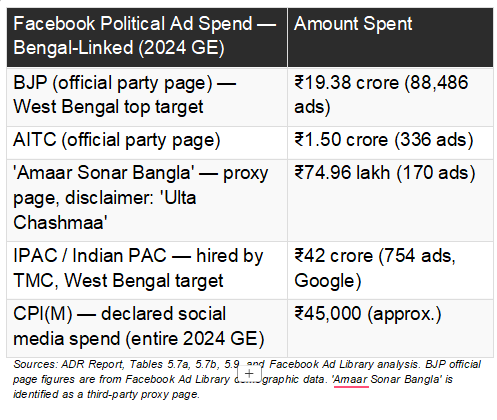
The ADR report also documents CPI(M)'s Facebook presence for the 2024 election: zero official party pages at the national level, zero proxy pages at the national level, five official candidate pages, and three proxy/supporter pages — a total of eight identified accounts, compared to BJP's 1,994 across official and proxy pages. The digital ecosystem of political influence is not a space CPI(M) can access at this financial scale.
TMC’s Data Spending Gap
The ADR report reserves some of its sharpest observations for the gap between what parties spend on digital campaigns and what they declare to the Election Commission. TMC's digital spending gap is one of the most egregious in the dataset.
In its official expenditure statement for the 2024 General Election, TMC declared zero rupees in its dedicated social media campaign column — a column the ECI specifically introduced in 2022 to capture this category of spend. Under all other expenditure heads combined, the party declared an estimated ₹59,000 in social media expenses.
The ADR cross-references this with Facebook Ad Library data, which shows that AITC spent ₹29.28 lakh (₹2.928 million) on Facebook advertising alone during the campaign period — approximately 50 times what it declared to the Election Commission. This figure does not include Google, YouTube, Instagram, WhatsApp, or the amounts paid to IPAC and other digital agencies on its behalf.
What This Kind of Money Means in Bengal
The financial data in the ADR report is national in scope, but its meaning is local. In West Bengal, where CPI(M) and other Left Front candidates are contesting constituencies in the 2026 Assembly elections, the money-power problem is not abstract. It is the cost of a mobile van, the number of wall paintings affordable, the capacity to run a ground-level voter outreach operation in 294 constituencies simultaneously.
A BJP candidate in a competitive Bengali constituency has access — through central party funds, state unit expenditures, Google and Facebook advertising operations, and the services of political consultancies — to a campaign infrastructure that CPI(M)'s says its entire national social media budget cannot match. The declared spending gap in 2024 alone was 67:1. The actual gap, once undeclared digital agency fees and surrogate advertising are factored in, is wider.
The 'Amaar Sonar Bangla' proxy page — spending ₹75 lakh on 170 Bengali-targeted political ads through an alias — is a small window into a much larger operation. The ADR report estimates that 19 proxy pages in the top-100 Facebook spenders nationally spent ₹190.29 crore on 14,982 ads. None of this appears in any party's official expenditure statement. None of it is monitored by the ECI. All of it targets voters.
For a party that has governed with a model of mass political participation — trade union mobilisation, door-to-door contact, public meetings in market squares, and a party levy system that makes its representatives financially accountable to working people rather than corporate donors — the financial environment of contemporary elections is a qualitatively different battlefield than the one in which Left politics was built.
Democracy for Sale?
The ADR report does not use the phrase 'democracy for sale.' But its data makes the argument. Among its central findings: more than 64% of funds collected by national parties since FY 2004-05 could not be traced to any identified source. The Electoral Bonds Scheme — now dead by Supreme Court order — enabled a system in which companies that failed regulatory inspections, were raided by enforcement agencies, or ran at a loss for years funnelled hundreds of crores to ruling parties. The ruling party at the Centre received 50.6% of all bond money. The ruling party in Bengal received 10.46%.
The report recommends a series of structural reforms: reducing the anonymous donation threshold from ₹20,000 to ₹2,000; introducing state or public funding of political parties tied to electoral performance and gender equity in candidate selection; capping online advertising spend; requiring full disclosure of all digital agency payments; and bringing third-party political advertisers within the ECI's regulatory purview.
None of these reforms are on the legislative agenda of either the BJP or the TMC. The parties that benefit most from the current opacity have the least incentive to dismantle it. The ADR report's data, in this sense, is also a map of democratic capture: those with the most money to hide are also those with the most power to prevent transparency from being enforced.
Note: All data cited in this article is drawn directly from the Association for Democratic Reforms (ADR) report 'Political Financing in India,' released March 10, 2026. ADR is a non-partisan electoral reform organisation. Figures cited for CPI(M)'s social media declarations are ADR's own estimates based on official ECI expenditure statements cross-referenced with ad library data. The characterisation of 'Amaar Sonar Bangla' as a proxy page is ADR's, not this reporter's.
Get the latest reports & analysis with people's perspective on Protests, movements & deep analytical videos, discussions of the current affairs in your Telegram app. Subscribe to NewsClick's Telegram channel & get Real-Time updates on stories, as they get published on our website.