





Africa Calls for Justice, Solidarity With Sudan
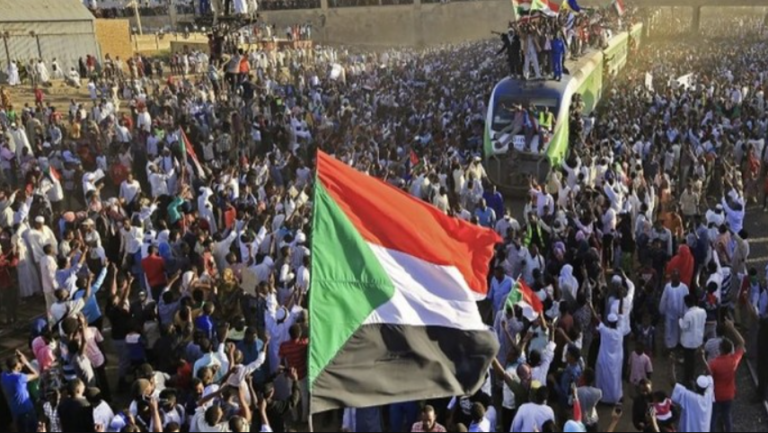
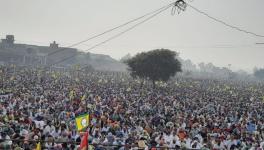
Protests in Sudan on the fourth anniversary of the Sudanese Revolution. Photo: Radio Dabanga
A recent webinar titled Stand with Sudan: An Urgent Call for Action and Solidarity, convened this week by Pan-African Today and the International Peoples’ Assembly, brought together leading Sudanese activists and intellectuals to discuss what is happening in Sudan and to amplify its call for solidarity.
For almost two hours, speakers Salih Mohammed Osman (Sudanese Communist Party, Central Committee), Mosaad Mohmed Ali (director, African Center for Justice and Peace Studies), and Dr. Amal Sidahmed (Sudanese Communist Party, Central Committee) outlined a grim but necessary analysis, one that cuts through the humanitarian issues to illuminate the political architecture of the violence engulfing Sudan.
They warned the conflict is being fueled by regional and global actors determined to fracture Sudan, seize its resources, and weaken the momentum of Africa’s fight for sovereignty at a time when imperialist aggression is intensifying worldwide.
The war in Sudan
Opening the discussion, Salih Mohammed Osman argued that Sudan today is witnessing “horrible, serious and heinous crimes, crimes against humanity and war crimes that demand immediate intervention from the AU, IGAD, and the United Nations.”
Osman emphasized four urgent priorities that should be adopted:
- Protection of civilians
- Stopping the war and all hostilities
- Addressing the severe humanitarian crisis
- Implementing justice and accountability
Reminding people that the genocide, which began in Darfur in 2003, was not only neglected but intentionally forgotten. Today, history is repeating itself with greater ferocity:
- 1.6 million Sudanese have been forced into displacement
- 2.6 million people face severe hunger and starvation
Drones and heavy weaponry are shelling entire neighborhoods as satellite images from El-Fasher show piles of human bodies.
Osman also notes that both the SAF and RSF are responsible for mass atrocities. But they are not the root cause.
“They are tools,” he said, “used by geopolitical forces that see Sudan’s fertile land, minerals, and especially gold as strategic prizes.”
Sudan’s tragedy, he continued, cannot be understood outside its colonial past. Independence in 1956 was incomplete, and Sudanese people have continued to confront dictatorships and external interference, defeating them in 1964, 1985, and again in 2019.
“Former colonial powers and their modern counterparts are responsible for fueling this war.”
What Sudan needs, he concluded, is internationalist solidarity, especially from African progressive movements, to defeat the internal and external alliance tearing the country apart and restore a democratic, people-led authority.
A war on women
Dr. Amal Sidahmed spoke on the gendered architecture of the war. Her intervention also coincided with the global 16 Days of Activism Against Gender-Based Violence, arguing that women and girls are facing “the worst conditions anywhere in the world”. Her message was sharp; the war is not only a class struggle, but simultaneously a gender struggle.
What distinguishes Sudan’s gendered violence, she noted, is that rape and forced pregnancy are being deliberately used as tools of genocide, not merely weapons of war.
RSF units and other armed groups believe that erasing certain ethnicities can be achieved through forced reproduction and sexual terror.
“This reflects ignorance, yes,” she said, “but it is also a conscious political project of ethnic destruction.”
Women are being killed, tortured, enslaved, and disappeared; subjected to forced pregnancies intended to “eliminate” certain tribes; threatened into silence along with their families; burdened with harsh labor, childcare, and survival roles as men are killed, targeted, or vanished; and further devastated by the collapse of health systems and widespread famine.
Sidahmed insisted:
“There is no solution except ceasefire and justice. Recycling perpetrators into the government is a recycling of war.”
She warned that Africa is entering a new phase of imperial extraction; not classic colonialism through armies, but corporate colonization with international companies taking resources while leaving Africans only with raw materials and no development.
Real liberation, she concluded, demands political and economic independence, ground-up organizing, women-led grassroots mobilization, and a united continental struggle against imperialism.
Human rights violations
Mosaad Mohmed Ali placed Sudan’s current catastrophe within a long historical pattern of authoritarianism, military coups, and systemic repression. Sudan, he noted, has never experienced a sustained democratic government; freedom of association, expression, and political organization has been consistently denied; torture, the long-term imprisonment of activists, and the banning of political parties have been routine; and mass atrocities that were once confined to regions such as Darfur have now engulfed the entire country.
Crucially, he added, civilian infrastructure is being targeted deliberately, including hospitals and schools, collapsing the social fabric and ensuring long-term societal trauma.
It also highlighted the regional dimension, noting that Kenya, the UAE, and other African and Gulf states have played troubling roles in supporting the RSF.
Throughout the webinar, speakers and participants tied Sudan’s crisis to a broader global context in which imperialist powers are accelerating military aggression and resource extraction. Whether in Palestine, Congo, or Venezuela, noting the deployment of US personnel in the Southern Caribbean, Washington’s drive to secure strategic resources, and the mounting threats of engineered destabilization. Sudan, they argued, is another front in this same geopolitical scramble. “The resource curse,” but, “is not a curse of Africa’s making; it is the curse of Western greed, imposed through war, plunder, and manufactured instability.”
A call for renewed solidarity on the African continent
Speakers and participants closed by reiterating that Africa’s national liberation project remains painfully incomplete. Across the continent, from Sudan to the Sahel, to the DRC, conflicts are being inflamed by foreign powers, while women and children continue to bear the heaviest burden of suffering. The webinar’s message was unequivocal:
- The war in Sudan is an organized counter-revolution
- The crimes underway are genocidal
- The perpetrators include internal armed factions and external imperial forces
- Women are at the heart of both the suffering and the resistance
Africa must unite to demand a ceasefire, civilian protection, accountability, and a democratic political transition. Above all, the speakers insisted the world, and especially progressive forces across the African continent must stand with Sudan with political clarity, historical understanding, and revolutionary solidarity.
Courtesy: Peoples Dispatch
Get the latest reports & analysis with people's perspective on Protests, movements & deep analytical videos, discussions of the current affairs in your Telegram app. Subscribe to NewsClick's Telegram channel & get Real-Time updates on stories, as they get published on our website.