





The Absurdity of World Trade Arrangements
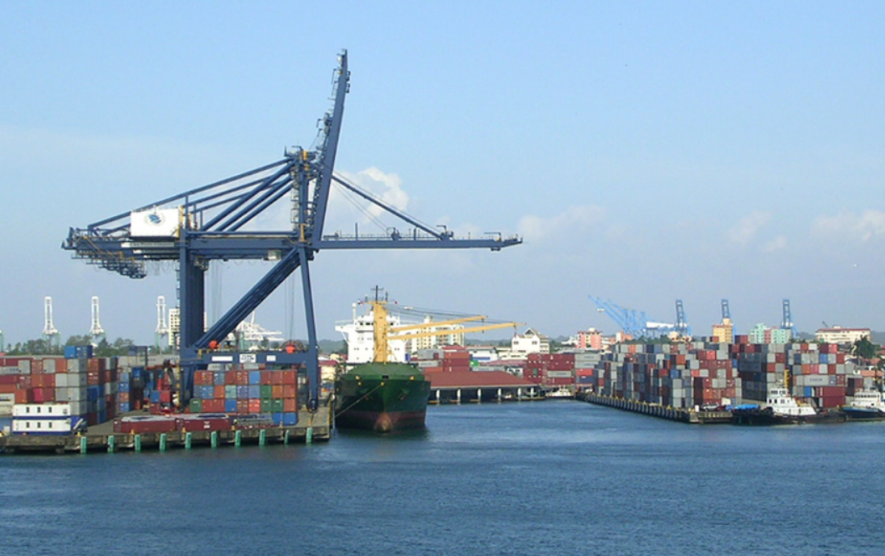
Representational use only.Image Courtesy: Wikimedia Commons
Consider a very simple picture, of a world in which there are only two countries that are engaged in trade. One of the two has a current account surplus while the other, by definition, has an identical current account deficit. It is reasonable to assume that since the surplus country is obviously more successful as an international competitor, it would be close to full capacity-use in a regime of free trade, while the deficit country that is weaker in its competitiveness would have much larger unutilised capacity.
Now, suppose the surplus country enlarges its domestic absorption of goods by increasing, say, the consumption of its workers; since it does not have much unutilised capacity, this larger absorption would entail a reduction in its exports and hence in its current account surplus. Since its surplus must be identical with the deficit of the other country, a reduction in it must mean a reduction in the second country’s current account deficit.
The mechanism through which this would occur is the following: as exports of the surplus country into the deficit country get reduced, the domestic producers in the latter can now get access to larger domestic markets, and hence produce more by utilising their unused capacity. The output, employment, and hence domestic consumption in the deficit country, therefore, will increase as a consequence of an increase in workers’ consumption in the surplus country.
Put differently, if the surplus country is forced to “adjust”, that is remove the current account imbalance between the two countries, then taking the world as a whole (which in the present case consists of only two countries), there will be larger output, employment and consumption, even as the current account imbalances are removed.
It stands to reason, therefore, that the removal of current account imbalances must be sought through “adjustments” by the surplus country, since it leads to a better outcome for all concerned.
The current international trading arrangement, however, is just the opposite of this: it forces not the surplus country but the deficit country to make the adjustment by reducing its domestic absorption of goods and services. The argument here is that a reduction in domestic demand in the deficit country will mean a reduction not just in its domestic output but also in its imports, which would reduce its current account deficit (and ipso facto the current account surplus of the first country) and thereby achieve the desired adjustment. In the process, however, demand in the world economy goes down, and with it, world output and employment; and needless to say, the level of consumption in the world economy gets reduced by such adjustment.
We thus have two possible ways in which adjustment to eliminate current account imbalances can be made: if the surplus country is made to adjust then world output, employment and consumption increases, while if the deficit country is made to adjust, then world output, employment and consumption falls.
The rise in world consumption incidentally must occur in the first case, even if the increase in domestic absorption in the surplus country is not effected through a rise in workers’ consumption; since the output and employment in the deficit country increases, total world wage-bill and world consumption increases, no matter how the surplus economy increases its domestic absorption.
Amazingly, however, the world trading arrangements are such that the inferior mode of adjustment is carried out whenever there are imbalances, and not the superior mode of adjustment. This is the irrationality of the world trading arrangements under which we live.
When the Bretton Woods system was being set up in 1944, economist John Maynard Keynes had mooted the idea of making surplus countries also undertake some adjustment. But the US those days was an economy with a persistent current account surplus and opposed the idea of making surplus economies undertake adjustment: it preferred holding claims on other countries which gave it power over them, compared to increasing domestic absorption, the most obvious way of doing so being by raising workers’ consumption. A capitalist economy in any case would scarcely prioritise raising workers’ consumption.
Much, of course, has changed since 1944 when the Bretton Woods conference was held; the US which had been a surplus country then and for a long time after the war, started posting persistent current account deficits from the mid-1970s. Why, it may be wondered, did the US not start asking for adjustment by surplus countries when it stopped having surpluses itself?
There are three obvious reasons one can cite why it did not do so. First, having a deficit is something that the “leader” of the capitalist world would have to accept as part of the duties of “leadership”; for instance, the “leader” has to maintain a string of military bases around the world for its counter-revolutionary activities, which entail incurring expenditures abroad and hence a current account deficit. The US, therefore, was not unduly shocked or surprised by the current account deficits it started experiencing.
Second, since the US dollar played the role of being de facto “world money” which the rest of the world was willing to hold in almost unlimited amounts, the US had no problems in financing its deficit by making dollars (and dollar-denominated assets) available to surplus countries, and hence felt no need for any adjustment on its part or on the part of the surplus countries, at least no urgent need for any adjustment.
Third, much of the exports being made to the US by the surplus countries, in East Asia for instance, were produced by American capital itself relocating its manufacturing activities to these countries. Insisting on a reduction in the surplus of these countries therefore might mean hurting the interests of American capital which obviously no US administration would do unless urgently required.
For all these reasons, despite the changed international situation that saw the US incurring persistent current account deficits, there was no immediate demand on the part of the US to bring about any change in the world trading arrangements.
The US was content to let dollars and dollar-denominated assets pour into the world economy as the means of settling its current account deficit. Matters, however, have taken a different turn of late. With China moving away from holding dollar foreign exchange reserves, and with the threat of de-dollarisation looming on the horizon (however distant that threat may be as yet), the US now feels the need to reduce its current account deficit; but it is not concerned with altering the world trading arrangements in a way that would benefit the world economy as a whole. The recent Trump measures testify to that.
The Trump measures are not meant to overcome the irrationality of the world trading arrangement that we discussed above; they are meant only to ensure that the US does not suffer from its deficit position, that it overcomes its predicament of being a deficit country without making the usual adjustment involving a reduction in its domestic demand that a deficit country is supposed to do. Indeed, on the contrary the Trump measures are meant to reduce the US deficit even while increasing its domestic output and employment. Let us see how.
The two basic weapons used by Trump are: punitive tariffs, and unequal trade treaties imposed on trading partners (of which India is the first instance); these unequal treaties stipulate the exact amounts that a country is supposed to import from the US (without stipulating anything in the opposite direction). In fact, punitive tariffs are used as the punishment inflicted on any country that does not accept the unequal treaty; and countries accept the unequal treaty as the lesser of the two evils.
As the trade deficit narrows through such coercive means, the demand for domestic goods increases within the US and hence domestic output and employment too. But this does not amount to any alternative trading arrangement for the world economy as a whole that would be universally beneficial and hence constitute an embodiment of rationality. It is the US holding a gun to the heads of countries and insisting on a favourable deal for itself.
In fact, with a better deal for itself, it will join with even greater gusto in enforcing the irrational world trade arrangement that forces deficit countries to undertake adjustments, an irrational arrangement that the US itself had been instrumental in imposing on the world.
Prabhat Patnaik is Professor Emeritus, Centre for Economic Studies and Planning, Jawaharlal Nehru University, New Delhi. The views are personal.
Get the latest reports & analysis with people's perspective on Protests, movements & deep analytical videos, discussions of the current affairs in your Telegram app. Subscribe to NewsClick's Telegram channel & get Real-Time updates on stories, as they get published on our website.