





Watching Homebound (2025): A Heartfelt Experience

Image Courtesy: Wikipedia
There’s a certain convenience in allowing ourselves to be carried away by everyday stream of events around us, focusing only on what stands at our doorstep. Perhaps we shy away from burdening the mind, since deep thinking is never easy. But no society has ever truly moved forward by ignoring the weight of its past. Memory – personal and collective – connects us to the experiences that shape who we are. Films and literature are among the vehicles capable of carrying us not just into the future, but back into that difficult, necessary time and terrain.
Homebound (2025) is one such film. It is a story that compels us to look back – at what we’ve done, what we’ve ignored, and what we’ve allowed to happen.
I want to begin by acknowledging the writers’ team, including Basharat Peer, whose writing sensibilities I admire the most, and the director and producers who chose to tell this story. They did so knowing well that it might not fit the dominant tastes of an audience often intoxicated by hollow displays of chauvinism. Yet they told it with all honesty, and for that, I remain beholden.
I lay no particular claim to expertise in matters of craft or technique. What moved me the most or what left me sobbing alone while watching it – was the validity of the story itself – the raw, unflinching material of lives caught in the machinery of a society fractured by caste, community, and indifference.
Homebound unfolds against the backdrop of the COVID-19 lockdown, but its roots go much deeper. It is a film about two young men, Shoaib Ali and Chandan Kumar, whose bond of friendship becomes a quiet rebellion against the worlds that seek to weaken them.
Shoaib is a Muslim, who loves his people, his soil, his dosti, his neighbourhood – Hindus and Muslims living like perfect neighbours, not rivals. Yet, he is constantly made to feel like an outsider in his own land. Chandan is Dalit and carries the burden of an identity he often tries to hide, knowing that even his dreams will be measured against the prejudice of a society that reduces him to a category box on the application form. Both aspire to become police officers, not out of a hunger for power, but for something more fundamental, that is, respect, which they never had in a prejudiced social milieu.
Their journey is marked by many piercing moments. The scene where they check their police exam results at a computer room is one of the most tender and natural in the film. But delays, corruption, and the casual cruelty of caste – like the police officer who demands to know Chandan’s full name, caste, and gotra – and most importantly, the material circumstances slowly pull them apart from their aspirations. When Shoaib’s father falls ill, the pressure to leave for Dubai grows. Yet Shoaib’s love for his home, his family, his dosti (friendship) and his surroundings holds him back. He finds work as a waiter and turns into a temporary salesman, only to be mocked by his seniors at a dinner party during an India-Pakistan cricket match. His true patriotism, genuine and unassuming, is twisted into something foreign. He resists and resigns in anger and disappointment even though he needed this job like blood needs veins.
Eventually, Shoaib reunites with Chandan in Surat, working in a cloth mill. This reunion was so painful, so natural and so lived – and the acting performance was truly sublime that I was intensely touched by the writers’ abilities to feel and actors’ abilities to perform (especially actor Ishaan Khatter as Shoaib Ali and Vishal Jethwa as Chandan). Their felt-acting was deeply natural and naturally humane.
In the harshness of their lives, there is a fragile dignity. They send every single penny of their small incomes home – Chandan to build a pucca house, Shoaib to pay off his father’s treatment loan. But then the hasty lockdown comes – one after another. And with it, the heartless collapse of everything (health, home and hope) they had begun to build.
The film does not shy away from the horrors of that time. We see migrant workers beaten by police, turned away from ration shops and stranded on roads and highways which was actually a common sight then. A “Special train” could not accommodate them to their home places in North India. The two friends manage to pay an unaffordable amount of fare to a truck driver heading to their state, but while on the way, Chandan catches a cold and begins to cough – certainly not due to any “corona-forona”, as Shoaib said, and requests and insists the driver carry them in their truck, but the fear of getting infected still turns fellow passengers into persecutors. Both are forced off the lorry, hundreds of kilometres still away from home.
In the scorching heat, without food, water and rest, Chandan weakens. Mid-way, villagers stone them, afraid of the virus, when they go there in search of some water. Only an elderly woman, moved by compassion, offers some. Shoaib carries Chandan and their luggage on his back for miles, walking until Chandan dies on the highway. Shoaib cries for help desperately, but the ambulance arrives only after Chandan is dead.
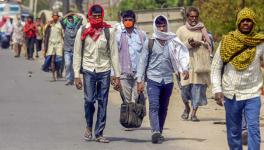
This scene is so emotional and makes me numb and reminds me of all those real stories – both written and unwritten – experiences of millions of such migrant workers who were left uncared for by the owners of their mills, factories, companies and all kinds of private small and big businesses in big cities. They found no facilities of transportation, and millions were forced to journey back to their homes in north India – thousands of miles – on foot in the scorching heat. Pregnant women, ailing and ageing men and women and kids became the victims. Many died of sunstroke, many of hunger and thirst – and never reached their homes. It was horrific.
Homebound is not just a story of loss. It is also a story of love. And no surprise that it is said to be inspired by a true story of Mohammad Saiyub, 22, and Amrit Kumar, 24, who grew up together in the small village of Devari in Basti, Uttar Pradesh, and who, despite thorny social barriers, formed an exemplary humane bond since childhood.
In this film, the friendship between Shoaib and Chandan is mirrored by their families—Hindu and Muslim, or more specifically Dalit and Muslim—who share food, festivals, and grief without hesitation. On Eid, Chandan walks into Shoaib’s house and eats biryani as if it were his own. Shoaib’s mother watches with quiet affection.
In a society that so often weaponises difference, these families remind us of what we once were and could still be. These scenes shame us. They hold a mirror to a bigoted social structure saying that look, ‘this is how to live, this is whom to care for’. Meaning, this is what to invest in – social relations, and, this is what to resist – I mean, bigotry or rising intolerance.
The film also shows us Chandan’s mother, a mid-day meal worker, whose cooking is loved by everyone, until upper-caste parents demand her removal because of her caste status. And Vaishali, Chandan’s sister, sharp and passionate, who never got the chance to study because the family’s limited resources went to her brother. She supports him anyway. And Sudha, a Dalit girl who tells Chandan to aim higher than the police – to dream of the UPSC, of becoming an officer who commands the respect he craves.
In one of the most heart-breaking scenes, after Chandan’s tragic death, Shoaib looks through his bag and finds two filled-out college application forms: one for Chandan, one for Shoaib. Chandan had also, for the first time, written his full name—Chandan Kumar Valmiki—and ticked the box for SC category which he used to hide earlier. He had perhaps begun to hope. I think the film does not give us easy closing, rather it gives us grief and questions that we need to ask that how did Chandan’s mother make us feel when she received the body of her beloved son wrapped up in white? What did Vaishali’s sacrifice do to us emotionally? And why does Sudha’s advice really matter not just to film’s larger point but also to Chandan’s, Shoaib’s and her own life’s greater goal? I’m still thinking and searching for the answers.
Homebound gives us an ideal humanist vision alongside a brutal account of social tensions and systemic failure. It shows us what compassion looks like – in the bond between two friends, in the harmony between families, in the quiet courage of an old woman offering water. But it also shows us what apathy – social, political and administrative – costs. We saw lives that were lost. Dreams shattered and the bloody “dignity” denied.
I don’t know whether to measure a film’s worth in crores. What I am sure is that this film cannot be viewed from the angle of its financial success. It’s far greater and superior than most others of our times. It is not unknown that Homebound (2025) earned very little; on the other hand, some films built on hollow, violent spectacle cross a thousand crores. This tells me something about what we as a society choose to see and what we choose to ignore. Are we ashamed of that? But I am also beholden that this film exists – that its writers, its director, its producers, and its actors chose to tell this story anyway, without worrying much about the size of the audience or box-office returns.
The acting, as I previously said, is remarkable. Ishaan Khatter as Shoaib delivers a performance of quiet, felt intensity. He delivered such a marvellous performance. Vishal Jethwa as Chandan brings a heartbreaking vulnerability. Janhavi Kapoor as Sudha, Shalini Vista as Chandan’s mother, Sudipta Saxena as Shoaib’s mother, Harshika Parmar as Vaishali—each of them is so natural, so real, that they stayed with me.
In recent decades, the Hindi film industry seems to be infected by all kinds of trashy propaganda stuff that has counter-effects on the popular beliefs/opinions of the people, and such movies are certainly unneeded in a sense that they don’t empower and humanise their audience; they enslave and make them violent. But Homebound is the opposite. It stays true to the emotional heart of the real story while sharpening its moments to highlight caste, class inequalities, communal bigotry, human vulnerability, administrative apathy, and, of course on friendship. It remains with me. The story and the performance both moved me to that extent. And I hope that, somehow, sane people find their way to watch it. Because stories like this – honest, difficult, compassionate – are not just worth watching. They are much-required efforts to humanise and civilise. Therefore, we can’t afford to ignore it.
The writer teaches literature in English in Dehradun, Uttarakhand. The views are personal.
Get the latest reports & analysis with people's perspective on Protests, movements & deep analytical videos, discussions of the current affairs in your Telegram app. Subscribe to NewsClick's Telegram channel & get Real-Time updates on stories, as they get published on our website.