





War in West Asia at a Dangerous Turning Point
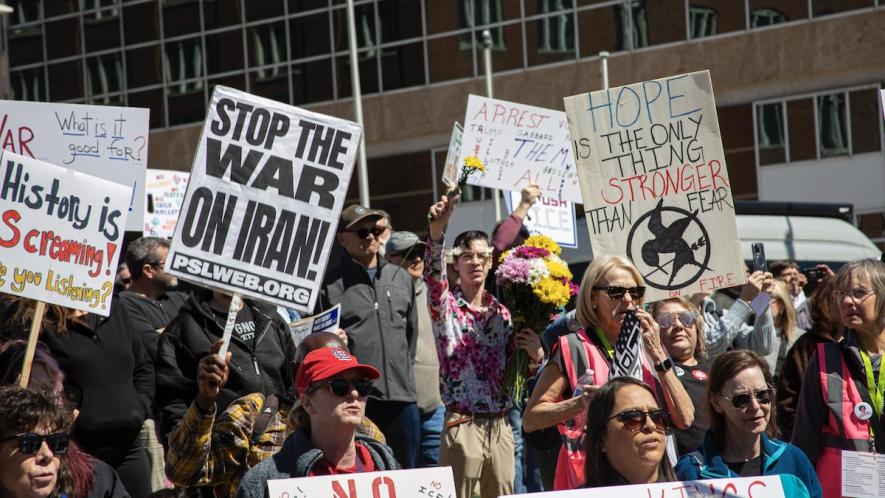
No Kings Day protest in St. Louis. Photo: PSL
The war in West Asia has entered a perilous phase, marked by intensifying geopolitical rivalries, deepening energy insecurities, and the visible fragmentation of the existing global order. What initially appeared to be a regional confrontation, has rapidly evolved into a multidimensional crisis with far-reaching global implications. The convergence of military escalation, economic disruption, and ideological contestation suggests not merely a transient conflict, but a structural turning point in contemporary international relations.
Recent remarks attributed to Italy’s Defence Minister — who reportedly confessed to sleepless nights under the shadow of impending war — encapsulate a broader anxiety permeating Europe. This unease reflects not only the fear of direct military confrontation but also the recognition that the continent stands at the intersection of competing global forces.
The United States’ efforts to mobilise European allies for direct military engagement against Iran have, however, exposed significant fissures within the Western alliance. Germany, the United Kingdom, France, and Italy have exhibited reluctance to participate in ground operations, while Spain’s refusal to permit the use of its airspace for American military logistics underscores a growing divergence in strategic priorities.
This emerging disunity within the Western bloc coincides with an acute energy crisis that has rendered Europe particularly vulnerable. The disruption of Russian oil and gas supplies, coupled with instability in the Gulf region—encompassing major producers such as Qatar, Oman, the United Arab Emirates, Bahrain, Kuwait, and Saudi Arabia—has precipitated an unprecedented strain on global energy markets. The resulting volatility has exposed the structural dependence of European economies on external energy sources, pushing them toward a precarious economic threshold.
The strategic significance of the Strait of Hormuz has further amplified these tensions. As a critical artery for global oil transportation, any disruption in this narrow maritime corridor carries profound implications for the world economy. Iran’s asserted control over this passage, accompanied by restrictions on maritime movement, has heightened fears of a sustained supply shock. In such a scenario, rising energy prices, inflationary pressures, and industrial contraction are not speculative possibilities but immediate realities with cascading global consequences.
Parallel to these economic disruptions, the militarisation of the crisis has accelerated dramatically. Russia’s nuclear preparedness, including the operational readiness of its strategic arsenal and the deployment of submarines in key maritime zones, underscores the gravity of the situation.
The potential involvement of additional actors, notably North Korea, further complicates the geopolitical landscape. The alignment of China, Russia, and North Korea in extending strategic support to Iran signals the consolidation of an alternative axis of power, one that challenges the longstanding dominance of the US.
China’s posture, in particular, reflects a broader strategic recalibration. Its explicit commitment to safeguarding Iran underscores its expanding role in shaping a multipolar world order. This stance is informed not only by considerations of regional influence but also by long-term imperatives related to energy security and global governance. The increasing coordination among these states indicates that the conflict has transcended regional boundaries, evolving into a contest over the future architecture of global power.
Beyond West Asia, the crisis has manifested in other geopolitical theatres, including the Western Hemisphere. Allegations concerning US interventions in countries, such as Cuba and Venezuela—ranging from infrastructural disruptions to the assertion of control over natural resources—highlight the persistence of interventionist strategies. The reported consequences, including disruptions to essential services and widespread public protests, illustrate the interconnected nature of contemporary geopolitical conflicts, where actions in one region reverberate across the globe.
Domestic developments within the US further complicate the situation. Large-scale protests across numerous cities, with millions reportedly demanding the resignation of Donald Trump, indicate a deepening internal polarisation. Such dissent raises fundamental questions regarding the sustainability of an assertive foreign policy in the face of significant domestic opposition. The intersection of internal unrest and external aggression creates a volatile dynamic that may influence future policy trajectories.
Warnings that the world may be approaching the brink of a third global conflict reflect a broader apprehension shared by policymakers and analysts alike. The prospect of nuclear escalation, though often treated as a remote contingency, cannot be entirely discounted in an environment characterised by heightened tensions and reduced avenues for diplomatic engagement. The catastrophic implications of such an eventuality would extend beyond national boundaries, posing an existential threat to humanity.
In this context, the earlier pronouncements of Vladimir Putin acquire renewed significance. His critique of Western dominance—rooted in a historical trajectory of imperial expansion and consolidated in the post-World War II era—resonates with an emerging discourse within the Global South. This perspective frames the current crisis as part of a broader struggle against entrenched systems of economic and political hegemony.
The role of emerging economies is central to this evolving narrative. The BRICS grouping, comprising Brazil, Russia, India, China, and South Africa, alongside institutions such as the Shanghai Cooperation Organisation, represents an alternative framework for international cooperation. These formations increasingly function as counterweights to Western-led institutions, advocating for a more equitable and multipolar global order. The inclusion of countries, such as Iran and Venezuela, within these broader alignments further illustrates the shifting contours of global power.
At the structural level, the crisis underscores enduring features of the global system: the dominance of the dollar and euro, the strategic control of natural resources, and the deployment of economic sanctions as instruments of geopolitical influence. Critics argue that these mechanisms perpetuate systemic inequalities and constrain the developmental trajectories of weaker nations. Consequently, the present conflict may be understood not only as a geopolitical confrontation but also as a manifestation of deeper structural contradictions within global capitalism.
The economic dimension of this confrontation is particularly salient. Sanctions, trade restrictions, and financial pressures have emerged as central tools of contemporary statecraft. However, their efficacy is increasingly contested, especially in light of the gradual emergence of alternative financial architectures. Efforts toward de-dollarisation, the expansion of regional trade agreements, and the development of independent payment systems signal a slow but discernible transformation in the global economic order.
Nevertheless, the transition toward a multipolar system is inherently fraught with uncertainty. Historical experience suggests that shifts in the distribution of power are often accompanied by periods of instability and conflict. The current crisis exemplifies these dynamics, wherein miscalculations and unintended escalations can produce disproportionate consequences. The interplay between military confrontation and economic competition creates a highly volatile environment, characterised by limited margins for strategic error.
Within this broader context, the role of transnational corporate power assumes critical importance. As Vladimir Lenin observed, the export of capital constitutes a defining feature of advanced capitalism, facilitating its expansion beyond national boundaries. Similarly, Karl Marx conceptualised capital as a system driven by the relentless extraction of surplus value. In the contemporary era, these theoretical insights find concrete expression in the operations of global corporate entities.
Major corporations such as Comcast Corporation, Amazon, State Street Corporation, Vanguard Group, and BlackRock exemplify the concentration of economic power characteristic of contemporary capitalism. Their influence extends across media, digital infrastructure, and global finance, enabling them to shape not only markets but also political and ideological processes. This concentration of power reinforces existing hierarchies and contributes to the persistence of global inequalities.
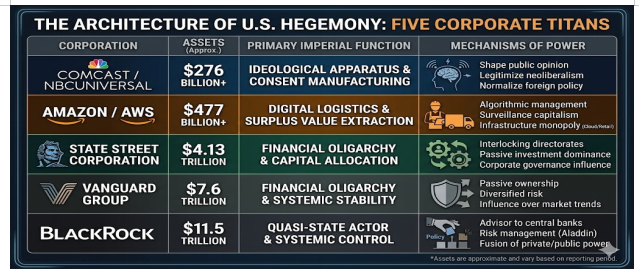
The structural logic of this system is further sustained by interconnected mechanisms, including the energy sector, the military-industrial complex, and the dominance of global financial institutions. Together, these elements constitute the institutional architecture of contemporary hegemony, facilitating the projection of power across multiple domains.
In parallel, similar patterns of capital concentration are observable in emerging economies such as India. Corporate conglomerates have increasingly consolidated their influence over key sectors, including infrastructure, media, and finance. This process has been accompanied by rising economic inequality, reflecting broader global trends. The alignment between state policy and corporate interests has given rise to a form of crony capitalism, wherein public institutions are often subordinated to private capital.
Yet, the intensification of these contradictions also generates conditions for potential transformation. As Marxist theory suggests, the concentration of wealth and the expansion of inequality create the material basis for systemic change. Whether such change will manifest through reform or more radical restructuring remains an open question.
At this critical juncture, the global system stands at a crossroads. The trajectory of the ongoing crisis will depend on the capacity of states to navigate complex and interdependent challenges with prudence and foresight. Escalation may lead to catastrophic outcomes, while constructive engagement could open pathways toward a more stable and inclusive order.
Ultimately, the present moment demands a reassessment of prevailing paradigms of power, security, and development. The war in West Asia, in its current form, is not merely a regional conflict; it is a reflection of deeper transformations within the global system. Its resolution—or further escalation—will shape the contours of the emerging world order and determine the prospects for peace, stability, and human progress in the years to come.
The writer, an economics professor and author, is currently engaged in research on Sustainable Economic Development, Political Economy of the Global South, and India’s Socioeconomic Crisis. The views are personal. acpuum@gmail.com.
Get the latest reports & analysis with people's perspective on Protests, movements & deep analytical videos, discussions of the current affairs in your Telegram app. Subscribe to NewsClick's Telegram channel & get Real-Time updates on stories, as they get published on our website.