





UGC Equity Rules: SC Stay Triggers Nationwide Student Outrage
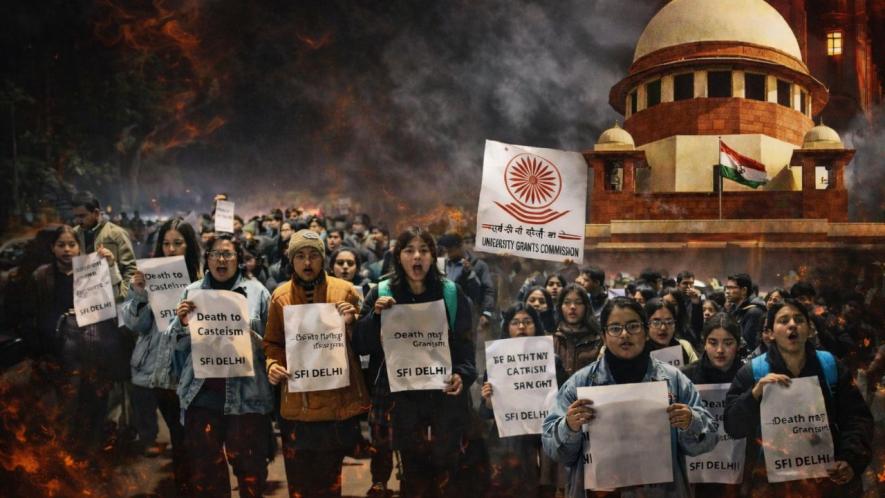
New Delhi: In what many student organisations, social justice advocates and legal scholars are calling a “deeply regressive moment” for Indian higher education, the Supreme Court on Thursday imposed an interim stay on the University Grants Commission (Promotion of Equity in Higher Education Institutions) Regulations, 2026. The stay has triggered protests across campuses, particularly in Delhi University, and reopened fundamental questions about caste discrimination, and the judiciary’s approach to social justice.
The apex court’s intervention has effectively halted the implementation of regulations that were intended—however imperfectly—to address caste-based, gender-based, and disability-based discrimination in universities and colleges.
For critics, the episode represents a familiar pattern: symbolic gestures toward social justice followed by capitulation to the entrenched privileged sections. As one student protester put it, “This is the politics of ‘heads I win, tails I win’—rules are announced, and then quietly buried.”
What Were UGC Equity Regulations, 2026?
On January 13, 2026, the UGC notified the Promotion of Equity in Higher Education Institutions Regulations, 2026, which were deemed to have come into force from January 15. These regulations were meant to replace the 2012 UGC guidelines on preventing discrimination in higher education institutions.
The stated objective of the new regulations was to curb discrimination on the basis of: caste, religion, gender, place of birth, and disability.
The constitution of Equity Committees in universities, mechanisms for grievance redressal, and institutional responsibility to prevent discriminatory practices on campus was proposed.
Importantly, these regulations did not emerge in a vacuum. They were the outcome of years of sustained struggles by students, teachers, and families of victims of institutional discrimination—most notably following the death of research scholar Rohith Vemula at the University of Hyderabad and the death of Dr Payal Tadvi. The demand for a comprehensive Rohith Vemula Act to address caste discrimination in higher education has been central to these movements.
Ironically, even before the SC stay, many progressive scholars and student organisations had criticised the 2026 regulations as inadequate and diluted. They argued that the rules lacked enforceable punitive provisions, failed to guarantee independence of complaint committees, and excluded premier institutions, such as IITs, IIMs, and private universities from their ambit.
Yet, despite being widely viewed as weak and insufficient, the regulations provoked fierce opposition from groups identifying themselves as defenders of “merit” and “academic freedom”—a rhetoric long associated with upper-caste privilege in Indian higher education.
SC Stay: What Did the Court Say?
According to LiveLaw, a bench comprising Chief Justice of India Justice Surya Kant and Justice Joymalya Bagchi took up the matter for urgent hearing on January 29, 2026. The court imposed an interim stay on the regulations and raised a series of questions directed at the UGC and the Union government.
Among the key observations and questions recorded by LiveLaw were: Why is caste-based discrimination defined separately, when the definition of discrimination already covers multiple grounds? Are the provisions sufficiently clear, or do they risk misuse and arbitrariness? Could the regulations, if improperly implemented, deepen social divisions rather than reduce discrimination? Why was ragging not explicitly included, given that it remains a serious problem on campuses?
The SC directed the Centre and UGC to file detailed responses and asked UGC to consider redrafting the regulations. It fixed the next date of hearing for March 19, 2026. Until then, the court ordered that the 2012 UGC guidelines would continue to apply nationwide.
During the hearing, the CJI also made remarks questioning whether India’s progress toward a “casteless society” was being reversed, noting that sections of Scheduled Castes (SCs) had become economically well-off.
The Problem with ‘Castelessness’
These remarks immediately drew criticism. Student groups and social justice advocates pointed out that invoking the idea of a “casteless society” while caste-based discrimination remains structurally embedded amounts to denial of lived realities.
Read Also: ‘Blatant Casteist Attack’: Lawyer’s Assault on CJI Gavai on Last Month’s Remarks Explained
Critics also recalled a recent incident in which former CJI B.R. Gavai was targeted with casteist abuse, including the throwing of a shoe by a lawyer—an incident that starkly illustrated how caste prejudice persists even at the highest levels of the judiciary.
For many, the contradiction was glaring: if caste discrimination were truly receding, why would complaints of caste-based discrimination in universities rise sharply?
According to UGC data cited by student organisations, complaints of caste-based discrimination increased by 118.4% over the past five years.
Govt Silence and Selective Outrage
The SC’s stay has also exposed the selective outrage of the political establishment and large sections of the corporate media.
In recent years, minor slogans raised on campuses like Jawaharlal Nehru University (JNU) have been portrayed as existential threats to the nation, triggering police cases, television trials, and branding of students as “anti-national.” In contrast, protests against the UGC Equity Regulations witnessed slogans such as “Modi teri qabr khudegi” and defacement of images of the Prime Minister and Home Minister—yet no police action, no outrage, and no media hysteria followed.
Observers argue that the difference lies in who is protesting. When dissent comes from marginalised students demanding dignity and equality, it is criminalised. When it comes from socially dominant groups defending privilege, it is treated with remarkable tolerance.
Delhi University Erupts: SFI Leads Student March
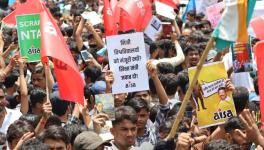
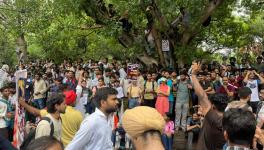
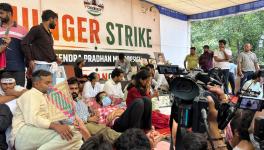
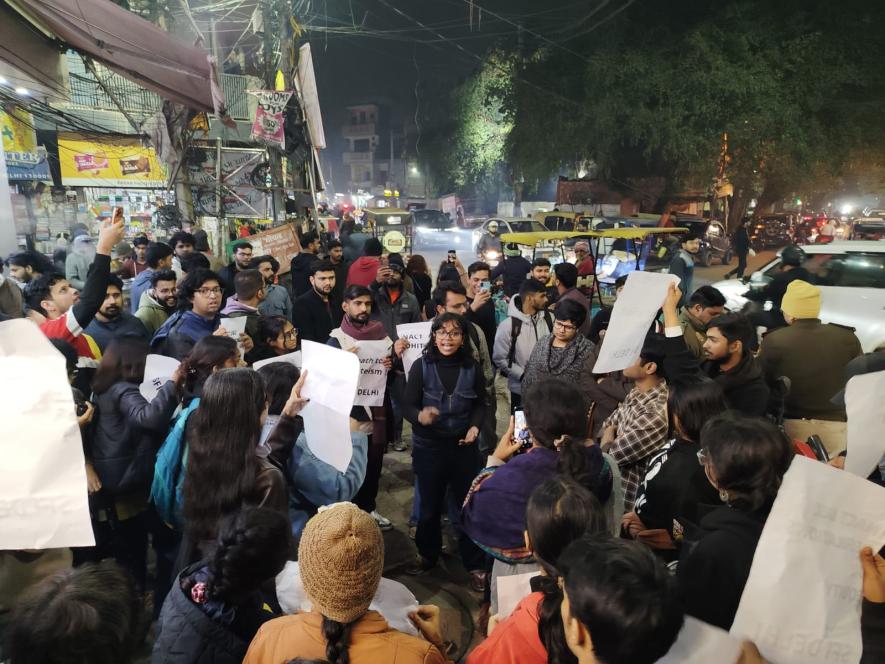
The most visible resistance to the Supreme Court’s stay came from Delhi University, where hundreds of students marched on Thursday on the call of the Students’ Federation of India (SFI) Delhi.
Students marched from the Arts Faculty, condemning what they described as a “judicial rollback of social justice.” The protest foregrounded the alarming rise in caste-based discrimination complaints and argued that the UGC regulations, while flawed, were a necessary step in addressing entrenched institutional bias.
SFI Delhi demanded:
--Immediate implementation of the UGC Equity Regulations
--Extension of the regulations to IITs, IIMs, and private universities
-- Democratic selection of student representatives in Equity Committees
-- Inclusion of gender minorities in grievance redressal mechanisms
SFI leaders alleged that the stay had come not because of legal infirmities alone, but due to sustained pressure from hegemonic and Brahmanical groups that perceive any discussion of caste as a threat to their dominance.
AISA: ‘Capitulation Before Brahmanical Pressure’
The All-India Students’ Association (AISA) issued a scathing statement, describing the SC stay as “reprehensible but predictable.”
AISA highlighted what it called a “pattern of judicial deference to dominant caste interests.” The organisation pointed out that no stay was granted during hearings on: The 10% EWS reservation, The abrogation of Jammu and Kashmir’s statehood, The controversial Special Intensive Revision (SIR) of electoral rolls, Yet, in the case of the UGC Equity Regulations, a stay was imposed even before detailed hearings could begin.
“What else is this, if not a clear display of Brahmanism at work?” AISA asked, calling for a nationwide movement to enact the Rohith Act. The organisation endorsed the draft prepared by the Karnataka government as a more comprehensive framework to address institutional violence against SC, ST, and OBC students.
A Familiar Pattern: Symbolism Without Substance
For many observers, the episode fits neatly into a broader political pattern under the current regime. The government can claim that it introduced equity regulations, thereby signalling concern for social justice. Simultaneously, by failing to defend them robustly in court—and by remaining silent when they are stayed—it reassures dominant social groups that their interests remain secure.
Critics allege that the Centre did not argue forcefully in defence of the regulations before the SC, contrasting this with the aggressive legal posture adopted by the government in other politically sensitive cases.
The Larger Question
The controversy surrounding the UGC Equity Regulations is not merely a legal dispute. It is a political and social confrontation over the meaning of equality in Indian higher education.
Are anti-discrimination measures inherently divisive, or is it discrimination itself that fractures society? Are universities neutral spaces, or are they shaped by historical hierarchies of caste and power? And finally, will the judiciary act as a guarantor of substantive equality, or retreat into abstract notions of neutrality that leave structural injustice untouched?
As protests spread and student organisations mobilise, one thing is clear: the stay on the UGC Equity Regulations has not ended the debate. Instead, it has pushed it out of courtrooms and back onto the streets.
For thousands of marginalised students, the struggle is no longer just about one set of regulations—it is about the right to dignity, safety, and equal belonging in India’s universities.
(This is an AI-assisted translation of the original Hindi report)
Get the latest reports & analysis with people's perspective on Protests, movements & deep analytical videos, discussions of the current affairs in your Telegram app. Subscribe to NewsClick's Telegram channel & get Real-Time updates on stories, as they get published on our website.