





Is SC’s ‘Existing Law’ Argument on Hate Speech Enough?
In 2025 alone, on average, four hate speech events occurred per day. Last week, the Supreme Court of India rejected the argument that India suffers from a legal vacuum on hate speech and declined to frame fresh guidelines, emphasising that while constitutional courts may step in to fill limited “interstitial gaps” to protect fundamental rights, such interventions are inherently temporary and cannot substitute for legislative action by Parliament or State legislatures.
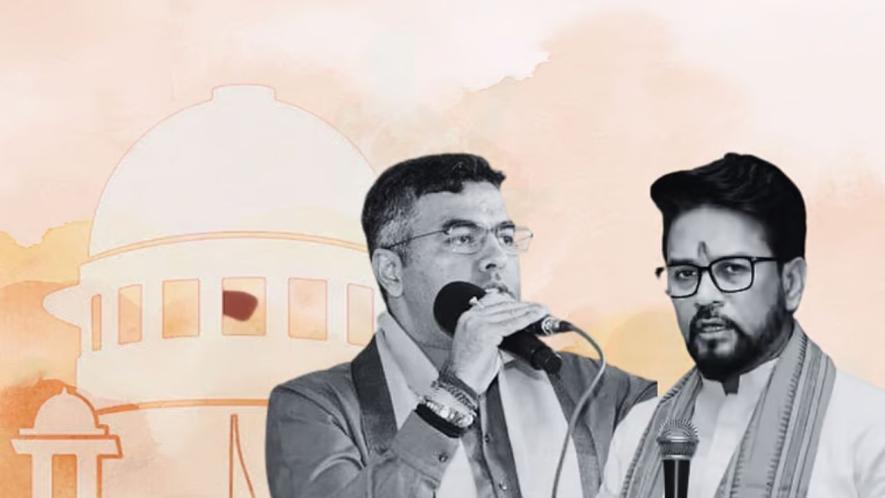
The bench comprising Justices Vikram Nath and Sandeep Mehta also held that no cognizable offence was made out against BJP leaders Anurag Thakur and Parvesh Verma, thereby upholding the Delhi High Court’s clean chit in relation to the “shoot the traitors” slogan raised against the backdrop of the 2020 protests against the Citizenship (Amendment) Act, 2019.
What were the petitions asking for?
Around thirteen writ petitions were clubbed together. Some of these drew from the 267th Report of the Law Commission of India, which had concluded that existing laws carry structural deficiencies in addressing hate speech and had recommended inserting dedicated penal provisions into the IPC. On this basis, the petitioners urged the Court to direct the Union to revisit the existing legal framework and enact clearer, more targeted hate speech legislation.
Set out below is a brief breakdown of the background and relief asked for in a few of these petitions:
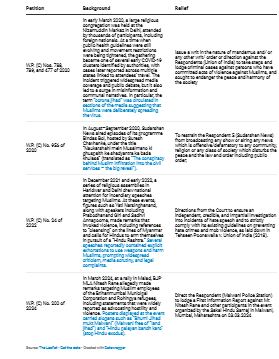
Disposing of the petitions, the Court noted that many of the specific prayers had become infructuous, having been tied to the communalisation of COVID-19 and went onto formulate four issues instead.
The Court framed the following questions for consideration: (i) whether it could create or expand criminal offences in the absence of legislative action; (ii) whether existing substantive criminal law adequately dealt with hate speech or the field was legislatively unoccupied; (iii) whether the existing procedural framework provided adequate and efficacious remedies, particularly in cases of non-registration of an FIR; and (iv) whether a continuing mandamus should be issued.
The bench comprising Justices Vikram Nath and Sandeep Mehta held that no cognizable offence was made out against BJP leaders Anurag Thakur and Parvesh Verma, thereby upholding the Delhi High Court’s clean chit in relation to the “shoot the traitors” slogan raised against the backdrop of the 2020 protests against the Citizenship (Amendment) Act, 2019.
What did the Court hold?
On the demand for expanding criminal offences, the Court reaffirmed the doctrine of separation of powers. The creation of criminal offences, it held, lies squarely within the legislative domain. While courts may interpret existing law and frame interim guidelines where the law is genuinely silent, such measures are stop-gap arrangements and cannot harden into permanent substitutes for legislation. The judgment read::
30. …in the absence of constitutional silence or a legislative vacuum, the Judiciary cannot assume the role of the Legislature by determining what ought to constitute an offence or by prescribing the appropriate punishment for a particular criminal act. Where the Legislature has already enacted a law governing the field and has provided for the corresponding punishment, the Court cannot, in exercise of its jurisdiction, supplant the legislative scheme.
On the adequacy of criminal law, the Court rejected the argument that there is a ‘legislative vacuum’ regarding hate speech and found that the existing framework including Sections 153A, 153B, 295A, and 505 of the IPC (now corresponding to the Bharatiya Nyaya Sanhita, 2023) and the Representation of the People Act, 1951 already penalise acts that promote enmity, outrage religious feelings, or disturb public tranquillity. The Court concluded that the difficulty stems from selective, delayed, or inconsistent enforcement of these laws.
Regarding non-registration of FIRs, the Court ruled that the Bharatiya Nagarik Suraksha Sanhita, 2023 (‘BNSS’) already provides a layered and comprehensive mechanism for aggrieved persons including approaching the Superintendent of Police under Section 173(4), petitioning a Magistrate to direct investigation under Section 175, and filing a formal complaint under Section 223. The Magistrate's supervisory jurisdiction, the Court emphasised, is of wide amplitude and acts as a vital safeguard against police inaction. It said:
62. In view of the layered statutory and constitutional remedies available within the existing legal framework, it cannot be contended that the law is either silent or deficient in addressing grievances arising from conduct that disturbs public order or fosters inter-group hostility….
Regarding issuance of continuous mandamus, the Court declined to assume an ongoing supervisory role and cautioned against judicial overreach. Mandamus, it held, cannot be issued on speculative fears of future inaction. Para 75 of the judgment read:
75. This Court [in Tehseen Poonawalla] cautioned that such an exercise would amount to “micro-management” of matters falling within the domain of the executive authorities and would be neither feasible nor consistent with the constitutional scheme. It was thus emphasised that mechanisms for enforcement must operate within the existing institutional framework rather than through continuous monitoring by this Court.
On the adequacy of criminal law, the Court rejected the argument that there is a ‘legislative vacuum’ regarding hate speech and found that the existing framework including the Bharatiya Nyaya Sanhita, 2023 and the Representation of the People Act, 1951 already penalise acts that promote enmity, outrage religious feelings, or disturb public tranquillity.
On the SLPs
The Court then turned to two Special Leave Petitions.
The first concerned alleged hate speech by Anurag Thakur in the context of the CAA. In 2020, a video surfaced showing Thakur raising the slogan “desh ke gaddaron ko,” to which a crowd responded with “goli maro sa*** ko” (“shoot the traitors”).
Trigger Warning: Hate Speech; Courtesy: The Print
The appellants initially approached the Commissioner of Police, Delhi. Following inaction, they sent a representation to the Station House Officer, and subsequently filed an application under Section 156(3) of the Code of Criminal Procedure, 1973 (‘CrPC’) before the Additional Chief Metropolitan Magistrate. The investigating agency submitted a status report stating that no cognizable offence was made out. On August 26, 2020, the Trial Court dismissed the complaint, holding that prior sanction was required to prosecute public officials.
This finding was upheld by the Delhi High Court on June 13, 2022, which ruled that under Section 196 of the CrPC, a Magistrate could not direct registration of an FIR or investigation without prior sanction. The matter was then brought before the Supreme Court.
The Supreme Court partly allowed the appeal. It set aside the High Court’s reasoning, clarifying that the requirement of prior sanction applies only at the stage of taking cognisance of an offence, and not at the earlier stage of registration of an FIR or investigation. However, the Court ultimately declined to direct registration of an FIR, agreeing with the investigating agency that the speech in question did not disclose a cognizable offence.
The second SLP arose from a challenge to an order of the Telangana High Court, which had closed a petition concerning Islamophobic social media posts and hashtags such as #Islamiccoronavirusjihad that circulated during the COVID-19 pandemic. The petitioner had sought broad directions restraining social media platforms from hosting content that insulted or hurt the sentiments of a particular community. The High Court declined this relief, noting that:
2. The second relief prayed for by the petitioner is for issuing directions to the respondents No.1 and 2/Central Government to restrain all online social media networks operating in India and not to carry out any Islamophobic posts or messages hurting or insulting the feelings of a particular community. Having regard to the manner in which the second prayer is couched, this court being a State High Court cannot grant such a relief. It is for the petitioner to approach the Supreme Court for appropriate orders.
Dismissing the appeal, the Supreme Court held that the grievance had already been adequately addressed in the proceedings before the High Court. In light of its broader conclusions on judicial restraint and the adequacy of existing statutory remedies, it found no reason to undertake further adjudication.
Arguably, the Court is treating the existence of law as equivalent to its adequacy. The Law Commission said as much in 2017. The data from India Hate Lab suggests the situation has only worsened since.
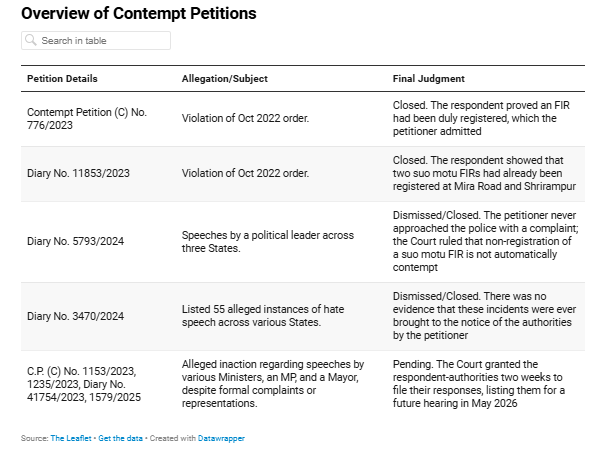
Contempt proceedings
In October 2022, the Court had directed the police in Delhi, Uttarakhand, and Uttar Pradesh to take suo motu action to register FIRs whenever a speech attracted offences under IPC Sections 153A, 153B, 295A, and 505, even if no formal complaint was made. In April 2023, these directions were extended to all State Governments across India.
In this context, several contempt petitions were filed alleging that authorities failed to register criminal cases against various political figures who made statements targeting religious communities
The Court closed several petitions where FIRs had in fact been registered. It also clarified that failure to register a suo motu FIR does not automatically amount to contempt. For contempt to be established, there must be clear evidence of wilful disobedience or deliberate inaction despite knowledge of a cognizable offence.
One petition, however, remains pending. It concerns the failure of the Directors General of Police of Tamil Nadu and Kerala to register FIRs over remarks attributed to figures including Udhayanidhi Stalin who have alleged to have called for the eradication of Sanatan Dharma." Responses from the concerned authorities have been sought.
Rising Hate Speech and its constitutional implications
India Hate Lab (‘IHL’) documented 1,318 hate speech events targeting religious minorities, particularly Muslims and Christians, in 2025 across twenty-one states, one union territory, and the National Capital Territory (NCT) of Delhi. It found that on average, 4 hate speech events occurred per day marking a 13 per cent increase from 2024, and 97 per cent increase from 2023.
A total of 1,289 speeches, or 98 percent, targeted Muslims, either explicitly or alongside Christians. 88 percent of these hate-speeches occurred in states governed by the BJP, either directly or with coalition partners, as well as in BJP-administered Union Territories.
The judiciary has not been unaware of the problem. In Pravasi Bhalai Sangathan v. Union of India (2014), the Supreme Court acknowledged the legitimacy of judicial guidance in the absence of legislative action:
In case of vacuum of legal regime to deal with a particular situation the court may issue guidelines to provide absolution till such time as the legislature acts to perform its role by enacting proper legislation to cover the field. Thus, direction can be issued only in a situation where the will of the elected legislature has not yet been expressed.
Three years later, the 267th Law Commission Report (2017) gave the legislative gap a name and a remedy. It observed:
6.24 …What is at issue is the criminalisation of hate speech and how the existing laws look at it. Since it is entrenched in the constitutional right of freedom of speech and expression, “hate speech” has been manipulated by many in different ways to achieve their ulterior motive under the garb of such right and the law courts in absence of clear provisions in IPC, are not able to prosecute hate speech charges brought before them with success.
The Report recommended inserting two new provisions into the IPC:
s. 153C (Prohibiting incitement to hatred) and s. 505A (Causing fear, alarm, or provocation of violence). It also summarised certain parameters for identifying hate speech: to include (i) incitement threshold; (ii) extremity; (iii) status of author and victim; and (iv) context and potentiality.
India has since overhauled its criminal law framework entirely, replacing the IPC with the BNS, yet, neither the recommended sections nor any equivalent provision found its way into the new legislation. Meanwhile, the use of communal and caste rhetoric by politicians, including senior leaders and the head of government, has only intensified.
The question, then, is pointed: Is it acceptable for Courts to wait for executive action that has been overdue for at least nine years?
In Vishaka v. State of Rajasthan (1997), the Court held that where domestic law is silent, they may draw upon international conventions, provided these do not conflict with fundamental rights under Part III of the Constitution. India has ratified both the International Covenant on Civil and Political Rights and International Convention on the Elimination of All Forms of Racial Discrimination, which expressly require state parties to prohibit by law any advocacy of national, racial, or religious hatred that constitutes incitement to discrimination, hostility, or violence. These treaty obligations would seem to provide a clear basis for judicial direction.
The Court, however, has rejected this line of reasoning. In paragraph 38 of its judgment, it held:
38. The mere occurrence of incidents of hate speech cannot lead to the conclusion that the law is silent on the subject. More often than not, the difficulty lies in the effective enforcement and application of the existing statutory framework. At best, such instances may reveal deficiencies in implementation in particular cases. That, however, cannot furnish a ground for the Court to assume the legislative function or to supplant the statutory scheme enacted by the Legislature.
Arguably, that is treating the existence of law as equivalent to its adequacy. The Law Commission said as much in 2017. The data from IHL suggests the situation has only worsened since.
If the legislature will not act, and the executive does not enforce, the burden on the judiciary will plausibly only become heavier.
For a detailed understanding of the trajectory of hate speech leading up to the 2024 General Elections: India Hate Speech Monitor
Case: Ashwini Kumar Upadhyay v Union of India WP (C) 943 of 2021
Courtesy: The Leaflet
Get the latest reports & analysis with people's perspective on Protests, movements & deep analytical videos, discussions of the current affairs in your Telegram app. Subscribe to NewsClick's Telegram channel & get Real-Time updates on stories, as they get published on our website.