





Reparations for Slavery: A Legitimate Struggle
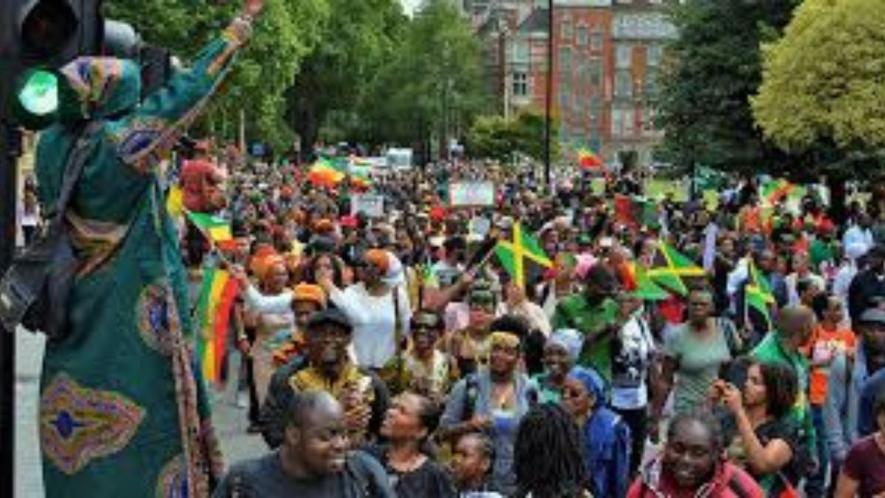
Thousands take part in a march for reparations in London on Emancipation Day (Aug 1). Photo: CARICOM Reparations Commission
When one person hurts another, common sense dictates that the person should apologize and, preferably, make amends for the harm they may have caused. Apologize, make amends, and ensure it won’t happen again. These seem like basic rules of coexistence. Coexistence among people, but also among sectors of a society and among entire nations. History shows us that coexistence is not the norm. Colonialism and exploitation have been present, but the perpetrators of these crimes rarely acknowledge them.
The colonization of what is now called the Americas (beginning in 1492) is an example. Europeans invaded, appropriated lands that did not belong to them, murdered millions of its inhabitants, and subjected the rest to servitude. Almost immediately, the kidnapping of Africans began; they were forced into slave labor, which generated immense profits that produced the “primitive accumulation” discussed by Karl Marx in “Capital” and paved the way for the development of capitalism.
Europe became the dominant power, and the standard of living it enjoys today is the product of wealth violently extracted from our lands, from Africa, and later from the rest of the world. A veritable plunder to which the US later joined. They have, as the revolutionary Thomas Sankara said, a blood debt to the peoples of the world.
Recently, the United Nations General Assembly adopted Resolution A/80/L48, dated March 25, 2026, which “declares the trafficking of enslaved Africans and racialized chattel enslavement of Africans as the gravest crime against humanity.” The resolution goes beyond the symbolic and highlights the nature of the crime in terms of the rupture it caused in world history, the magnitude and duration of the crime, its systemic character (institutional, normative, logistical), its brutality, and its lasting consequences expressed in “racialized regimes of labor, property, and capital.”
This resolution brings to the table a crucial issue such as reparative justice, by urging states that benefited from slavery to take concrete measures that include not only formal apologies but also financial compensation and the immediate return of cultural property, works of art, manuscripts, documents, artifacts, etc., without hindrance and at no cost to their countries of origin. The Resolution reaffirms that, due to its gravity, this crime is not subject to a statute of limitations.
The Resolution was approved by 123 votes in favor—primarily from Africa, Latin America, and the Caribbean – 3 votes against from the US, Israel, plus the shameful vote of Argentina, and 52 abstentions, including the entire European Union, Canada, Australia, and Japan. As might be expected, the colonizers placed themselves on the dark side of history. Europe, in particular, argued that reparations could not be demanded for something that was not illegal at the time.
There can be no greater cynicism than the one from countries that, being fully aware of the concept throughout history, have taken actions in favor of the perpetrator – what we might call “reverse justice”. During the 19th century, for example, England provoked two wars in China known as the Opium Wars. Essentially, England sought to flood China with drugs to weaken its people and reap economic benefits. Even so, after the wars, England, the aggressor country, forced China to pay “reparations” equivalent to USD 736 million today to cover the costs of the war. Part of the reparations was also intended to compensate for the opium destroyed by Chinese authorities and to indemnify the merchants – that is, the drug traffickers – for the losses they suffered.
Another case, equally outrageous, is the payment France forced Haiti to make to compensate for the damages caused to France by the loss of its colony. Haiti was paying a debt – clearly illegal – from 1825 to 1947. In 2003, then-President Jean Bertrand Aristide demanded that France return USD 21.7 billion to Haiti. The following year, he was deposed by a military coup supported by France and the US.
Resolution A/80/L48 acknowledges the crime, the victims, and the perpetrators, and urges the perpetrators to make reparations for the crime committed. It calls for achieving true restorative justice. This is not a new development, as the struggle for such recognition has been brewing for decades in various forums, including multilateral ones. Thus, in 1973, the United Nations (UN) proclaimed the Decade for the Elimination of Racial Discrimination, which was extended in 1983 and 1993. Little concrete progress was made during those decades, so in 2001, the UN organized the World Conference against Racism, Racial Discrimination, Xenophobia, and Related Intolerance in the city of Durban, South Africa. The conference produced a Final Declaration and a Plan of Action that serve as a comprehensive framework for addressing racism and discrimination and include measures to combat them, ranging from calls to reform legislation, concrete actions to protect victims of racism and discrimination, education and health plans, measures to combat poverty, resources for victims, and more.
In 2013, given that the objectives set forth in the Plan of Action had not been achieved, the UN proclaimed, in its Resolution 68/237 on December 23, the International Decade for People of African Descent, effective from January 1, 2015, to December 31, 2024, extended for an additional 10 years until 2034 (Resolution A/79/193).
Specifically regarding reparations, a notable development in 2013 was the creation of the CARICOM Reparations Commission, which produced a 10-Point Plan outlining concrete actions to demand reparations from European governments for the genocide perpetrated against the 15 million indigenous people of the Caribbean and for the multitude of “crimes against humanity”, slavery and its legacies, which were committed against enslaved Black or African people.
In this same context, on March 24, 2018, the International Meeting on the Decade of Afro-Descendants was held in Caracas, during which the Venezuelan government signed the decree for the National Decade for Afro-Descendant Peoples, in order to implement actions in this regard. In May 2018, the First International Meeting on Reparations was organized, where Venezuela committed to promoting lines of research on the legal, multilateral, political, historical, and philosophical aspects of the issue. Following this, Venezuela has organized three International Seminars on Reparations, and the Ministry of People’s Power for Science and Technology has funded research projects addressing this issue.
The struggle for reparative justice is a legitimate struggle that unites the peoples of the Global South with a shared history of colonization and that unites the racialized and discriminated peoples of the world. Ghana promoted the adoption of the resolution declaring the transatlantic slave trade the most serious crime against humanity. CARICOM proposed a 10-point plan to implement reparations; Venezuela has made progress in creating institutions that fight for this right and has promoted research to inform public policies on the issue. Sharing these experiences is of vital importance. Demanding reparations – that is, recognition of the crime, compensation in whatever form, and guarantees of non-repetition – is a cause of the Global South and a cause worth fighting for.
Guillermo R. Barreto is Venezuelan and holds a Ph.D. in Science (University of Oxford). He is a retired professor at Simón Bolívar University (Venezuela). He served as Deputy Minister of Science and Technology, President of the National Fund for Science and Technology, and Minister of Ecosocialism and Water (Bolivarian Republic of Venezuela). He is currently a researcher at the Tricontinental Institute for Social Research and a visiting fellow at the Center for the Study of Social Transformations-IVIC.
This article was produced by Globetrotter.
Courtesy: Peoples Dispatch
Get the latest reports & analysis with people's perspective on Protests, movements & deep analytical videos, discussions of the current affairs in your Telegram app. Subscribe to NewsClick's Telegram channel & get Real-Time updates on stories, as they get published on our website.