





Punjab: Four Years’ Rule of Aam Aadmi Party
Courtesy: Twitter/@AamAadmiParty
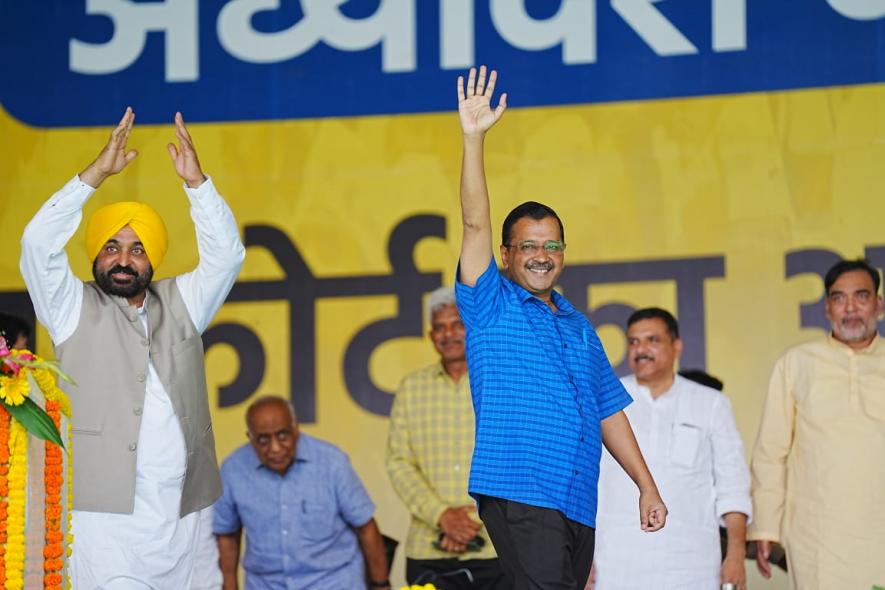
In a way, 2022 was the momentous year in the history of Punjab when the Aam Adami Party (AAP) came to power with an overwhelming majority with 92 MLAs out of 116 seats. The people’s mandate was a result of various factors, one of which was the farmers’ movement in 2020. At the same time, the people of Punjab were tired of the two parties coming to power one after the other, without bringing any substantial change in policy and the mode of actions.
Promises remained unkept and when in 2017, Captain Amarinder Singh (then in Congress) swore by the Holy book of the Sikhs to end the problem of drug abuse in the state, the people believed him. After coming to power, he just seemed to have forgotten his promise. What offended people was that he had said it under oath of the sacred book.
Instead of mapping the report card of AAP’s performance, it is important to examine whether it made an attempt to fulfil its promises it made to the people of Punjab and challenges it faced during four years.
Let us first begin with what it did during these four years. Shortly after forming the government, the Bhagwant Mann government formed the anti-gangster task force to handle rising cases of crime. Electricity up to the consumption of 300 units was made free. The other two promises that AAP made were ending corruption and overcoming the menace of drug abuse. Shortly afterwards, bus travel in State-owned buses was made free for women.
The only promise which the AAP government delayed in keeping was giving monetary help to women, which it did after completing four years. Education, health and employment were other three sectors regarding which the Delhi model was emphasised and promised. In a way, AAP had presented its manifesto covering most of Punjab’s socio-economic aspects, but it was important to see what it would do after forming the government.
With most of the newly elected MLAs being first-timers and none of them with any experience of handling bureaucracy and governance, the AAP government tread on the path to something different from other parties. Though people in general expected them to fulfil the promises, yet serious observers were quite clear that AAP would never be successful in carrying out what it had promised.
However, the Mann government began in earnest to fulfil all promises it had made. Free electricity up to 300 units as well as bus travel for women were implemented. Actions were carried out to end the gangsterism and drug menace in the state. The Delhi models of Aam Aadmi Clinics and smart schools were introduced. However, the major achievement of AAP was canal water restoration to the tail-end to ensure its regular supply in the command areas.
During four years of its rule, the AAP government faced challenges of various kinds. The moment it initiated the process of filling vacant posts in the government, most temporary employees started agitating to be made permanent without following due process resulting in continuous protests of such employees of one or the other department.
The second challenge was the AAP government’s relation with Governor Banwari Lal Purohit, who continued to block various legislations till 2024. Added to this are delays in the release of grants to the state on the part of the Central government. Finally, the farmers’ struggle continued unabated, sometimes against the state government but most of the time against the Central government regarding various issues.
The first act that invited a lot of criticism of the AAP government was the election of Rajya Sabha members, most of whom had nothing to do with the party’s politics. It was a general impression, though unverified, that some of them had contributed to party funds, whereas the others, except Sant Balbir Singh Seechewal, were said to be close to AAP leader Arvind Kejriwal. Their lack of commitment to the party has now become clear, as they have now joined the Bharatiya Janata Party (BJP.)
If we learn from experiences of other countries, it is a grim reminder that any crusade against drug menace and gangsterism is expected to be continuous and the challenges cannot be overcome in a short period of time. However, there seems to be a degree of action in this area. The major issue facing Punjab has been all-pervading corruption in government offices dealing with the public at large. It is here that the AAP government has faced failure.
Immediately after AAP came to power, there was decline in corrupt practices, but that was just a pause, after which it restarted with the same intensity. Stories of MLAs and a few ministers indulging in corrupt practices began to spread after two years of its coming to power. At present, one of the ministers is in police custody, but the number of MLAs indulging in unfair means is quite large. Many of them have started accumulating money with an eye on the next elections.
One of the unfortunate aspects of Indian democracy is that most of the top leaders lead their parties in perpetual insecurity of threat from within. After coming to power, they begin to showcase themselves larger than life. This is exactly what is happening to Chief Minister Mann. He is invariably present in all functions, whereas the ministers concerned occupy backseats. His photographs in posters etc. loom larger than life. On top of this, Mann has been continuously cultivating either the Malwa region in general, or his on constituency in particular.
Despite this half-success, failures and shortcomings, the AAP government is the first to carry out the policies it promised to the people. In addition, the one commendable action one has to single out its purchase of the thermal plant at Goindwal Sahib.
The writer was a professor of sociology at the Guru Nanak Dev University, Amritsar, and former president of the Indian Sociological Society. The views are personal.
Get the latest reports & analysis with people's perspective on Protests, movements & deep analytical videos, discussions of the current affairs in your Telegram app. Subscribe to NewsClick's Telegram channel & get Real-Time updates on stories, as they get published on our website.