





Power Elite and Moral Hypocrisy: What Epstein Files Reveal
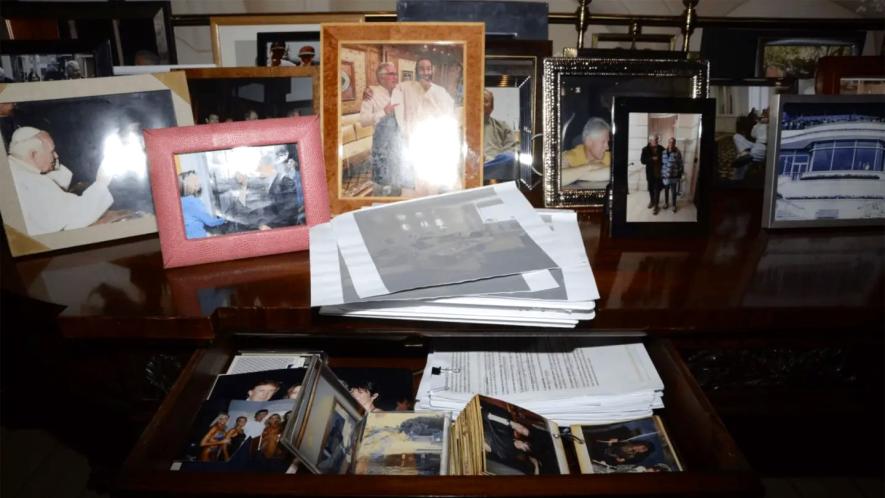
Desk drawer with printed pictures including Donald Trump with Jeffrey Epstein and Ghislaine Maxwell and Trump standing with women in swimwear. Photo: DOJ
When the latest tranche of materials from the Jeffrey Epstein investigations entered the public sphere, millions of pages of documents alongside vast stores of images and video, it felt less like a legal disclosure and more like a cultural reckoning. Released through proceedings overseen by the United States Department of Justice (DOJ), the files did more than catalogue crimes already known. They forced an uncomfortable confrontation with the moral architecture of modern society and, in particular, with the people who claim authority over it.
At first glance, the revelations appeared familiar. Flight logs, contact lists, emails, and records of private gatherings connected Epstein to a constellation of wealthy, influential, and respected figures. But the public response was not driven simply by shock at the proximity to a convicted sex trafficker like Epstein. What ignited outrage was the gap between public virtue and private behaviour. Many of those named were not obscure power brokers. They were professors who lectured on ethics, motivational figures selling self-discipline, health and wellness influencers preaching purity, philanthropists advocating compassion, and political leaders speaking endlessly of values.
This is where the scandal cuts deepest. These individuals were not merely powerful. They were moral narrators. They helped shape how millions think about right and wrong, success and failure, discipline and decay. To see them entangled, directly or indirectly, in environments defined by exploitation felt like a betrayal of trust. The issue was less legal guilt than moral hypocrisy, the sense that one set of rules governs the public, while another, looser code protects the elite.
The reaction was swift and global. Screenshots and excerpts spread across social media, often stripped of nuance but heavy with symbolic force. Guest lists circulated like modern day indictments. Videos and messages, some crude and some chilling, were interpreted as evidence of unchecked indulgence among those who publicly scold society for its moral lapses. For many observers, long held suspicions hardened into conviction. Morality, as publicly preached, seemed less a shared standard and more a tool of control.
As confidence in institutions eroded, people asked difficult questions. How could a self mastery guru justify association with such a figure? How could an academic champion of intellectual honesty ignore obvious ethical red flags? Why did advocates of philanthropy and doing good appear comfortable in morally toxic spaces? The answers, if they exist, were drowned out by a deeper disillusionment. Trust did not merely weaken. It fractured.
To understand why this moment resonates so powerfully, it helps to turn to philosopher Friedrich Nietzsche. In On the Genealogy of Morality, Nietzsche dismantled the idea that morality is a timeless, neutral truth. Instead, he argued that moral systems emerge from historical struggles for power. Values, in his view, often masquerade as universal principles while quietly serving the interests of those who benefit from them.
Nietzsche was especially suspicious of moral posturing. He warned that professions of virtue can conceal resentment, that guilt can be weaponised to suppress vitality, and that moral superiority often disguises a desire to dominate. This was not a call to abandon ethics altogether. It was a challenge to ask harder questions. Who defines morality? Who enforces it? And who is conveniently exempt?
Seen through this lens, the Epstein files look less like an aberration and more like a symptom. The hypocrisy they expose appears systemic, not accidental. Moral elite enforces norms on society, discipline, restraint, transparency, while privately navigating a parallel world of exceptions. The performance of virtue becomes theatre, necessary to maintain legitimacy, while real power operates beyond the spotlight.
Nietzsche warned that such contradictions were dangerous. When morality is exposed as hollow, people do not simply become freer. They risk becoming cynical. Values lose their credibility. Words like integrity, leadership, and ethics begin to sound performative rather than meaningful. This is the gateway to nihilism, not chaotic rebellion, but weary disengagement, where nothing feels worth believing in.
The Epstein revelations intensify this risk. When motivational icons are linked to indulgent excess, when scholars of ethics appear ethically compromised, when billionaires preaching benevolence orbit known predators, moral language itself erodes. Society is left with rules that feel arbitrary and sermons that feel dishonest. The result is not moral clarity but moral exhaustion.
Yet Nietzsche’s critique was never meant to end in despair. His project was diagnostic, but also generative. By stripping away false sanctity, he hoped to clear space for values grounded in life, creativity, and honesty rather than fear and control. Morality, in this sense, must be judged by its fruits. Does it cultivate excellence, responsibility, and human flourishing? Or does it merely protect hierarchies and punish the powerless?
The current moment demands this kind of reckoning. The exposure of elite hypocrisy does not mean morality itself is obsolete. It means moral authority must be earned, not assumed. Words must align with actions. Transparency must replace prestige as the currency of trust. Those who speak loudest about virtue should be subject to the highest scrutiny, not the least.
For institutions, this means real accountability rather than symbolic apologies. For cultural leaders, it means stepping aside when credibility is lost, not hiding behind legal technicalities. And for the public, it means resisting both blind faith and blanket cynicism. The challenge is to reject corrupt moral systems without abandoning the human need for shared values.
The Epstein files, disturbing as they are, offer an opportunity. They strip away comforting illusions and force society to confront the distance between what is preached and what is practiced. In that uncomfortable space lies the possibility of renewal, a moral framework rooted in consistency, transparency, and respect for human dignity rather than status and spectacle.
Ultimately, this is not just a scandal about individuals. It is a stress test for our ethical order. Will we continue to outsource morality to elites who speak well but act poorly? Or will we demand a form of ethics that survives exposure, one strong enough to withstand scrutiny and honest enough to admit its failures?
Nietzsche warned that unexamined morality decays into nihilism. The choice now is whether we allow hypocrisy to hollow out our values, or whether we use this moment to rebuild them on firmer, more truthful ground.
The writer is an Assistant Professor of History, Department of Education, Akal University, Bathinda, Punjab. The views are personal. He can be reached at aishxing@gmail.com.
Get the latest reports & analysis with people's perspective on Protests, movements & deep analytical videos, discussions of the current affairs in your Telegram app. Subscribe to NewsClick's Telegram channel & get Real-Time updates on stories, as they get published on our website.