





The Other Kerala Story: Development, Displacement & People Forgotten by Progress
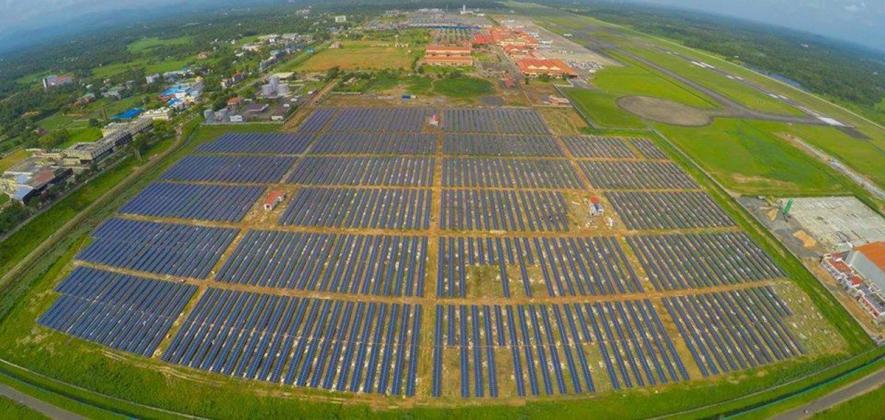
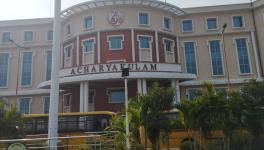
Image Courtesy: Facebook/CIAL
Kerala occupies a distinctive place in India’s development imagination. Celebrated for its achievements in literacy, health, social reform and welfare provision, it has often been presented as a model of development with equity. The Kerala Model challenged the conventional wisdom that rapid economic growth must precede social progress. Kerala’s achievements are undeniable. However, the experiences of those who have borne the costs of development projects undertaken in the name of growth, connectivity and modernisation remain less visible.
It is this less visible side of Kerala’s development story that forms the subject of T.V. Aneesh’s Experiencing Development in Kerala: Narrations of Accumulation, Dispossession and Rehabilitation. Through a detailed study of the Cochin International Airport (CIAL) project, Aneesh examines how large infrastructure projects transform the lives of those displaced by them. The questions raised by the book extend far beyond Kerala. At a time when governments increasingly pursue growth through airports, highways, industrial corridors and urban redevelopment projects, public debate tends to focus on investment, employment and infrastructure creation, while the social costs of displacement receive far less attention.
The book rests on a substantial empirical foundation. Drawing upon household surveys, interviews and focus-group discussions conducted among displaced families, it documents the experiences of more than 200 respondents affected by the airport project. Several chapters analyse livelihood outcomes for 165 respondents who participated in rehabilitation-linked employment schemes.
In paying particular attention to women and Dalit communities, the study goes beyond being an aggregate account of displacement, it examines how social inequalities shape the experience of dispossession.
The study reinforces the fact that land is not merely a productive asset that may be monetised and replaced, land embodies livelihood, security, social status, identity and community. Land is the basis of informal rural economy that is built around cultivation, livestock rearing, common resources, neighbourhood cooperation and multiple supplementary sources of income. Therefore, while compensation may be able to reimburse the market value of land, it fails to reconstruct the economic and social structures that are destroyed with dispossession of land.
A substantial body of research on development-induced displacement in India has documented how the social costs of development extend far beyond the market value of acquired land. Walter Fernandes’ studies of displacement associated with dams, mines and industrial projects in eastern and central India during the 1980s and 1990s highlighted the inadequacy of rehabilitation and the disproportionate burden borne by marginalised communities. S. Parasuraman’s work on development-induced displacement in the 1990s similarly demonstrated how livelihood loss and social dislocation frequently persisted long after formal resettlement had been completed.
Amita Baviskar’s seminal study of the Narmada Valley (In the Belly of the River, 1995) drew attention to the ways in which development projects disrupt not merely economic activity but entire social and cultural worlds. The erosion of livelihoods, weakening of community networks and uneven rehabilitation outcomes observed in the CIAL project echo concerns repeatedly raised by the literature. However, the significance of this book lies in showing how these processes unfold within Kerala, a state more commonly associated with social development and democratic mobilisation than with displacement and dispossession.
The lives documented by the book reveal that the families who once relied on a combination of agriculture, livestock, seasonal work and community-based support systems found themselves pushed towards insecure wage labour and greater dependence on markets. Agricultural production declined after displacement. Livestock ownership fell sharply. Access to common spaces was lost. Informal support networks weakened. The loss was not confined to land titles, it extended to the broader social economy that had previously provided a measure of economic security and resilience.
The evidence on employment generation under the rehabilitation package reveals that while airport-related employment opportunities were created, many of the displaced entered contractual, temporary or low-paid forms of work. Permanent and secure employment remained limited. What emerges from Aneesh’s analysis is not a restoration of livelihoods but a transition from relatively autonomous land-based livelihoods to dependence on precarious, informal, wage labour. The book identifies a process of proletarianisation accompanying displacement.
The book also demonstrates that displacement does not affect everyone uniformly, existing inequalities often magnify its consequences. The chapters on women are amongst the strongest in the book. The data shows that displacement disrupted not only livelihoods but also the social networks, support systems and routines that structured everyday life. Women frequently reported heightened insecurity, increased domestic burdens, psychological stress and exclusion from decision-making processes. Employment opportunities generated through rehabilitation often reproduced existing gender hierarchies, concentrating women in low-paid and insecure occupations.
Similarly, the discussion of Dalit experiences reveals how displacement intersects with historical patterns of caste-based marginalisation. Dalit households entered the development process from positions already shaped by unequal access to land, resources and opportunities. Rehabilitation did not erase these inequalities. In many cases, it reproduced them in new, magnified forms. Clearly showing that technocratic approaches that evaluate rehabilitation solely through compensation packages while ignoring the structural inequalities that shape people’s lives are flawed.
The significance of the CIAL experience, however, extends beyond the displaced households themselves. It also raises important questions about Kerala’s political trajectory. Unlike many Indian states, Kerala has a long history of land reforms, strong trade unions, active civil society organisations and alternating governments led by the Left Democratic Front (LDF) and the United Democratic Front (UDF). One might, therefore, expect development-induced displacement to be subject to greater democratic scrutiny and political contestation.
The history of the airport project complicates such assumptions. The project enjoyed support across political regimes and gradually came to symbolise Kerala’s aspirations for modernisation, investment and global connectivity. Opposition to land acquisition emerged, but it never evolved into a sustained mass movement comparable to the anti-displacement struggles witnessed in Narmada, Singur or Nandigram. Over time, resistance shifted from opposing acquisition itself to negotiating compensation and rehabilitation.
One of the more interesting implications of the study is that despite the alternation of power between the UDF and the LDF, the broad developmental consensus surrounding the airport project remained remarkably stable. The book suggests that developmental consensus can sometimes prove as effective as coercion in marginalising dissent. Once the airport came to symbolise modernisation, employment and regional progress, opposition to displacement increasingly risked being portrayed as opposition to development itself.
This helps explain why resistance remained localised despite the significant social costs documented by the study. The benefits of the project were widely dispersed across society in the form of improved connectivity, investment and economic opportunities, while the costs were concentrated among a relatively small group of displaced households. At the same time, compensation and rehabilitation shifted the terrain of struggle from opposing acquisition itself to negotiating the terms on which displacement would occur. What began as resistance gradually evolved into a demand for better rehabilitation.
The book, therefore, invites reflection on the broader relationship between development and democracy. The displaced communities organised, protested, negotiated and sought better terms of rehabilitation. Yet their ability to influence the larger developmental trajectory remained limited.
The CIAL experience suggests that democratic participation often operates within parameters already established by a broader political consensus regarding what constitutes development and who must bear its costs. Similar tensions continue to shape contemporary conflicts over land acquisition across India.
To be fair, neither the book nor the experience it documents lends itself to a simple opposition between development and displacement. The airport has undoubtedly contributed to Kerala’s connectivity, investment and economic growth. The issue, therefore, is not whether infrastructure projects should be undertaken, but how their costs and benefits are distributed.
A development process can claim legitimacy only when those who bear its immediate costs are able to share meaningfully in its benefits. The challenge is not to choose between development and justice, but to ensure that development does not impose disproportionate burdens upon a small group while its gains are enjoyed by society at large. Compensation alone cannot satisfy this requirement if it merely offsets losses without creating opportunities to participate in the gains generated by development.
The book is considerably stronger on dispossession than on accumulation. We learn a great deal about those who lost land and livelihoods, but comparatively less about the distribution of benefits generated by the airport itself. CIAL has undoubtedly become one of Kerala’s most significant economic assets, contributing to connectivity, tourism, trade and employment. It would be important to find out more systematically how these gains were distributed and whether subsequent generations of displaced households experienced upward mobility through education, migration or integration into the regional economy.
This limitation, however, does not diminish the book’s central achievement. It succeeds in challenging the tendency to evaluate development exclusively through aggregate indicators and demonstrates that beneath every large infrastructure project lies a complex terrain of social costs, unequal burdens and contested notions of justice. The Kerala celebrated in policy documents and development textbooks is real. It is a story of literacy, public health, social reform and democratic mobilisation.
But there is another Kerala story as well, one inhabited by displaced farmers, insecure workers, marginalised women and Dalit communities struggling to rebuild lives disrupted by projects undertaken in the name of progress.
The significance of Experiencing Development in Kerala lies not in demonstrating that development produces winners and losers, such a proposition is hardly controversial, the significance lies in showing how those losses are experienced, distributed and even rendered invisible. The airport that emerged from the CIAL project is undoubtedly an important economic asset. Yet the experiences documented in this book remind us that development cannot be evaluated solely through infrastructure created, investment attracted or passengers handled. It must also be judged by what happens to those who surrender land, livelihoods and community in its name. Any serious assessment of the Kerala Model must make room for both stories.
The writer is Associate Professor at Zakir Husain Delhi College, University of Delhi. The views are personal.
Get the latest reports & analysis with people's perspective on Protests, movements & deep analytical videos, discussions of the current affairs in your Telegram app. Subscribe to NewsClick's Telegram channel & get Real-Time updates on stories, as they get published on our website.