






Odisha: Administrative Opacity Sends Tuskers Running for Cover to Survive
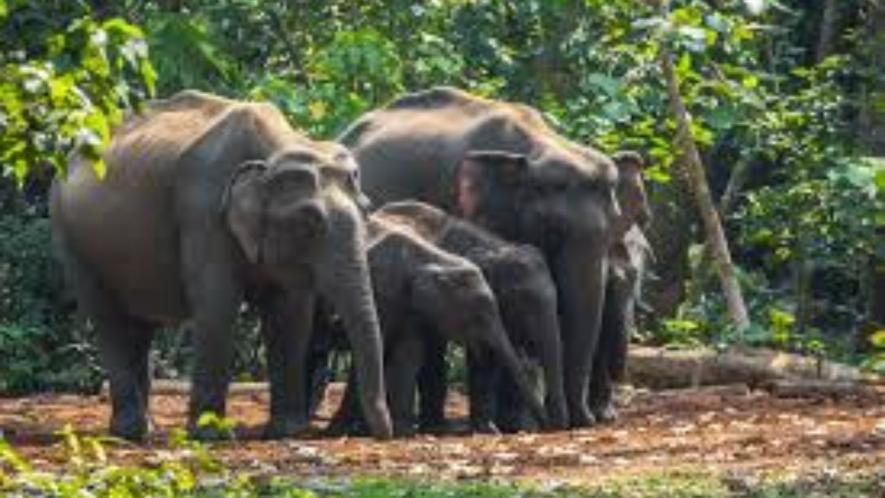
Bhubaneswar: In a horrifying incident, three women firewood collectors were killed and three other women injured by an angry tusker at Patapuri Reserved Forest in Dhenkanal division, adjoining Kapilash Wildlife Sanctuary on February 10, 2026.
The above incident is one of many in the state’s woods causing damage to lives from both sides-- man and animal.
This brings into light the rising Human-Elephant Conflict (HEC) in Odisha that holds the dubious record of the maximum number of human deaths among states despite being home to a lower number of elephants compared with Karnataka, Assam, Kerala and Tamil Nadu.
Clueless Forest Department
The state forest department seems clueless about handling this tragedy, let alone finding any solution or guiding the system even after years and years of neglect being perpetuated.
According to “Status of Elephants in India: DNA based synchronous all India population estimation of elephants” (2025) census carried out by the Wildlife Institute of India, Odisha has 912 elephants, compared with Karnataka’s 6,013, Assam’s 4,159, Kerala’s 2,785 and Tamil Nadu’s 3,136, Uttarakhand (1,792), West Bengal (707) and Chhattisgarh (451).
Though the results of this new methodology are not comparable to past results, Odisha recorded a sharp population decline of nearly 1,100 elephants or 57% in just last year. The last census of November 2024 carried out by the forest department recorded 2,103 elephants.
Odisha topped human deaths in 2024-25 with 171 deaths, followed by Jharkhand (87), West Bengal (53), Assam (74) and Tamil Nadu (61). Over the past five years, 2019-2024, Odisha recorded the highest cumulative death of 624 persons across India, revealing extremely high levels of conflict.
Humans Killed by Elephants in Odisha in Past 4 Years:
2022-23 (148); 2023-24 (154); 2024-25 (171) and 2025-26 (127) (till February 10, 2026)
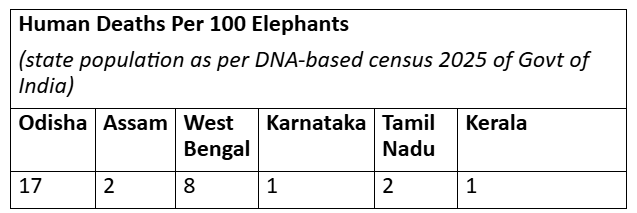
The humans killed per 100 elephants for 2024-25 is 17 for Odisha, which is highest in the country compared with only one per 100 elephants in Karnataka and Kerala, respectively.
Despite this shocking situation, it seems the state government has turned into a mere onlooker as families lose their bread winners – a poor farmer or a tribal firewood or food gatherer.
The less said about the forest department or the wildlife wing of the state, the better. They always have a set of ready-made excuses to hide behind.
Consultancy Extravaganza
Skirting its moral role and side-stepping public gaze, what is unbelievable is that the reverse pyramid structured forest department is usually entrenched in the state capital Bhubaneswar, with their big bosses stationed here, while the realities on the ground are extremely vulnerable.
“The forest department has shirked its responsibility to address this ghastly human tragedy despite humongous amounts spent on consultancy, patrolling and conflict management. “Though the state government paid Rs. 3.67 crore to a private consultant in (2016) for a wildlife conflict mitigation plan, there is no relief for local villagers for nine years”, Biswajit Mohanty, a wildlife activist who also heads the Wildlife Society of Odisha, told this writer.
Since 2019-20, human kills by elephants in Odisha rose sharply, crossing 115 persons. Since then, it has been on the rise, reaching an all-time high of 171 in 2024-25.
The highest human kills in Odisha had been recorded at Dhenkanal district (24) followed by Keonjhar (28), Mayurbhanj (15), Angul (13), Sundergarh (12) , Deogarh (5) in 2025-26.
“On January 7, 2023, four men were killed by a Makhana elephant spanning Bantala, Angul and Talcher Ranges in Angul district, all within two hours over a 20 sq km area”, said Mohanty.
On July 31, 2025, three persons were killed by a tusker near Baghadharia village in Hindol Range. On February 10,2026, three women were killed at Lochhapalli village of Dhenkanal by one elephant.
Though Odisha has been recording a rise in forest area as per FSI survey reports, yet there is rapid rise in human-elephant conflict since tuskers are stressed due to mining, industries and new highways and rise in railway traffic across the state.
Corridors Honeycombed
Elephants being migratory animals keep moving from one territory to other through designated paths called elephant corridors in search of fodder and water etc.
But now this has become an alien concept, as most of the corridors have nearly vanished leaving the huge animals to take any route, which are mostly disrupted by human activities and other non-forest activities.
Railway lines carry trains with small intervals of less than five minutes, giving little time to elephants to cross in forest areas in many forested districts.
Reasons For the Rise in HEC
The Rengali canal network in Angul and Dhenkanal district has disrupted age-old movement paths of local elephants triggering rampant attacks on villages and raids on crop fields leading to human deaths. Elephants are trapped in small pockets and are forced to climb up steep canal walls.
“There has been a 10 times growth in quarries and industries in Dhenkanal district, as per satellite imagery of 2011 vs 2021 which has strong correlation with jump in human deaths. Despite a demand by WSO for four years, including to the Forest Minister in 2025, to shut down quarries, no action has been taken by government”, added Mohanty.
Rungta Mines steel plant at Tarkabeda in Hindol, spread over nearly 3,000 acres, has cut off movement paths and adversely impacted locals. Three people have been killed in adjacent villages. On December 8, 2023, the Wildlife Society of Odisha (WSO) had demanded that the Chief Wildlife Warden, Odisha, take immediate steps to control illumination by the plant to ensure easy movement of elephants. However, the forest department has failed to act.
Widespread felling of palm trees that provide fodder to elephants in monsoon has also badly affected their food needs, leading to attacks on houses for stored paddy. Very few adult palm trees survive in Dhenkanal and Angul districts now.
Shocking Ignorance of Politicians
Elephant movement in corridors is severely affected as they are degraded by quarrying and development. The state forest department did not notify 14 corridors though a decision was taken by the Chief Minister in 2012. Rather, it has claimed that corridors are not necessary for elephant survival, in a case filed by WSO. Though the National Green Tribunal issued final orders for notification of 14 corridors, the state government challenged this and obtained a stay order from the High Court.
Perhaps, the day is not far when certain species, like the pachyderms, would be confined to museums, and nature would never forgive us.
The writer is a freelance journalist based in Odisha with over 40 years’ experience in the profession.
Get the latest reports & analysis with people's perspective on Protests, movements & deep analytical videos, discussions of the current affairs in your Telegram app. Subscribe to NewsClick's Telegram channel & get Real-Time updates on stories, as they get published on our website.