





New VBGRAMG Draft Rules Create Hurdles to Right to Work: NREGA Sangharsh Morcha
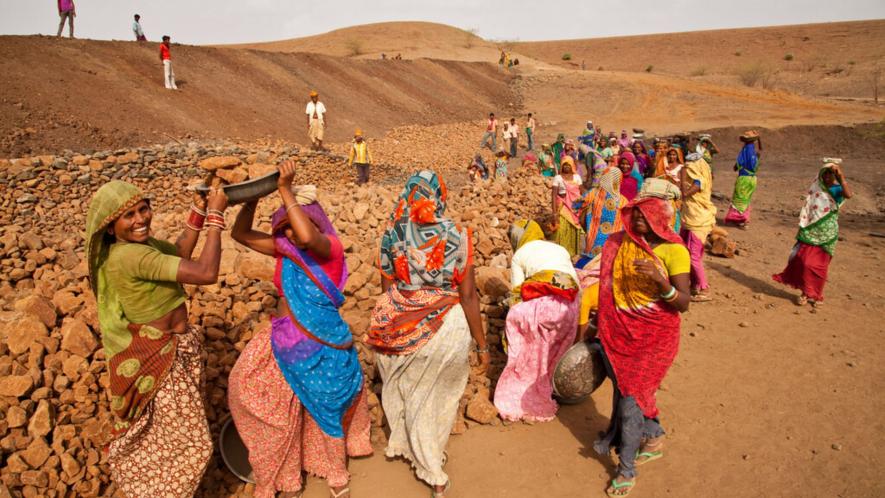
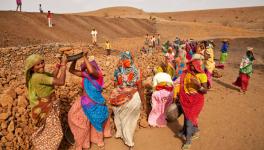
Representational Image. Image Courtesy: Flickr
New Delhi: Terming the new VBGRAMG rules as “hurdles to Right to Work”, as guaranteed by the Constitution, grassroots organisation, the NREGA Sangharsh Morcha has demanded that “VBGRAM is rolled back and the NREGA, which is a demand-based employment guarantee programme, is brought back.”
In a press statement issued after taking stock of the situation on the ground, the Morcha pointed out that NREGA was “born out of a people’s struggle”. But, today its promise of the right to work has been “hurriedly, illegally and unconstitutionally demolished by an Act born out of a technocratic imagination, devoid of consultation with states, workers and unions.”
Referring to the Centre’s new draft rules, the Morcha said the VBGRAMG (Viksit Bharat Guarantee for Rozgar and Aajeevika Mission -Gramin), which is projected as an “enhanced” replacement for the Mahatma Gandhi National Rural Employment Guarantee Act (MGNREGA),
claims to provide an enhanced employment guarantee of 125 days per household. “However, an analysis of the Government’s own data and proposed fund allocations demonstrates that this promise is neither financially backed nor administratively feasible because of the extent of centralization and discretion at the hands of the Central Government,” read the statement, adding that “Our first demand is that the VBGRAM is rolled back and the NREGA, which is a demand-based employment guarantee programme, is brought back.”
The Morcha said under the new Act, the government has fixed allocations for each state and is demanding that state governments allocate 40% of the programme months after state budgets have been passed. Nikhil Dey of the NREGA Sangharsh Morcha, said this Act weakened federalism.
B. Venkat, general secretary of the All India Agricultural Workers’ Union announced sustained protests across the country beginning on July 1, until the VBRAMG is repealed, a series of actions is planned including speaking to politicians and putting pressure on the central and state governments.
“A majority of workers are women, 25% are Dalits and Adivasis. The attack on workers is clearly an attack on social justice,” he added.
Flagging technical issues, the Morcha cited the example of Kamla Devi, a NREGA worker from the Rajasthan Asangatith Mazdoor Union, stated that digital attendance processes were causing extreme difficulties for workers. “For many women, the photographs of their eyes are not taken. Many works take place in the jungle where there is no signal leading to inability to mark online attendance. If they want to pass laws, why are they targeting workers? Why can’t they impose these technologies on functionaries and themselves? We do not want this new law, and we ask the Modi government to give us back the Rozgar guarantee.,” said Devi.
Jagannath, another NREGA worker from Sitapur, UP, said, “From last year itself we did not get 100 days of work. It takes almost three hours for us to put online attendance. Many workers who are not able to put their faces into the machine just leave, unable to work and mark attendance. Geotagging of works is not working because of network issues. They ask us to submit applications through mobile phones which is not possible for many workers, particularly those without mobile phones who cannot read.”
Nikhil Dey also said that “The draft rules also call for the making of new job cards based on E-KYC, a digital requirement that has caused devastation across the country.”
The Morcha also contested the Centre’s claim of 125 days of guaranteed work, saying that it was just in “name.”
It said, eight days ago, the proposed interim allocations made to states show grossly inadequate to support even to reach the current level of employment generation of 100 days, let alone an expanded guarantee of 125 days.
The Morcha, with the help of graphs and figures, has analysed that the proposed interim allocation for every active job card showing that the number of persondays that can be generated under the proposed allocations falls dramatically short of the promised 125 days.
“In no major state does the proposed allocation support even half of the promised entitlement. In several states, the allocation would finance barely one-fifth of the claimed 125 days guarantee. For instance:
● Andhra Pradesh would be able to generate only 42.35 persondays per active Job Card.
● Chhattisgarh only 39.07 persondays.
● Bihar only 30.94 persondays.
● Karnataka only 26.44 persondays.
● Madhya Pradesh only 25.66 persondays.
● Uttar Pradesh only 27.50 persondays.
● Maharashtra only 14.40 persondays.
● Haryana only 13.78 persondays.
The Morcha demanded that the Central government:
1. Immediately repeal the VBGRAMG and bring back a strengthened MGNREGA
2. Ensure payment of statutory minimum wages
3. Remove NMMS, facial and biometric authentication and ensure continuous transparency, grievance redress and social audits to check corruption
Get the latest reports & analysis with people's perspective on Protests, movements & deep analytical videos, discussions of the current affairs in your Telegram app. Subscribe to NewsClick's Telegram channel & get Real-Time updates on stories, as they get published on our website.