






New Transgender Law: Who is Allowed to Be?
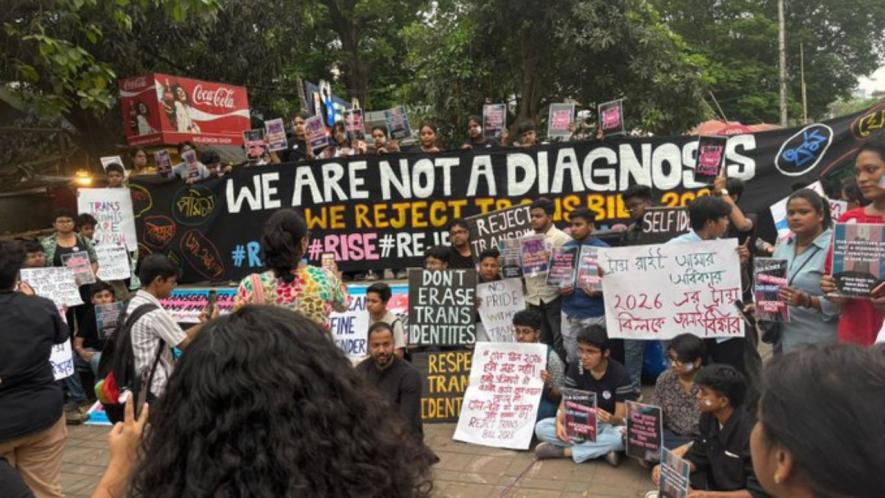
Image: Twitter
India’s transgender law has been fundamentally altered through recent amendments. At the heart of this change lies a decisive shift: the removal of self-identification as the basis for recognising transgender identity. In its place, the amended law introduces a system of medical verification and bureaucratic certification, requiring individuals to be assessed and approved before their identity can be legally recognised.
It also narrows the definition of who qualifies as transgender and places existing identity certificates under a cloud of uncertainty. What appears, at first glance, as administrative restructuring is, in effect, a profound shift in how identity itself is understood and governed.
A right that must be mediated through such a process is not necessarily problematic in itself; modern states routinely rely on certification. However, in this case the problem lies with the assumption that gender identity that is an intimate, self-experienced dimension of personhood can be subjected to medical verification.
What the amended law introduces is not merely a process of certification, but a regime of arbitrary judgement, where the authority to define identity is transferred from the individual to institutions ill-equipped to adjudicate it.
Gender identity does not present itself as a clinical fact that can be diagnosed. Gender identity must not be treated analogous to a disease, a disability, or a measurable physiological condition. It is to be understood, lived, experienced, and articulated from within. To subject it to medical scrutiny is to misunderstand its very nature. And once such scrutiny is institutionalised, it inevitably becomes discretionary; different boards, different interpretations, different thresholds of “proof,” producing an uneven and unpredictable landscape of recognition. What is at stake, therefore, is not procedure but arbitrariness.
In a country of nearly 140 crore people, barely 34,000 individuals have so far been able to formally assert their transgender identity through self-certification. This number does not signal absence; it signals fear. It reflects stigma, social sanction, and the immense cost of visibility. To come out, even under a self-identification regime, requires extraordinary courage, often in the face of familial rejection, economic vulnerability, and everyday violence. The amended law replaces this fragile opening with a far more onerous pathway of medical scrutiny and bureaucratic validation. What was already difficult is being rendered prohibitive. When recognition itself becomes conditional, invisibility is not accidental; it is produced.
This is, at its core, a constitutional question. Article 14 guarantees equality before the law; Article 15 prohibits discrimination on grounds of sex, a category the Supreme Court has interpreted to include gender identity; Article 19 protects the freedom of expression, including the right to express one’s identity; and Article 21 guarantees life with dignity, autonomy, and privacy.
The NALSA vs. Union of India judgment located gender identity firmly within this constitutional architecture, affirming that self-identification is intrinsic to dignity and personal autonomy. By introducing medical gatekeeping into a domain that is inherently self-determined, the State does not merely regulate access; it alters the very basis of recognition.
Drawing on economist Amartya Sen’s capabilities approach, the issue at hand is not whether the State continues to enumerate schemes or benefits, but whether individuals retain the substantive freedom to be and to do. Capabilities are not formal entitlements alone; they are the real possibility of living a life one has reason to value. In the earlier framework, self-identification functioned as a capability-enabler. It allowed individuals to recognise themselves, to be recognised by institutions, and to access education, healthcare, and work without mediation. The amendment disrupts this conversion at its very foundation.
The law now inserts a new and restrictive chain, identity must pass through medical validation and administrative approval before it can translate into access. Each step becomes a site of possible exclusion. This produces unequal conversion, where those with access to medical systems navigate the process while the most marginalised are filtered out. It generates capability failure, where rights exist formally but cannot be exercised in practice. And it entrenches institutional dependency, where the self is no longer sufficient and one must be validated in order to exist.
The consequences will not be merely procedural; they will be deeply psychological. What is at stake is hope, the capacity to imagine a future and act towards it. Hope, here is understood as a foundational condition of agency. It is what enables individuals to invest in education, seek employment, enter public spaces, and claim institutional belonging. When identity itself becomes uncertain, this foundation begins to erode.
Read Also: Transgender Bill: A Law of Identity, Passed Without Listening
Uncertainty about recognition alters behaviour long before any formal exclusion takes place. Individuals begin to anticipate rejection at the level of documentation, at the workplace, in educational institutions, and in everyday interactions with the State. This anticipation produces withdrawal. Aspirations are scaled down, participation is deferred, and engagement with institutions becomes cautious, fragmented, or altogether absent. The existential question shifts from “what can I become?” to “will I be recognised at all?”
This is anticipatory exclusion, exclusion that operates not through explicit denial, but through the internalisation of likely barriers. It is subtle, often invisible, but profoundly consequential. It does not require the State to deny access; it only requires the State to make access uncertain.
In capability terms, this represents a contraction not only of achieved functionings but of the feasible set itself. Choices that once appeared available begin to disappear from consideration. The set of possibility narrows. What remains is not merely a lack of opportunity, but a reconfiguration of expectations, where individuals adjust their aspirations downward in response to structural constraints.
A society that conditions recognition in this manner does not simply restrict opportunity; it reshapes the very imagination of what is possible. And when the imagination of possibility is constrained, exclusion becomes self-reinforcing, operating as much within the individual as through external institutions.
At the same time, the amended law generates systemic instability. Previously issued identity certificates now exist in a zone of uncertainty, raising the possibility of re-verification and loss of access. Medical boards become arbiters of identity, introducing discretion, variation, and delay into what was earlier a matter of self-declaration. Recognition becomes fragmented, uneven, and contingent. The result is a condition of capability volatility, where access to rights is no longer predictable and institutional trust begins to erode.
This instability is not incidental; it signals a deeper philosophical shift. The earlier framework was grounded in a rights-based logic of identity enabled rights, that expanded capabilities. The amended framework moves toward conditionality: identity is screened, eligibility is filtered, and access becomes contingent. What emerges is not merely a change in procedure, but a transformation in the relationship between citizen and State. It resembles not a regime of rights, but a regime of rationing, where dignity itself is administered.
Seen through a broader political economy lens, this reflects a shift from enabling inclusion to managing populations. Identity is no longer treated as a site of freedom; it becomes an object of regulation. Welfare is no longer anchored in universality or justice; it is targeted, conditional, and exclusionary.
The State does not withdraw benefits; it redraws the boundaries of who is permitted to access them. Identity is subjected to arbitrary validation and freedom ceases to be foundational; it becomes derivative, hope diminishes, and chaos follows.
A constitutional democracy is tested not by how it defines its citizens, but by whether it allows them to define themselves. When identity is made contingent on external validation, what is diminished is not merely recognition, but the very conditions under which dignity can be lived. The damage does not remain confined to law or policy; it reshapes how individuals see their place in the world narrowing possibility, eroding hope, and replacing certainty with instability.
Shirin Akhter is Associate Professor at Zakir Husain Delhi College, University of Delhi. The views are personal.
Get the latest reports & analysis with people's perspective on Protests, movements & deep analytical videos, discussions of the current affairs in your Telegram app. Subscribe to NewsClick's Telegram channel & get Real-Time updates on stories, as they get published on our website.