





MP: Why an Amrit Sarovar Pond Failed to Recharge Groundwater in a Bhopal Village
A follow-up visit to Gunga shows how poor design, seepage and administrative delays rendered a community-funded water project ineffective.
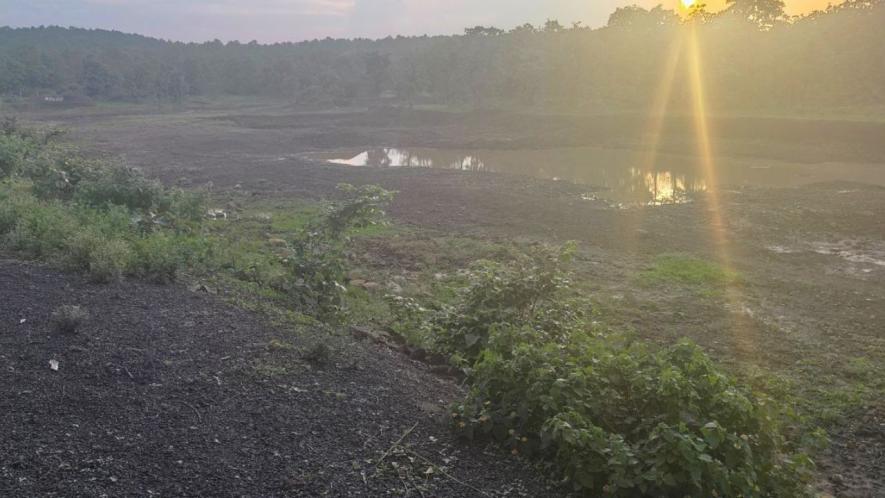
The pond still exists, its embankments neatly paved and chairs placed along the retention wall. But it barely holds water. (Photo - Sanavver Shafi, 101Reporters)
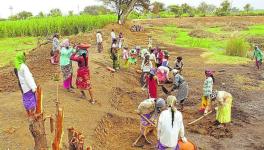
Bhopal, Madhya Pradesh: In 2022, 101Reporters reported on a community-led effort in Gunga village, around 25 km from Bhopal, where residents pooled money, fuel and heavy machinery to help the district panchayat build a 50,000 cubic metre pond under the Mahatma Gandhi National Rural Employment Guarantee Act and the Amrit Sarovar Yojana. Officials said at the time that the project would recharge groundwater, ease chronic water scarcity and create new livelihoods through activities such as fish farming.
In December 2025, nearly three years later, 101Reporters returned to Gunga to see what had become of those promises. The pond still exists, its embankments neatly paved and chairs placed along the retention wall. But it holds no water. Within 25 to 30 days of the monsoon ending, the pond dries up completely, leaving daily life in the village much as it was before the project began.
The daily routine of labourer Dharmendra Ahirwar (38) has remained unchanged since the pond came into being. The promises of improved water supply have come to nothing: he still fetches water from a private borewell three kilometres away.
For Aarti Ahirwar (20), a Class 12 student, each day begins with the search for water. “Even after the pond was built, nothing changed,” she said. “No water comes from the taps under the Nal Jal scheme. We have complained to everyone, from the sarpanch and secretary to the CM Helpline, but the problem remains the same.”
In search of water, Aarti sometimes misses school. “For now, we manage with private borewells nearby and two government handpumps in the village,” she added. “But in summer, we have to bring water from Karodia village, several kilometres away.”
This is not just Aarti’s experience but the collective reality of Gunga, a village of 4,650 people that has faced a groundwater crisis for decades. The water table here has fallen to 450-500 feet, and in summer, it drops beyond 800 feet.
Technical failure
Villagers and experts say the failure of the pond was not inevitable, but the result of basic engineering flaws.
When the project began in 2022, then district Chief Executive Officer Rituraj Singh said the site had been selected based on scientific recommendations. But villagers say that in the Rs 21.4 lakh project, emphasis was placed on “beautification” while core engineering requirements were ignored.
Sadhana Lodhi, who leads a women’s self-help group in the village, said the most serious flaw lies in the retention wall built along the road-facing side. “Water leaks from there,” she said.
Farmer Madanlal, who contributed a tractor-trolley and 40 litres of diesel during construction, said the embankment meant to hold water was poorly built, with multiple leakage points. “Other parts of the pond have also been left open. When the water level rises, pressure builds on weak sections and the water seeps out,” he said.
Bhupendra Singh, who provided a JCB and 350 litres of diesel, said the administration installed paver blocks and chairs for aesthetic appeal but ignored essential techniques such as clay lining. “That is why the water does not stay,” he said.
Food and Agriculture Organization guidelines recommend that the bottom of a pond contain at least a 20% clay-rich soil layer to prevent seepage. Villagers allege that while the site earlier collected rainwater naturally, the absence of a strong embankment and adequate depth allowed water to drain away.
“We thought the administration would deepen the pond and strengthen the embankment so that water would remain for a few months after the rains,” Sadhana Lodhi said. “But rain ends… water ends.”
Environmental expert Subhash C Pandey said many of Madhya Pradesh’s 5,839 Amrit Sarovars suffer from similar problems. “Without proper site surveys and geotechnical testing, a pond is nothing more than a pit,” he said, adding that desilting and maintenance are rarely carried out, further reducing capacity. As a result, promised livelihoods such as fish farming have failed to materialise.
For farmers like Umrao Singh, the consequences are immediate. Singh, who owns 10 acres of land and contributed equipment and diesel to the project, has two borewells, one at 400 feet and another at 900 feet, but both dry up during summer. His field lies about 500 metres from the pond, yet even the deeper borewell yields only one or two buckets every 30 to 60 minutes in peak summer.
“It was said the pond would hold water year-round and recharge surrounding land,” Singh said. “I hoped at least one assured crop would be possible. That hope now seems unrealistic.”
Even promised livelihoods such as fish farming have failed to materialise (Photo - Sanavver Shafi, 101Reporters)
Why the pond is not working
A water structure creates impact only if it retains water long enough to recharge groundwater or meet domestic, livestock or irrigation needs.
Environmental expert Rakesh Diwan said it is scientifically difficult to prescribe a fixed number of days for water retention, as this depends on soil type, geology, catchment, outlet design, lining and maintenance. However, he said, the core objective of the Amrit Sarovar scheme is to extend groundwater recharge beyond the brief monsoon window.
Central Ground Water Board data show that in many regions, most natural recharge occurs within just 20 to 30 days of the monsoon. Recharge structures are therefore meant to extend this period to up to three months. In Gunga, the pond retains water for only 25 to 30 days, effectively nullifying its recharge function.
Environmental activist Rashid Noor Khan said the most visible point of failure in Gunga is the retention wall. “If joints are open or the slope and spillway are faulty, the pond turns into a drain,” he said. “Without water retention, both recharge and village supply fail.”
The failure of the pond has had serious consequences in a region already under groundwater stress. According to the Central Ground Water Board’s Dynamic Ground Water Resources Report 2024, Bhopal district falls in the “semi-critical” category, extracting 79.29% of its groundwater annually while recharge remains limited to 20.71%.
The crisis extends beyond the district. Across India, more than 11% of the country’s 6,553 groundwater Assessment Units are classified as “over-exploited”, where extraction exceeds recharge. Experts say it is precisely in such regions that recharge structures must be designed and maintained with care.
For residents like Nafisa Bi (48), who moved to Gunga after her marriage in 1997, the pond’s technical failure has only prolonged an old struggle. “I spent my youth standing in queues for water,” she said. “Now the same fate is written for my children. Files are full of assurances, but the water did not stay in the village pond.”
However, when villagers raised concerns about seepage and design flaws, they encountered bureaucratic delays. Santosh Lodhi, the sarpanch of Gunga, said a proposal for technical improvements and wall repairs was sent eight months ago and is still awaiting approval.
The delay has been especially costly for villagers who collectively contributed Rs 4.28 lakh to the project. Gunga, however, is not an exception. Across the state and the country, many ponds exist in form, but not in function.
Beyond statistics
Launched in April 2022, the Amrit Sarovar scheme aimed to build at least 75 water bodies in every district. By March 2025, 68,842 ponds had been constructed nationwide. Uttar Pradesh leads with 16,630 ponds, followed by Madhya Pradesh with 5,839. The government has described the mission as a landmark water conservation effort.
But villages like Gunga show that “completion” does not equal “usefulness”.
A 2025 impact assessment by the NGO, GIZ India reported groundwater recharge effects from Amrit Sarovars in Madhya Pradesh up to a radius of 1,164.7 metres, the highest in the country. Pandey said such figures may hold where engineering is sound. “But in hundreds of places like Gunga, the impact is zero because water simply does not stay,” he said.
Sanavver Shafi is a freelance journalist and a member of 101Reporters, a pan-India network of grassroots reporters.
Get the latest reports & analysis with people's perspective on Protests, movements & deep analytical videos, discussions of the current affairs in your Telegram app. Subscribe to NewsClick's Telegram channel & get Real-Time updates on stories, as they get published on our website.