





Marathwada: Climate Extremes, Microfinance Loans Driving Women Into Debt Cycle
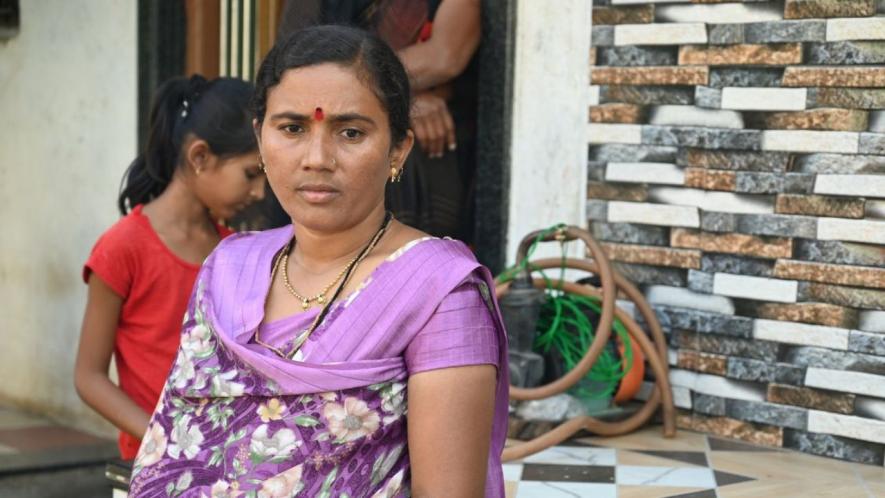
Shamal Kate, who has no work in the fields, no money in hand, and struggles to repay her loans (Photo - Sanjana Khandare, 101Reporters)
Parbhani, Maharashtra: “You still have the responsibility of my marriage, and so that you don’t do something like what my brother did, I am ending my life… Your Sarika”
In Manoli village of Parbhani district, Maharashtra, Sarika (17) left behind a note for her family in February 2021 before she took her own life.
“Dear Papa. Brother went to the field and killed himself because all the crops were scorched,” she wrote. “There is a burden of loans upon our house. Because the rains did not come, the sowing you did by taking loans got scorched…I cannot bear to see your suffering. The loan from my sister’s marriage is yet to be repaid. You still have the responsibility of my marriage.”
In the same district, Lalita Nagorao Ghode (47), a woman farmer from Sonpeth taluka, left her village in the middle of the night in January 2025 and has been missing ever since. Her neighbour, Raju Kate, said her life had “become unbearable”.
Ghode had been allotted a house under a government housing scheme, but when the sanctioned amount proved insufficient to complete the construction, she borrowed Rs 3 lakh in parts from a microfinance company in 2024. To repay that, she took further loans from villagers.
The loan amount had stacked up so that she owed Rs 300 everyday to the microfinance company.
Ghode had no farmland of her own and survived on daily-wage work on others’ fields. But repeated bouts of heavy rain and cloudbursts in Parbhani during the monsoon season last year had wiped out work opportunities for her.
“When there wasn’t even enough food for two meals a day, how was she supposed to pay back her loan?” Kate asked.
He said loan recovery agents began visiting her daily, threatening her and abusing her verbally. With no income and mounting pressure, Ghode sold the half-built house she had dreamt of owning. That same night, carrying a few belongings, she quietly left the village. No one knows where she went.
Ghode is not alone. Microfinance companies aggressively market loans, personal loans, home loans, business loans, mortgage loans, vehicle loans, farmland loans, promising instant approval. Drawn in by these offers, many women farmers across Marathwada have fallen into a deepening debt trap.
Easy loans, hard lives
Across Maharashtra, networks of self-help groups once gave women financial stability. But in a region battered by unseasonal rain, long dry spells and sudden hailstorms, every calamity hits the farmer’s household directly. When crops fail, everything collapses at once and for the next season, taking another loan becomes the only way to survive. Into this desperation have stepped microfinance companies, travelling from village to village with promises of “easy instalments” and “instant approval”.
Studies show the majority of borrowers from some microfinance units are women. According to ‘Sa-Dhan’, the association of microfinance companies, India has 86.7 million microfinance borrowers: 99% of them women. Of these, 77% women live in rural areas.
The process of getting a loan is simple. A person just has to submit an Aadhaar and PAN, form a small group with neighbours, and money is disbursed. But as agricultural incomes collapse under climate stress, repayment becomes impossible. For many agricultural labourers, mornings now begin with loan recovery agents at their door and nights end in fear of the next instalment. Microfinance companies aggressively target women: agents visit homes and say, “Your husband’s signature isn’t needed”, or “Take the loan in your own name”.
On November 2, 2025, sitting on the verandah of her home, Meera Kharat described how the debt piled up for her. She first borrowed Rs 60,000, then Rs 50,000 from another company, and another Rs 25,000 later. “I was paying Rs 7,000 every month,” she told 101Reporters. “But when the rains failed, work stopped. How are we supposed to pay?”
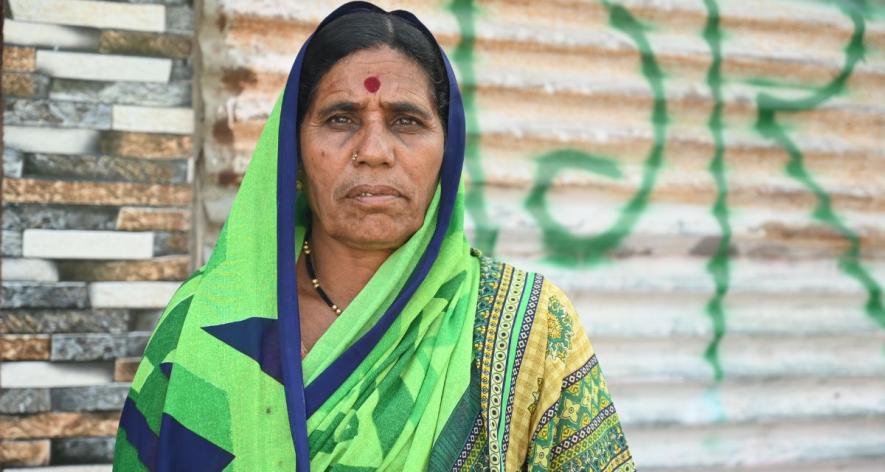
“If work in the fields starts again, we will be able to repay the loans,_ says Nirmala Kapse (Photo - Sanjana Khandare, 101Reporters).
Her daughter Divya (12), listened as she spoke. “We take loans only when there’s a need, repairing the roof, school fees, seeds, fertiliser. But when unseasonal rains destroy everything, where do we get money?
A little away, Shamal Kate recounted a similar tale. “Earlier, we could repay small loans. Now companies come every month offering more. We take one to pay another. In the end, we’re buried under a burden of debt.” She counted on her fingers: Rs 70,000 from one company, Rs 60,000 from another, Rs 50,000 from a third – which amounted to over Rs 1.8 lakh total. “Everything depends on the monsoon. If it rains well, we can repay. If it does not, we are finished.”
Women in Sonpeth said that agents visit the village every week. If an instalment is missed, they stand at the door, shout, and humiliate women publicly. “They say, ‘You wear gold but don’t repay!’ They threaten to take utensils, the TV, even goats. When men aren’t home, they stand outside shouting until we feel ashamed and somehow pay.”
A system without safeguards
This constant humiliation has forced many women from stepping out. The mental pressure has grown so intense that some stop eating, some fall ill, and some, like Ghode, slip away quietly in the night.
Lalkrishna Bahadur, a senior executive officer with Bharat Finance, oversees loan disbursement for small enterprises, goat-rearing, and home-based businesses through women’s self-help groups.
He said: “Each group has 11 women members, and they are given loans of up to one lakh rupees. We verify documents and check whether the money will genuinely be used for business. Every month, 40-50 self-help group files from Parbhani are approved, and about Rs 50 lakh is disbursed. Weekly installments range from Rs 4,500 to Rs 7,000, with an interest rate of 9.5%.”
If a woman misses a payment, she is charged a penalty of Rs 1,000. Failure to pay affects her credit score, making it impossible to obtain future loans. “If she still cannot repay, we file a court case,” he added.
According to feminist activist Surekha Ghadge from Jintur, “These women are neither recognised as farmers, nor as labourers, nor as entrepreneurs. They are invisible in every government record. When they earn, the system takes their labour. When they fall into debt, they vanish from every list, nobody even counts them as citizens.”
Local gram panchayats and the formal banking system have almost no oversight over these companies. They enter villages, give loans, collect money, and disappear. Women often don’t know which company they borrowed from, only that they must pay Rs 300-Rs 500 every week. “We don’t have papers or receipts,” said Sunita, another borrower. “The man comes, we give money. Sometimes a new agent comes and says our old installments weren’t counted, so we must start again. What do we do then?”
Microfinance companies have expanded sharply across Marathwada and Vidarbha in the last five years. According to the Microfinance Institutions Network (MFIN), there are now 1,491 microfinance branches in Maharashtra, one of the five highest-borrowing states in the country. Districts like Parbhani, Beed, Jalna, Osmanabad and Nanded account for a significant share of this lending boom.
“It’s a modern debt trap,” said Sheetal Kamble of Bajaj Finance Limited, who has researched women’s microfinance groups in Beed and Parbhani. “Companies tell women this is empowerment, take loans, do business. But there’s no market support, no steady income, no relief when crops fail. So they keep borrowing to repay older loans. That is not empowerment. That is entrapment.”
Ghadge added that the burden falls entirely on women. “When instalments aren’t paid, the agents scold the women, not the men. The men say, ‘It is your loan. You handle it.’ So all the pressure falls on her.”
Even during the Covid-19 lockdown, when farming came to a halt, loan recovery continued. Rekha from Bhogaon village recalled: “We told them we would pay later. They said, ‘If you don’t pay now, your group will be blacklisted.’ Then we had to borrow from neighbours just to pay them. How long can that go on?”
Invisible losses
In a study by the Tata Institute of Social Sciences (TISS) on climate vulnerability and women’s livelihoods in Marathwada, researchers found that women are routinely excluded from formal credit systems like banks. As a result, they depend almost entirely on microfinance companies and informal moneylenders institutions that rarely evaluate repayment capacity in the context of climate distress.
Microfinance units take advantage of this gap in the formal system.
“The microfinance model assumes income stability,” said Professor Vandana Deshmukh of TISS. “But in a drought-prone area like Marathwada, stability doesn’t exist. Every failed monsoon pushes women deeper into debt.”
The shift is visible on the ground. “Earlier, when our self-help group met, we talked about savings or farming,” said Meera Kharat. “Now every meeting is about who has paid, who hasn’t, and who’s being threatened by which company.”
Researchers have noted that the stress and humiliation faced by indebted women often lead to mental health breakdowns, marital conflict and, in some cases, suicidal thoughts. But because women’s names rarely appear as “farmers” in land records, they are excluded from farmer-suicide statistics and compensation schemes. “When a man dies by suicide, it’s counted as a farmer death,” explained Kamble. “When a woman borrower dies because she can’t repay, she’s labelled a ‘housewife’. Her death doesn’t count as agrarian distress, even though the cause is the same.”
According to National Crime Records Bureau data, suicides among female agricultural labourers and homemakers in rural Maharashtra have steadily risen between 2018 and 2023. Nationally in 2018, of the 4,586 suicides by agricultural labourers, 515 were women, a number that has increased in subsequent years, particularly in drought-affected districts.
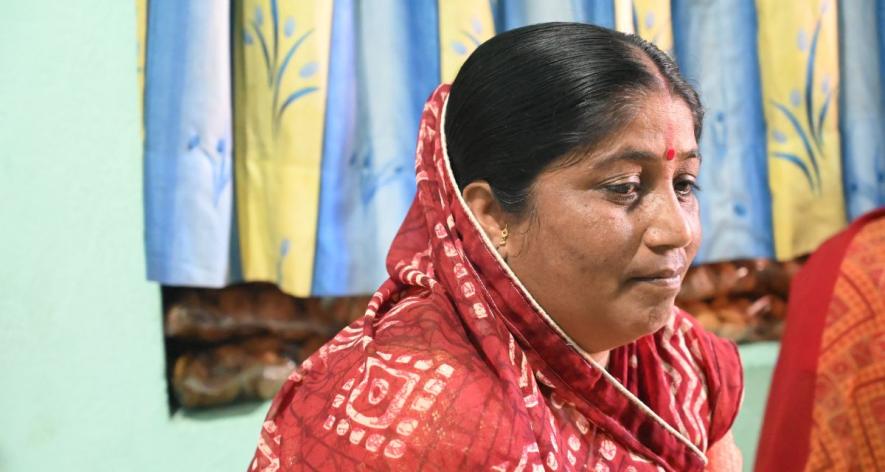
Meera Kharat, trapped under the burden of debt (Photo - Sanjana Khandare, 101Reporters).
“We see these women in every village working all day, attending meetings, worrying about loans,” said Ghadge. “They are holding up the rural economy. But in policy documents, they do not exist.”
As climate shocks intensify in the form of droughts, floods and crop failures, experts warn that women’s financial vulnerability will deepen. “Unless microfinance institutions are regulated and climate-linked credit relief is built into the system, women in Marathwada will continue paying not just with money, but with their health, dignity and sometimes their lives,” said climate and gender researcher Smita Kulkarni.
Kulkari’s statement echoes in the narrow lanes of Sonpeth where as lamps flicker and kitchen smoke drifts between homes, the evening conversations are not about festivals or songs, but about repayments. “How much this week?” “How much left?” “When will the agent come again?” Each household keeps a small notebook, pages smudged with thumbprints and oil, a record of survival through arithmetic.
During field visits, the district administration speaks of “financial inclusion,” “women’s empowerment,” and “entrepreneurship.” But in the villages, empowerment has turned into endurance. “We wanted to stand on our feet,” Meera said. “But now the ground itself is slipping.”
“We don’t want sympathy,” added Shamal Kate, tying a cloth around her head as she started walking toward the dry fields. “Just give us a chance to work, to earn, to live without running from debt collectors. The rain will come someday but we need to survive till then.”
Just then, clouds gathered over Parbhani, dark but uncertain. The women looked up at the sky, some with hope, some with fear. Because in Marathwada, every drop of rain carries both a promise and a debt.
Sanjana Khandare is a freelance journalist and a member of 101Reporters, a pan-India network of grassroots reporters.
Get the latest reports & analysis with people's perspective on Protests, movements & deep analytical videos, discussions of the current affairs in your Telegram app. Subscribe to NewsClick's Telegram channel & get Real-Time updates on stories, as they get published on our website.