





Manufacture of a Usable Past: NCERT & Hindutva Rewriting of Indian History

Representational Image. Image Courtesy: Flickr
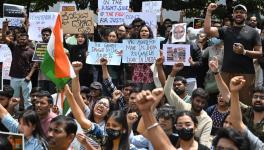
The past few weeks of encampment at Jantar Mantar by the Cockroach Janata Party (CJP) along with various Left organisations like SFI, AISA AND AISF, and nationwide protests, have shaken the power corridors of New Delhi and resulted in an unprecedented resignation of a cabinet minister for the first time since the victory of the Bhartiya Janata Party in 2014.
Education has become a live political fault line in India right now. While paper leaks and mismanagement have been the central taking point of the movement, Left groups have consistently pointed out the deeper embedded rot in the education system, where curriculum seems to have transformed into a frontier for the regime to establish its legitimacy and political-cultural world-view.
Nationalist projects also need a past, one which is comfortable for them to live with. However, the past on offer is very often inconvenient, ambiguous, or simply too complicated to serve present politics, a challenge that serves as catalyst for projects of remaking the past. Historian Eric Hobsbawm called this the invention of tradition, wherein there is a deliberate construction of a lineage or a set of origins along with a moral order and universe which is argued to be as ancient, pristine and beyond critical scrutiny given its sacred and unbroken continuity; even though much of it is in fact actually freshly assembled information arranged to the end of answering contemporary, modern needs.
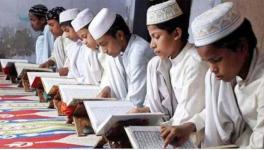
Italian communist thinker Antonio Gramsci gave another name for the end product of such undertakings: common sense, the layer of belief which is so deeply absorbed and accepted that it ceases to be an argument at all, and instead it is the only way things obviously are. School textbooks are an important site where this common sense takes shape. The textbooks reach a child before she has the tools to question them, and they do it under the authority of the state and the discipline of history itself, which is precisely why regimes carry a relentless and compulsive drive to remake a nation's self-understanding.
The Hindutva movement has pursued revision of history for a long time. Its account of the past rests on a few load-bearing claims: that Hindus are the original and continuous inhabitants of the subcontinent, stretching back to the first urbanisation and Harappan period; that the arrival of Islam had interrupted an otherwise harmonious civilisation and inflicted several centuries of unrelieved suffering on it; and the caste system, whatever its faults, is a secondary and largely colonial-era distortion rather than something woven into the fabric of the sub-continent’s religious and social life.
All these claims collapse against evidence, and cannot survive in the form the movement needs them to. Genetic and linguistic research supports migration into the subcontinent rather than an unbroken line running from Harappa to the Vedic age.
The five centuries of the Delhi Sultanate and the Mughal empire were, like every other period of subcontinental history, a mix of conquest, patronage, syncretism, and violence and cannot be categorised under a singular category of Dark Era. Caste hierarchies, far from being introduced by colonialism, have textual and social roots that predate colonialism by well over a thousand years, as generations of scholarship from Ambedkar onward have shown.
This is the gap that the revised NCERT textbooks, rolled out at every level from class six through class twelve, exist to close. For roughly a decade after the BJP’s rise to power in 2014, the NCERT curriculum had proven surprisingly resistant to wholesale rewriting. That resistance has now given way. What has replaced it is not a coherent alternative history so much as a patchwork of insertions, omissions, and reframing, each aimed at a different pressure point in the discipline, and each traceable back to one or another of Hindutva's foundational claims.
Reading the textbooks, chapter by chapter makes it apparent that it is not merely ideologically motivated revision which is visible, but rather a kind of muddle: contradictions within a single chapter, contradictions between chapters written for different classes, and a persistent unwillingness to follow any argument to a place the writers do not want it to go. This essay works through four of those pressure points, and then asks what it means for a country to raise a generation of students on a history built this way.
Remarkable Continuity, Invented On The Page
The clearest instance of this confusion is also the most consequential, because it touches Hindutva's founding myth of civilisational continuity. The class six textbook Exploring Society: India and Beyond opens its chapter on the Harappan civilisation by listing its various names - Indus, Harappan, Indus-Sarasvati, Sindhu-Sarasvati - and announcing that the book will use all of them. It then does nothing of the sort. The term "Harappan civilisation" never appears again in the chapter, even as the people themselves are still called Harappans throughout. "Indus-Sarasvati" recurs at least five times; "Sindhu-Sarasvati" twice. The term Sindhu-Sarasvati re-appears, briefly but more prominently, as the only term used for the civilisation in the textbook on social sciences for class nine. The class twelve textbook, by contrast, sticks to "Harappan civilisation" from beginning to end and never uses the Sarasvati formulation at all.
This is not a stylistic inconsistency. It is the seam where an argument the writers want to make meets an argument they cannot quite bring themselves to complete. Archaeology names cultures after the site where they were first identified, which is why "Harappan" remains the term of choice among working archaeologists. Today, well over a thousand sites are known, spread from Alamgirpur in western Uttar Pradesh to Sutkagen-dor on the Makran coast, from Manda in Jammu and Kashmir down to Malvan in Surat district, with an isolated site as far off as Shortughai in North Afghanistan.
An archaeological culture distributed across that much territory, along multiple river systems, is poorly served by a name tied to any single one of them, whether that name is Indus or Sarasvati. The identification of a string of sites along the dried bed of the Ghaggar-Hakra with the Rigvedic Sarasvati is a live and interesting hypothesis, one that even Romila Thapar's older NCERT text treated as worth entertaining, but it remains a hypothesis, not a settled finding, and the objection to river-based naming applies to the Sarasvati formulation exactly as much as it applies to “Indus Valley Civilisation."
What the Sarasvati formulation buys, when a textbook insists on it anyway, is continuity: a direct line from the Harappan cities to the age of Rigveda, and from there onward to a Hindu civilisation that has occupied the subcontinent since the beginning, needing no migration story to explain how the Vedic-speaking peoples got there. This is precisely the ground on which the Class 12 NCERT rejects the Aryan migration hypothesis outright, notwithstanding the weight of genetic and linguistic evidence behind it. But the chapter that would need to do the actual work of establishing that continuity, the class twelve chapter on Harappa itself, declines to touch the Sarasvati terminology at all, presumably because making the case at the level of specialised, university-track history invites exactly the scrutiny the term cannot survive. It is at the Class 6 and 8 level, where most students will encounter their last formal history lessons, that the claim gets planted and left uncontested. Very few of those students will go on to study history in college. Fewer still will ever read the counter-argument.
Turning The Past Into The Present's Mirror[1]
A second, subtler technique is anachronism: describing the past in the vocabulary of the present, so that old events come pre-loaded with contemporary political meaning. Historical method treats this as close to a cardinal sin, because it erases the very thing that makes a period worth studying on its own terms, the fact that people in the past operated within categories, loyalties, and constraints that were not ours.
The Class 6 textbook's account of Shivaji's night raid on Shaista Khan's camp offers a textbook case, in more than one sense. After describing the raid, in which Shaista Khan escaped having lost several fingers and abandoned Maharashtra, the text adds that "this daring raid resembles the modern-day surgical strike." A 17th-century Maratha ruler's assault on a Mughal governor is folded into the vocabulary that has, over the past decade, become central to Indian political rhetoric around cross-border military action against Pakistan.
The effect is to make Shivaji legible to a child not as a figure of his own century but as a proto-nationalist forerunner of today's state, and to make today's state, by the same gesture, an inheritor of an eternal Hindu tradition of righteous retaliation against a Muslim adversary. When put to test with the historical method such conflation is bound to be extremely untenable. Raiding for tribute is about as far from the self-image of a modern professional army as a historical practice gets, yet this is what the textbooks attempts at establishing.
The Maratha state, if studied on its own terms, reveals much more nuanced histories of statecraft and polity, of raiding, wars, alliances and conciliations, including those with muslim polities of the same period. It also reveals the friction between new polities like that of the Marathas and the existing Brahmanical order, histories which are conveniently ignored. Shivaji[2] has long been a central icon for the Hindutva movement's account of Hindu resistance to Muslim rule; a comparison this anachronistic does not happen by accident in a textbook that otherwise polices its language quite carefully[3] .
The historian David Ludden identifies this manoeuvre as a repeating ingredient in most nationalist history projects. This is territorial anachronism, or the projection of a present-day map backward onto a past that never organised itself along those lines, so that the boundary appears ancient rather than freshly drawn. Ludden's point is that a national map carries the emotional freight of belonging, prerogative , and exclusion. This freight , rather than geography, decides who counts as inside the nation and who counts as an intruder in it, legitimising present day structures of power and authority. Civilisational formulations throughout the textbook seem to project this very kind of demarcation, as which polities are constituents of the ancient and righteous civilisational lineage and which ones are aberrations to it.
Building a dark age out of a colonial habit
The most audacious revision sits at the opening of the history section in the class eight textbook, under a heading titled "A Note on History's Darker Periods." It concedes, reasonably enough in the abstract, that history often dwells on war and cruelty, and counsels that such periods be approached with detachment. What follows makes clear which centuries the framing is meant to cover: roughly six hundred years, from the establishment of the Mamluk dynasty in Delhi in 1206 through the decline of the Mughals after Aurangzeb. The textbook's own justification is that this era saw "war, abuse, fanaticism, bloodshed" descend suddenly upon an otherwise era of peaceful social order.
The claim does not withstand a moment's scrutiny, since the subcontinent before 1206 was no stranger to war, conquest, or bloodshed of its own. But its purpose is not really historical; it is to reintroduce, under a new vocabulary, the periodisation that the British colonial historian James Mill imposed on Indian history two centuries ago, dividing it into Hindu, Muslim, and British ages. That scheme was always a political instrument rather than a neutral chronology, useful to a colonial administration that wanted to present British rule as a rescue from Muslim tyranny. Hindutva has recycled it for a domestic audience, where it does a double duty: it supplies a centuries-long narrative of Hindu victimhood, which is the emotional fuel of majoritarian politics, and it erases everything about the period that complicates the picture, above all the Bhakti movements, whose critique of caste and Brahmanical authority makes them an uncomfortable fit for a history organised around Hindu suffering at Muslim hands rather than internal Brahmanical hierarchy[4] . Attention to the latter would also have brought light to structural caste violence, institutionalised as the varna-jaati system, which is a major constituent in any serious reconstruction of ancient and medieval Indian history, and thus, discredit any framing of pre-sultanate landscape as harmonious and
The textbook's treatment of the Delhi Sultans compounds this. It notes, accurately, that the Sultans “lived in luxury funded by plunder, taxation, and the slave trade” — a description equally true of essentially every medieval court anywhere in the world, and offered here without that comparison, so that ordinary medieval statecraft reads as evidence of a uniquely foreign and barbaric rule.
The section on temple destruction follows the same pattern. It states that the period saw attacks on Buddhist, Jain, and Hindu religious images, motivated not primarily by plunder but by iconoclasm, which it later defines as unique to Islamic polities. Most serious historians situate temple desecration in the wider subcontinental practice of desecrating a defeated rival's patronised deity and temple, a practice that long predates the arrival of Turkic rule.
Richard Eaton's extensive research on temple desecration lays out the pattern clearly: in 642, the Pallava king Narasimhavarman I looted the image of Ganesha from the Chalukyan capital at Vatapi; in the eighth century, Bengali troops destroyed what they believed was the state deity of the Kashmiri king Lalitaditya; in the early tenth century, the Rashtrakuta ruler Indra III not only destroyed a Pratihara temple at Kalapriya but took evident pride in recording it. Temples of state deities were understood across the subcontinent as targets in war precisely because they embodied a rival king's authority. None of this excuses the destruction that did occur under Turkic and Mughal rule; it simply means that treating that destruction as the unique signature of Muslim conquest, rather than a regional political practice that Muslim rulers also participated in, is bad history in service of a predetermined conclusion.
In the same textbook for class 8, It is noted that Aurangzeb issued a blanket ban on all non-muslim institutions of education. This seems to be based off a de-contextualised reading of a court Farman dated 1669. It quotes the order as instructing provincial governors "to demolish schools and temples of the infidels and put down their teachings and religious practices," presenting it as a blanket order for religious persecution. The fuller record, found in the Ma'athir-i 'Alamgiri, situates the order as a response to a specific report reaching the court that April: that certain teachers in Thatta, Multan, and Benares were spreading what the court called "false books" and drawing students of both Hindu and Muslim background from great distances. Whatever the court's actual objection to this teaching was, the order reads as a response to a targeted complaint about a specific mode of instruction at certain specific locations, not a general campaign against the worship and practices of non-muslim groups, and it sits awkwardly beside the extensive documentary record of land grants and patronage that Aurangzeb extended to various sects, communities, temples and religious institutions throughout his reign, what Richard Eaton and Satish Chandra, along with others have well highlighted in their work on Aurangzeb. This misreading of the Aurangzeb record is not new; Hindu nationalist historians going back to Sita Ram Goel have leaned on selectively quoted Persian court sources for decades, by reading Persian hyperbole at its face value. Mainstream historiography corrected the record long ago. The reappearance of this long rejected extrapolation here is clearly a politically motivated choice[5] .
The Caste Violence That Disappears
The fourth pressure point is caste, and here the method is not distortion so much as removal. The previous class eight social science textbook carried a dedicated chapter on women, caste, and reform. The revised edition drops it, and caste as a subject barely surfaces anywhere else in the new curriculum. Where the class six social science text does address the varna-jati system, it offers the following account: that “the system was more flexible in earlier periods and became rigid over time, in particular during the British rule in India," and that varna-jati, while significant, is only one of several mechanisms shaping Indian society.
Both halves of that sentence do real ideological work. The first pushes the hardening of caste hierarchy onto the colonial period, letting pre-colonial Hindu society off the hook for a rigidity that, as the historical and textual record shows, long predates British rule. The second minimises caste's centrality to Indian social life by placing it on a list alongside unspecified other factors, treating a structuring institution as one variable among many. Both moves protect the same thing: a vision of a harmonious, undivided "Hindu society" that Hindutva politics needs in order to mobilise Hindus as a single vote bank across caste lines, something the movement's own internal history, from its Brahmanical leadership to its uneasy relationship with Dalit assertion, makes considerably harder to sustain than the textbook suggests. A curriculum genuinely interested in restoring suppressed history would have expanded its treatment of caste and gender not deleted it. That it has done the opposite, in a project explicitly framed as correcting historical injustice, is the clearest evidence that the aim is at producing a rather communitarian history, where hinduism becomes an homogenised category rather than the diverse and stratified social reality it that is swept under the rug.
Continuity For The Victors, Catastrophe On Loan
There is an older vocabulary for what these four moves add up to, and it comes from Walter Benjamin in his Philosophy of History, written in 1940. Here he argues that the historian who identifies with the past as an unbroken inheritance is, whether he admits it or not, identifying with whoever currently holds power, because that inheritance, the "cultural heritage" passed down as a triumphal procession, belongs to "the heirs of all those who have ever been victorious." Continuity thus is what gets constructed for the people who won. Set against this is what Benjamin calls the tradition of the oppressed, for whom the state of emergency is not an interruption of history but its rule: not a chain of events but a single unbroken catastrophe piling wreckage at its own feet. The attempt at establishing continuity from Harappan culture to the Vedic age seeks to manufacture an unbroken civilisational line running from the Harappan urban centres, through the Vedas to the present, so that whoever stands at the end of that line inherits it as birthright. That is what continuity is for.
But framing of the period of muslim polities, as an “Dark Age”, does something Benjamin's schema does not anticipate. It assigns the vocabulary of rupture, emergency, centuries of unrelieved catastrophe, to the same party that is supposedly the uncontested heir to the so called eternal and essentially Hindu civilisation. Hindutva historiography wants continuity and catastrophe at once, applied to the eternal Hindu civilisation which is perpetually at the risk of imminent catastrophe and subjugation. A textbook that wants its readers to feel both at the same time is not describing a historical position so much as borrowing an emotional register it has no structural claim to, which is catastrophe without the risk of actually occupying any losing side of history.
What a common sense costs
None of these four revisions reads, on its own, as overtly dramatic falsification. That is what makes the method effective. A confused nomenclature here, an unearned comparison there, a selectively quoted order, a deleted chapter: each is small enough to defend individually, and cumulatively decisive enough to rebuild a child's sense of who did what to whom over two thousand years of subcontinental history. Gramsci's point about hegemony was never that a ruling narrative announces itself as ideology. It is that it stops looking like an argument at all, and becomes simply what everyone already knows, absorbed before the tools to interrogate it exist. That is what a Class 6 or Class 8 textbook does better than almost any other instrument a political movement could design, because most of the students reading it will never take another history course.
What is at stake, then, is not a dispute between two versions of the past that reasonable people might weigh against each other. It is whether the discipline of history, with its ordinary and unglamorous obligations to evidence, context, and the refusal to read the present back into the past, survives as something Indian children are actually taught, or whether it is replaced by a story whose only real test is whether it flatters the politics of the government that commissioned it. Historians can and do argue about the Aryan migration, about the balance of plunder and patronage under the Delhi Sultanate, about how rigid caste hierarchy really was in any given century. What they cannot do, and what these textbooks do throughout, is settle those arguments in advance and then wish away every piece of evidence that points the other way.
A country's history curriculum is usually the last place its citizens will encounter organised, evidence-based arguments about their own past before they either forget the subject or make their peace with whatever version of it they were handed at the age of 13 years. It is difficult to imagine a more consequential place to get this wrong.
The writer is an activist with the Students' Federation of India and currently a Master's student in the Department of History, University of Delhi. The views are personal.
Get the latest reports & analysis with people's perspective on Protests, movements & deep analytical videos, discussions of the current affairs in your Telegram app. Subscribe to NewsClick's Telegram channel & get Real-Time updates on stories, as they get published on our website.