





Manipur: Growing Kuki-Naga Strife Adds to Govt Woes
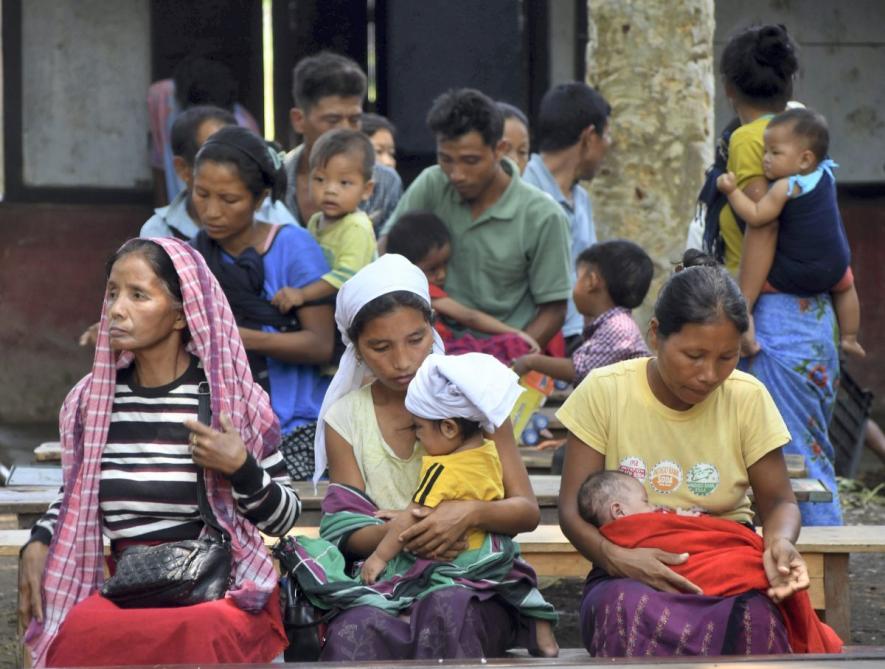
People from the violence-hit areas of Manipur at a relief camp set up by the Assam government, in Cachar district of Assam. Image Courtesy: PTI (Representational image)
Kolkata: In recent weeks, inter-tribe conflicts in Manipur involving the Kukis and the Nagas have escalated so much that even treatment of seriously injured persons belonging to one side has been opposed by mobs suspected to have been mobilised by the rival side. Supporters of the victims of the attacks, it goes without saying, openly accuse that the perpetrators are from their rival tribes.
Security personnel experienced these new tactics on Monday, June 15, when they struggled to arrange treatment of three Kuki persons injured in an attack in the Kuki-majority Kangpokpi district. Security forces had to wield batons and fire tear gas shells to disperse the mobs at the Regional Institute of Medical Sciences (RIMS) at Meitei-dominated Imphal, where the injured Kukis were under treatment.
Kuki Inpi Manipur, the apex outfit of Kukis in the state, blamed the violence on the National Socialist Council of Nagalim (NSCN) and the Kamson faction of Zeliangrong United Front. NSCN is better known as the Isak-Muivah faction of the outfit.
But matters worsened two days later, when on June 17 (at 12.15 a.m.) those under treatment at RIMS had to be shifted to Churachandpur Medical College, about 60 km south of Imphal. Churachandpur, which never ceases to be in news for the wrong reasons, is a Kuki-Zo stronghold (one of the three Kuki youths, Paogoulal Chongloi, is a football player, who has played for Kolkata’s Mohun Bagan Club).
While large-scale violence engulfing vast areas is not taking place, the increasing number of localised Kuki-Naga conflicts in recent weeks adds to the challenges the elaborate security apparatus has to cope with on a daily basis. Abductions and killings, including of church functionaries in the tribal districts where Christians account for an overwhelming majority, have made the situation sensitive.
Trust in the ability of the police and paramilitary personnel to decode the crimes and bring offenders to book still is a far cry. This is forcing the 19-week-old ministry, which assumed office on February 4, to hand over cases to the National Investigation Agency (NIA). In fact, the Union Home Ministry’s Counter-Terrorism and Counter-Radicalisation (CTCR) division, in recent weeks, had to hand over at least two cases in quick succession to the NIA.
While the release on June 9 by Naga armed groups of the 14 Kukis held hostage in Senapati district for nearly a month, was expected to have a positive impact on the law and order situation, the hopes were belied as on June 10 it came to light that six Naga villagers who were suspected to have been abducted by armed Kuki groups on May 13 had been killed. The victims included two pastors whose bodies had been identified by their family members. The United Naga Council (UNC), the apex outfit of the Naga tribes, said the other four bodies were highly mutilated and dismembered.
“The tragedy has shaken the faith of the citizens in the government’s ability to ensure safety and security of innocent civilians. Also, we consider this as a direct challenge to the collective identity and security of the Naga peope”, UNC observed in its memorandum to Union Home Minister Amit Shah. It suggested it has definite reasons to suspect the complicity of the Kuki National Front (President Group) in the abduction and cold-blooded murder and sought immediate decision to declare the outfit as a terrorist group.
As in their earlier representations to the Centre, UNC repeated the demand for abrogation of the Suspension of Operations Agreement New Delhi, signed with 25 Kuki and Zomi groups. These demands were also made by UNC’s president NG Lorho and general secretary Vareiyo Shatsang in a letter to Chief Minister Yumnam Khemchand.
For a fairly long time since the outbreak of ethnic violence on May 3, 2023, the involved parties were the Valley-based general category Meiteis and the majoritarian Kuki-Zos of the hills. The Nagas, who constitute a distinct segment of the hills’ tribal population, maintained a neutral stance. Hostility between them, stemming, inter alia, from ancestral land ownership concerns, has resurfaced in the past four-five weeks, adding to the woes of the ministry.
In the given circumstances, only civil society organisations are active in taking up with the Centre and the state government issues of critical importance to their respective constituencies. For all practical purposes, there is a prolonged pause in the political parties’ public mobilsation activity on bread and butter issues, according to CPI (Marxist) state secretary Khetrimayum Santa and CPI state council secretary Nabachandra.
Of course, at intervals, the parties discuss matters among themselves. One such matter which in the weeks ahead will engage the attention of political parties is whether Manipur will be election-bound by end-February-early March 2027 for constituting the 13th Legislative Assembly. The doubt over the feasibility of the next Assembly poll has surfaced although the SIR (Special Intensive Revision of electoral rolls by the Election Commission) exercise is on and draft electoral rolls are to be published on July 5.
The last Assembly elections were held in two phases – on February 27 and on March 3, 2022 – and the results, which facilitated the constitution of the 12th Legislative Assembly, were declared on March 10, 2022. The state has a 60-member House. The party-wise position then was (number of seats): Bharatiya Janata Party -- 32, Nationalist People’s Party of Meghalaya’s Conrad Sangma – seven, Janata Dal (United) – six, Congress – five, Naga People’s Front – five, Kuki People’s Alliance – two and Independent – three. Against the magic figure of 31 for a majority, BJP had just one more seat. So, the party with N Biren Singh (a defector from Congress] as Chief Minister was proactive from the start in upping its numbers; although the support of non-Congress parties was comforting enough. The first to succumb was JD(U), five of whose MLAs obliged Biren Singh.
After ethnic violence broke out on May 3, 2023, and as the situation was worsening by the day, Sangma held Biren Singh responsible and withdrew NPP’s support to the ministry. But, NPP MLAs outsmarted Sangma by attending a meeting of MLAs called by Biren Singh This became a defection issue and remains a live issue even now.
Subsequently, Biren Singh, in whom the Centre had lost confidence, resigned and the state was put under President’s Rule, which continued for 356 days. A new ministry with Yumnam Khemchand, a senior Meitei leader, became chief minister on February 4 this year.
Political leaders NewsClick spoke with are not at all sure whether the Khemchand ministry can restore normalcy in the intervening months and pave the way for Assembly polls in February-March next. It’s a tall ask, Santa told this correspondent. The government’s handling of safety and security concerns in the past 19 weeks is far from reassuring, Nabachandra and some Manipur watchers opined.
Meanwhile, the hearing by the Speaker’s tribunal on the defection matter involving 11 MLAs was completed in the second week of February 2025 and the Speaker has reserved his verdict, constitutional lawyer N Bupenda Meitei told NewsClick. Bupenda handled the subject at the Speaker’s tribunal on behalf of the petitioner Hareshwar Goswami, vice-president of Manipur Congress.
The writer is a senior freelance journalist based in Kolkata.
Get the latest reports & analysis with people's perspective on Protests, movements & deep analytical videos, discussions of the current affairs in your Telegram app. Subscribe to NewsClick's Telegram channel & get Real-Time updates on stories, as they get published on our website.