





Manipur: Glimmer of Hope Amid Violence as CM Reaches Out to Aggrieved
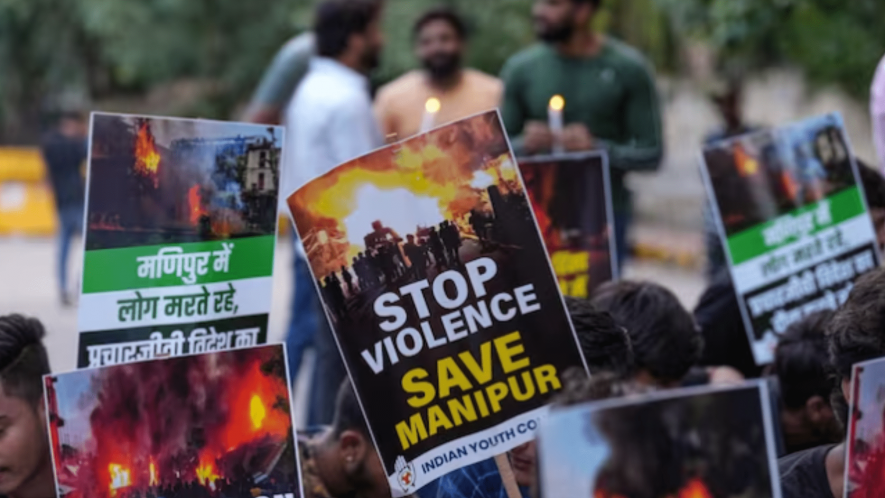
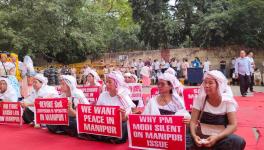
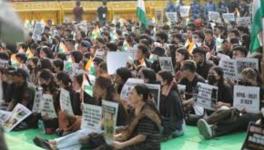
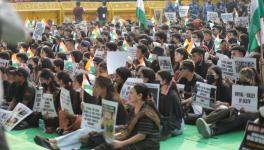
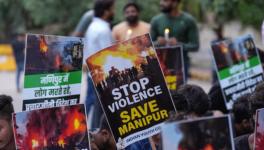
A candle march to pay tribute to those killed in Manipur violence, at Jantar Mantar in New Delhi. File photo: PTI
Kolkata: Certainly, there is a glimmer of hope for the first time since May 3, 2023, in strife-scarred Manipur. This is partly because of positive political reasons and partly because, as ground realities suggest, the fatigue factor is quietly at work over the past almost three weeks.
In the 2026 calendar, February 2026 will qualify to be treated as a month that marked a break from the desperate situation that this small North-eastern state has been passing through because of an ethnic conflict between the Valley-based majoritarian Meiteis and the Hills-based Kuki-Zo tribals, who oppose the Meitei demand for ST (Scheduled Tribe) status.
Also at play has been and continues to be the issue of land ownership, often termed as ancestral land. The Hills population include Naga tribes concentrated in a few districts and scattered in some others. Significantly, the Nagas had largely remained neutral during the state’s desperate phase.
If one were to take an unbiased view of Manipur’s present situation, it has to be conceded that violence has not engulfed vast areas in recent weeks. The state got a ‘popular’ ministry on February 4, after being under President’s Rule for 356 days with effect from February 13, 2025. For now, it is a three-member ministry headed by a Meitei but having participation of a Kuki woman MLA and a Naga MLA, both as deputy chief ministers.
Given their strident opposition to the Meiteis’ dominance in politics and administration and their oft-repeated demand for a separate administrative mechanism for the Hills in the format of a UT (Union Territory) with legislature, the participation of a Kuki MLA is definitely an important political development. Even if it is interpreted as a sign of a split in the Kuki ranks, it also suggests willingness on the part of a section of them s to accept, for now, restoration of parliamentary democracy while sticking to their core demand.
It is true the administration led by Governor Ajay Bhalla succeeded in containing large-scale violence by intensifying combing operations and by the onset of 2026, the state’s law and order situation had improved, although tension persisted in certain pockets.
Between January 21 and February 10, that is even almost a week after Khemchand became Chief Minister, there were some serious incidents in some sensitive pockets. First was the execution of a Meitei man in the Tuibong area of Churachandpur on January 21, while he was visiting his Kuki-Zo wife. Bhalla acted swiftly and announced handing over the case to the National Investigation Agency the next day.
Tension gripped the Litan Sareikhong area of Naga-majority Ukhrul district between February 7 and February 9 as members of Kuki-Zo and Naga communities torched each other’s houses. The trouble followed the assault on a Tangkhul Naga on Saturday night, February 7 by a Kuki-Zo group. This specific Naga tribe has a fairly strong presence in Ukhrul district.
The positive impact of the state having a “popular” ministry was seen when Naga deputy CM Dikho visited the conflict area along with local MLA Ram Muivah on Monday, February 9. Dikho talked to the recognised leaders and managed to diffuse the situation. But, the administration, as a precautionary measure, imposed restrictions on internet services for five days on February 10, Tuesday.
The Kuki-Zo majority district of Kangpokpi has also been the scene of simmering tension since the last week of January following the exchange of allegations and counter-allegations between Nagas and Kuki-Zo groups. Though Kangpokpi (carved out of Senapati district in 2016) is a Kuki-Zo majority district, people belonging to different Naga tribes also live there in fairly large numbers.
The resurfacing of conflicts between Kuki-Zos and Nagas is a cause for serious concern for the new ministry because since the ethnic flare-up in the state from May 3, 2023, the Naga community has maintained neutrality; though sections of Kuki-Zos have at times alleged that Naga groups ‘collude’ with Meiteis.
The other Kuki-Zo majority district, Churachandpur, too witnessed blockade in recent times by Naga villagers of a road used by Kuki-Zos to move between Kangpokpi and Churachandpur.
According to Informed quarters, the recent conflicts and those seen before May 3, 2023 may be traced to both communities accusing each other of encroaching on their respective ancestral lands. The solution lies in the settlement of land ownership and follow that up with agreements. No doubt, it would be a complicated, long-drawn-out exercise, sources told NewsClick.
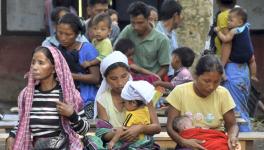
Talks with a cross-section of Manipur watchers suggest that Khemchand has begun his innings as CM with goodwill of sections of people associated with civil society organisations. They have made note of his efforts over the past several months to reach out to Kuki-Zos. On Monday, December 8, 2025, he had travelled to two Kuki villages, Litan in Ukhrul and Chassad in Kamjong, both of which are Naga majority Hill districts. Then he had also visited a Kuki relief camp at Litan Sareinkhong Baptist Church and interacted with the inmates there (His outreach initiative, Manipur watches said, largely explains why the Bharatiya Janata Party (BJP) high command preferred him as CM. They were already aware of his political experience. It is also believed in political quarters that Khemchand’s outreach had somewhat softened the stance towards him of Kuki-Zos whose grouse against Biren was deep-rooted as the latter relentlessly branded them as illegal immigrants from Myanmar and accused them for spreading illegal poppy cultivation.
The ministry’s expansion is likely soon and there is a strong possibility of two more BJP Kuki-Zo MLAs being made ministers. Which would mark an effort by the political decision-makers to allow them a greater say in administration than they had in Biren’s time. Free movement of vehicles and people of all communities on National Highway 2 and return of displaced persons to their homes with the government’s financial support are being accorded priority (deputy CM Nemcha Kipgen has not been able to move to Imphal, she is functioning from her home in Kangpokpi).
As a confidence-building measure, Khemchand proposes to hold a cabinet meeting in Naga-majority Senapati where they will go by road that passes through Kuki-Zo-majority Kangpokpi and is part of NH 2 (Point mentioned by Dikho in an interview to The Hindu, carried in its February 17, Tuesday edition).
For the record: After several rounds of administrative, political and Kuki-Zos’ internal meetings in New Delhi, Imphal and Guwahati in the course of January, matters started moving fast on February 2, Monday with the BJP decision-makers calling a meeting of party MLAs in New Delhi on February 3, Tuesday. Tarun Chugh, national general secretary was named observer. Former Speaker and minister Yumnam Khemchand Singh, a Meitei, emerged as the “most acceptable legislature party leader”. Immediate past CM and a tall Meitei leader N Biren Singh had been “gently managed” by the BJP top brass before MLAs met under Chugh’s watch.
The gazette notification revoking president’s rule and reactivating the Assembly followed on February 4 and in a matter of hours the same day, a three-member ministry comprising Khemchand as CM and Kuki-Zo woman MLA Nemcha Kipgen and Naga people’s Party MLA Losii Dikho as deputy CMs assumed office after taking oath (Ms Kipgen did so virtually from New Delhi). There are 10 Kuki-Zo MLAs, of whom seven are from BJP. The coalition includes the NPP unit in Manipur. It is part of NPP in Meghalaya, which is headed by that state’s CM Conrad Sangma.
The writer is a senior freelance journalist based in Kolkata.
Get the latest reports & analysis with people's perspective on Protests, movements & deep analytical videos, discussions of the current affairs in your Telegram app. Subscribe to NewsClick's Telegram channel & get Real-Time updates on stories, as they get published on our website.