





“Lest We Forget”: Six Years After Delhi Violence
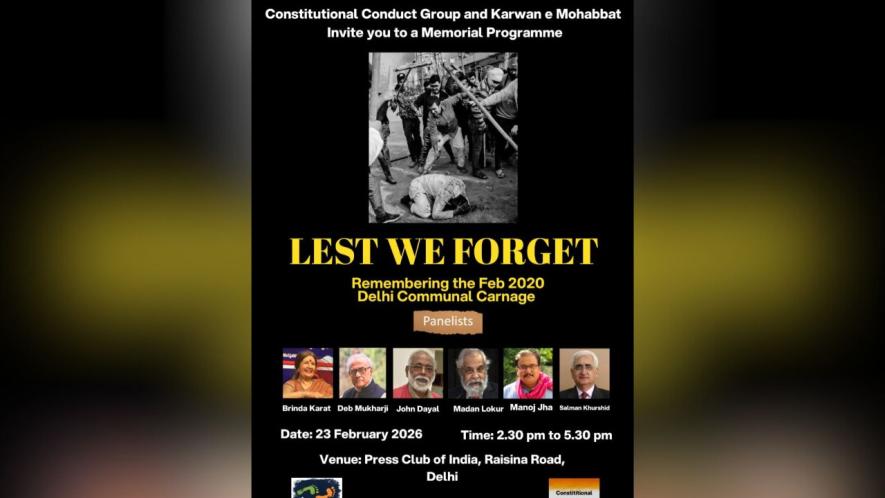
On 23 February, at the Press Club of India in New Delhi, survivors, lawyers, former judges, scholars, activists, and concerned citizens gathered under a banner that read: “Lest We Forget” to mark six years since the communal violence that engulfed northeast Delhi in February 2020. The carnage claimed 53 lives as per official figures while leaving hundreds injured and thousands displaced. Some civil society groups maintain that the number of persons killed is 54.
Organised by Karwan-e-Mohabbat, the event was conceived not merely as a memorial, but as a civic intervention. Moderated by Harsh Mander — former Indian Administrative Service officer, author, and long-time human rights campaigner — the gathering sought to revisit the events of February 2020 and assess where the pursuit of justice stands today.
Six years is a significant span in the life of a city. Buildings are reconstructed, shops reopen, governments change, headlines move on. Yet for families who lost loved ones, homes, livelihoods, and a sense of security, time has not resolved the central question: has justice kept pace with memory?
Revisiting February 2020
The violence erupted in late February 2020 against the backdrop of countrywide protests against the Citizenship Amendment Act and fears of a discriminatory National Register of Citizens (NRC). Tensions had been mounting for weeks. Protest sites such as Shaheen Bagh had become symbols of constitutional assertion. At the same time, inflammatory political rhetoric escalated.
When clashes began in northeast Delhi — in neighbourhoods including Jaffrabad, Maujpur, Chand Bagh and Shiv Vihar — they quickly spiralled into arson, vandalism, and targeted attacks. Homes were torched. Shops were looted. Religious sites were damaged. Fifty-three deaths were officially recorded. Civil society groups later documented an additional name — Asif — whose death, they argued, had not been formally included.
Multiple investigations followed. Hundreds were arrested. Yet six years later, the legal landscape remains deeply contested. Conviction rates in many cases are low. In others, trials have barely progressed. Allegations of investigative lapses, fabricated evidence, and selective prosecution continue to circulate in courtrooms and public discourse alike.
Memory as Democratic Responsibility
Opening the event, Harsh Mander framed remembrance as a constitutional duty rather than an act of nostalgia. “A democracy,” he said, “is measured not only by elections but by how it responds when its most vulnerable citizens are harmed.”
Drawing on his long engagement with survivors of communal violence — from Gujarat in 2002 to Delhi in 2020 — Mander emphasised that “Lest We Forget” carries institutional weight. Forgetting risks normalising injustice. Memory, by contrast, insists on accountability.
He stressed that justice must be understood in its full constitutional sense: impartial investigation, equal protection of the law, and meaningful rehabilitation. “Justice,” he said, “is not vengeance. It is fairness, transparency, and accountability.”
Citizenship, Fear, and Institutional Inversion
Former civil servant Deb Mukherjee reflected on the broader political climate that preceded the violence. He spoke of the deep anxiety triggered by discussions around a countrywide NRC. “It was a new experience,” he said. “Even after proving your identity, even after documents were verified, you could still be picked up and sent to a detention centre.”
He argued that the burden of proof had been inverted. People’s Tribunal members, he noted, had affirmed that citizenship is a fundamental right and that it is for the state to prove that someone is not a citizen — not for individuals to endlessly prove that they are.
Mukherjee recalled visiting Shaheen Bagh during the protests. He described being moved by a woman who declared: “We do not care what the government says. We are ready to assert our rights as citizens.”
He rejected portrayals of protest sites as anti-national. “Those spaces were marked by the Indian flag, the national anthem, and the Constitution. They were deeply constitutional spaces.”
He also raised concerns about hate speech. When a judge questioned why an FIR had not been filed in response to inflammatory slogans, that judge was transferred the next day. “Years later,” Mukherjee observed, “that ‘appropriate time’ to act still has not arrived.”
He noted that various reports — by political parties, independent lawyers’ groups, citizens’ committees, and the Delhi Minorities Commission — converged on one conclusion: the police had failed in their duties, and in some instances, there were indications of complicity.
Six years later, he said, many young people remain imprisoned under the Unlawful Activities (Prevention) Act. “The use of UAPA here,” he argued, “has not simply been procedural. It has amounted to a travesty of justice.”
Due Process Under Strain
Former Supreme Court judge Madan B. Lokur addressed the gathering with a detailed examination of the legal process. He began with conviction statistics: many cases have been decided, yet acquittals dominate. In several judgments, courts have sharply criticised police investigations.
One grave allegation, he noted, is fabrication of evidence. Courts have observed instances where prosecution witnesses were not even present at the scene. Producing false witnesses, he said, “strikes at the heart of the justice system.”
Yet despite judicial criticism, accountability appears absent. “If there are no consequences for investigative misconduct,” he warned, “the deterrent effect is lost.”
He questioned the elastic invocation of a “larger conspiracy.” Could a handful of individuals destabilise a nation-state? “Is our government so fragile?” he asked. Without careful scrutiny, such theories risk becoming blanket justifications for prolonged incarceration.
Turning to delays, he cited the case of Umar Khalid. Six years on, charges have yet to be formally framed, though a voluminous charge sheet was filed long ago. It reportedly took over two years for the accused to receive copies of relevant documents.
“The presumption of innocence is foundational,” Lokur emphasised. “It is not the accused’s duty to expedite the trial. It is the prosecution’s obligation — and the court’s.”
He also referred to a widely circulated video showing a man being beaten and forced to sing the national anthem. “It took six years even to consider registering an FIR,” he said. “When those entrusted with enforcing the law are accused of breaking it, and no prompt action follows, public confidence suffers.”
Justice, he reminded the audience, must be blind. “No one is above the Constitution. If influential individuals remain untouched while others face prolonged incarceration, justice begins to look selective.”
Commission of Inquiry, Hate Speech, and Rehabilitation
Senior political leader Brinda Karat spoke next, outlining three central concerns. First: Why has there been no official Commission of Inquiry? After the 1984 anti-Sikh violence, multiple commissions were constituted. After Gujarat 2002, inquiries were held. “But for Delhi 2020?” she asked. “No official commission.”
Without a state-constituted inquiry, she argued, a particular “chronology” presented in Parliament shaped the entire narrative before cases were even filed.
Second: hate speech and sanction. Complaints were filed against political leaders for inflammatory slogans. Yet FIRs remain stalled, partly over questions of prior sanction for prosecuting public servants. “If hate speech is legally linked to violence,” she said, “that principle must apply equally.”
Third: compensation and long-term rehabilitation. Of the 54 families civil society groups track, most lost primary breadwinners. Many households are now female-headed. Karat described the work of a relief and rehabilitation committee that continues to support 64 children with scholarships.
Compensation, she argued, cannot be a one-time payment. It must include long-term educational support, livelihood rebuilding, and monitoring to prevent school dropouts.
She also proposed forming an independent “case audit committee” to review all decided cases and place findings before the public. “When justice shows double standards,” she warned, “social trust erodes.”
The Language of Outreach
Former Union Minister Salman Khurshid offered a reflective intervention. “You are here because you already understand these issues,” he said. “But what about the distant villages? What about those who do not share this vocabulary?”
He argued that the movement must develop a new language of engagement — one capable of reaching beyond familiar circles. Referring to his experiences during Jamia and Shaheen Bagh struggles, he suggested that constitutional language must be translated into everyday idioms.
He invoked Gandhi — not merely as a symbol of non-violence but as a practitioner of dialogue. “We have to find a way to speak across differences,” he said. “Otherwise, divisions harden permanently.”
He acknowledged that the “balance sheet” of the last six years appears discouraging. Yet he urged participants to learn from other movements — including the farmers’ protests — about building wider public consensus.
Survivors and the Human Cost
Documentary screenings during the event foregrounded survivors’ testimonies: a shopkeeper whose business was reduced to ashes; a father searching hospital corridors; women navigating widowhood and sudden economic responsibility.
Parents of the deceased, speakers noted, live with dual burdens — grief and ongoing responsibility for surviving children. Some families relocated permanently. Others rebuilt amid quiet mistrust.
Trauma lingers. Children face anxiety and disrupted education. Women heading households confront economic precarity in environments shadowed by fear.
In January 2025, petitions were filed in the Delhi High Court alleging that even previously announced compensation had not been fully disbursed. A court order directing payment within three months reportedly faces challenges. “Justice,” one speaker observed, “is not complete when an order is passed. It is complete when it is implemented.”
Where is justice?
As the evening concluded, there was no declaration of closure. Instead, there was recognition that February 2020 remains an unfinished chapter.
Infrastructure in northeast Delhi has largely been rebuilt. Markets bustle. Schools function. Life moves forward.
But justice, participants insisted, cannot be measured by anniversaries. It is measured by equal application of law, institutional accountability, due process, and meaningful rehabilitation.
Until that question receives a credible, consistent answer — for victims and for the accused alike — “Lest We Forget” will remain not just a memorial phrase, but a constitutional demand. Justice, six years on, remains an unfinished promise.
Get the latest reports & analysis with people's perspective on Protests, movements & deep analytical videos, discussions of the current affairs in your Telegram app. Subscribe to NewsClick's Telegram channel & get Real-Time updates on stories, as they get published on our website.