





The Leak Economy Under ‘Shadow Education’
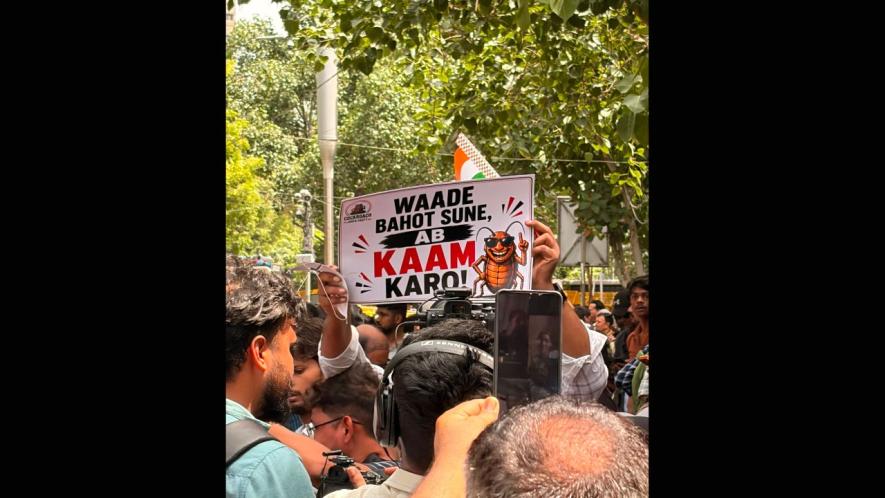
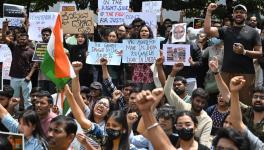
Today’s Bharat is witnessing a huge job crisis emerging from the jobless growth. The emergence of the CJP (Cockroach Janta Party) campaign is not mere an anguish of youth but also carries a deep-seated crisis hitting young minds to the extent of coming out on every possible platform in today’s physical and digital world.
A young mind exploring social media for jobs may get entrapped by the grace of job algorithm and he/she keeps on waiting for their turn -mera number aayega (my turn will come). But this long wait is taking away their life’s crucial productive years and is landing them in unstable and underpaid jobs. They are constantly told to wait for an exam that doesn’t get cancelled or whose paper doesn’t get leaked. This is how the State machinery in the past 15 years has badly played with India’s future.
Behind the $4 trillion GDP (gross domestic product) headlines lies a generation exhausted by three interlocking crises: no stable work, a starved public education system, and a recruitment machinery so corrupt that a parallel “shadow education” industry now profits from every leak.
Education, employment and health, are the three pillars with a constitutional mandate based on equality and justice. When these are not served to the country's citizens, it demands their protest, firmly grounded in the constitutional of provision of the same.
Today’s socio-economic and political scenario strongly seek an Alternative Welfare State – one with decent employment assurance through public investment, 6% of GDP for inclusive quality education, and a complete structural overhaul to end the nexus of paper leaks, coaching mafias, and exam irregularities.
The overall scenario puts forward four striking challenges, of hitting not only India’s constitutional mandate of providing quality education, decent employment and health under fundamental rights – but Right to Education and Right to Life, to all its citizens, as well.
Challenge 1: Downplaying Public Higher Education
Considering the overhaul of education as its core agenda, the public-private nexus, along with further hampering the quality of school education, has now started shifting its focus to higher education. The NEP 2020’s (National Education Policy) reforms in higher education have grossly diluted the curricular structure by including a number of shallower courses and increasing the duration of the programmes, that too in the name increasing employability.
On the contrary, private universities are being given a free hand with regard to designing their curriculum with equivalent weightage of papers and coursework. The university spaces are now being converted into skill development centres, that too of shallower quality in the absence of any sincere efforts to provide the needed infrastructure and link to industries.
Challenge 2: Education Emergency – 6% GDP Still a Mirage
It’s true that there cannot be any employment without employability, and similarly, no employability is possible without public education. It is noteworthy that India spent only 2.8‑3.5% of GDP on education from 2010‑2019; even in 2025, total expenditure was just 4.1% – far below the NEP 2020 mandate of 6%. The cumulative shortfall over 15 years exceeds ₹20 lakh crore. This has further resulted in a drastic increase in the number private universities from 87 in 2010 to over 510 in 2025.
Government colleges are, however, suffering from issues like poor student-teacher ratio, i.e., 32:1 (double the recommended 15:1). Similarly, one third of the research faculty posts in the central universities are lying vacant. At the professor level, the OBC (Other Backward Classes) positions are 80% lie vacant, and 83% Scheduled Tribes or ST teaching, too, are vacant. Thus, the marginalised communities rarely see university space as their own.
Challenge 3: Paper Leaks, Shadow Education Racket
Privatisation in education has surged with greater autonomy to private educational institutions to set up their campuses and design their curriculum. This has been in continuum with greater engagement of private agencies (via outsourcing) in fulfilling the managerial along with tasks in education. This begins with the provision of infrastructure (under Corporate Social Responsibility) to educational institutions to engage private Edtech firms to check board examination papers at the school level.
The coaching industry, which acts as ‘shadow education’, and thrives on the ongoing chaos, has expanded after the government introduced a new filtering layer to seek admission in colleges, i.e., CUET (Common University Entrance Test). In higher education, the recent intrusion that left the youth and their parents shocked is the leak of NEET (National Entrance cum Eligibility Test) question papers and the revaluation error in CBSE Class 12 examination sheet.
There is a long list of such paper leaks and poor management of CUET entrance examination episodes. Some of the prominent ones since 2018 include, when the Class XII Economics paper was leaked from Una, Himachal Pradesh, and after few days, a class X Math paper was circulated in WhatsApp group from a Delhi school. In October 2024, there were three more arrests in Himachal for leaking CBSE Class XII Economics paper again.
To add to the chaos, in 2022 and 2023, the CUET server crashed leaving thousands of students in despair. There have been a series of such news being reported every other year, related to mismanagement in planning and conducting of CUET papers.
In 2024, students at Kanpur’s Maharana Pratap College pelted stones after discovering that some candidates had already finished the CUET paper while others were still writing. Recently, in 2026, CUET‑UG delayed nationwide due to a “technical glitch” at TCS (Tata Consultancy Services), just weeks after NEET‑UG 2026 resulted in cancellation outright. This was the first time that an all‑India medical exam was scrapped post conduct.
In 2024, Bihar police busted a syndicate that had accessed JEE (Main) question papers 48 hours before the exam, selling them for ₹15‑20 lakh per candidate. It is to be noted that the ‘shadow education’ industry – coaching centres like those in Kota or Patna, often make huge profit from such leaks.
Thus, the ‘leak economy’ continues to thrive at the cost of millions of students attempting to ensure their future in and through higher education. The nexus between coaching industry and systemic loopholes continues to grow as the coaching centre owners have networks with printing presses, examination centre administrators and even NTA (National Testing Agency) insiders.
The turnover from the private coaching market is worth over Rs 1 lakh crore, as in Kota alone, students pay Rs 2-4 lakh annually. Whenever an exam paper is leaked, it is the coaching centre that makes profit by selling papers followed by offering crash courses for the re-exam, thereby institutionalising corruption indirectly.
Outcome - Contractual Trap, Deepening Inequities
The current scenario has contributed to growing mistrust among youth and an uncertainty about securing space in public university campuses or in the job market. The situation may worsen with gradual de-facto privatisation of government educational institutions in India, complemented by the growing share of private universities.
All this has induced greater job instability for youth, contributing to “jobless growth”. As per the Centre for Monitoring Indian Economy or CMIE, India’s youth unemployment rate is at an alarming level of 45.4%, which is highest at the global level.
There has been a huge decline in permanent jobs in government sectors, while the share of contractual workers in formal manufacturing rose from 21.8% in 2001‑02 to 36.4% in 2017‑18, crossing 41% by 2024. Among new contract workers, 61% are under 29 of age.
Recently, the UPSC (Union Public Service Commission) competitive job result also showed flaws in the recruitment process of ‘Economic Weaker Section’ seats, as it reported that the upper socio-economic strata of the population got recruited in large numbers, reflecting more problems in the selection process for top bureaucratic jobs.
According to the Periodic Labour Force Survey or PLFS 2022‑23, among regular wage workers, the SCs and STs hold only 14.2% and 6.8% of positions, far below their population share. Women’s labour force participation, after rising from 23.3% in 2010 to 37% in 2023, is slipping again. The Union Budget 2024‑25’s ₹2 lakh crore employment package largely subsidises private contracts, not permanent public jobs. Thus, the gap between rich and poor is further widening and deepening.
Alternative Welfare State: Vision for 2026‑2031
The above discussion reveals how a market-driven system, facilitated by the government, exploits human labour at the cost of their welfare. The Indian youth are demanding an alternative system offering opportunities in education and in the job market through education, so that the nation can embark on the path of sustainable development (as highlighted in UN identified 17 SDGs). Some of the more critical agendas that can provide a pathway toward achieving dignity instead of mistrust, include:
1. Ensuring 6% of GDP in creating a strong public education system by building and developing more public educational institutes and recruiting new teachers to address the problem of shortage of teachers and filling all vacancies in the next three years across India.
2. Creating a Public Testing Agency by replacing NTA with an independent public funded and decentralised structure for entrance and competitive examination bodies, rather than a centralised body under direct judicial oversight.
It should be mandatory to include government teachers and employees, like Kendriya Vidyalaya teachers and universities teachers, in the process of entrance and competitive examinations, similar to earlier fair amd transparent exam structures, such as in JNU and UPSC Make paper leaks a non‑bailable offence with fast‑track courts (conviction within six months).
3. Regulate the coaching industry – via ensuring mandatory registration and putting caps on fees, and transparency in ensuring criminal liability for any coaching centre found involved in leaks.
4. Decent Employment Assurance: There is a need of strong political and administrative will to ensure a decent employment for all educated and skilled youth. It can be done by spending in public sector investment in fields like- green energy, public health, rural infrastructure. It should be followed by creating five million permanent, formal jobs annually with mandatory SC/ST/OBC/EWS/women quotas.
5. Social Inclusion Audits: Such audits are essential so that the marginalised communities get equal share in education and employment and for that every job notification and education budget must publish a public audit tracking SC/ST/OBC/EWS/women representation from application to selection.
Conclusion
As we see that the youth of India, the future of India, at the moment, needs greater care and guidance under a trustworthy environment, which, of course, is not charity rather the responsibility of the State and society so that the youth can use their potential to the optimum level, have a clear vision and move forward with confidence to build ‘new India’, free from socio-economic inequities.
The writer teaches at the Department of Economics, Dr. Bhim Rao Ambedkar College, University of Delhi. The views are personal.
Get the latest reports & analysis with people's perspective on Protests, movements & deep analytical videos, discussions of the current affairs in your Telegram app. Subscribe to NewsClick's Telegram channel & get Real-Time updates on stories, as they get published on our website.