





Kerala Budget 2026-27: A Lesson in Funding Education
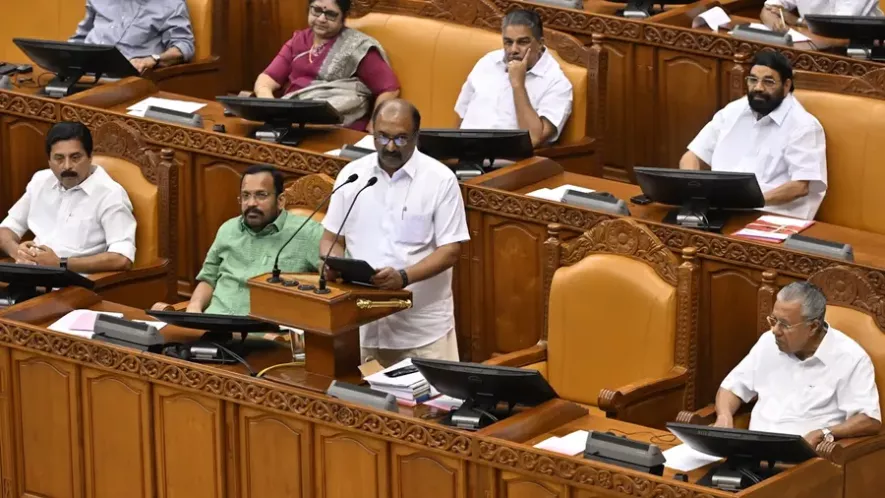
Kerala Finance Minister K N Balagopal presenting the 2026-27 Budget in the Assembly. Image credit: Deshabhimani
The Kerala Budget for the fiscal year 2026-27, presented by Finance Minister K. N. Balagopal, represents a significant intervention in the discourse on public financing of education within India’s federal framework. For any administration seeking to budget meaningfully for education, this budget offers a comprehensive, statistic-driven model that marries radical access with systematic quality enhancement and unwavering welfare commitment.
The budget meticulously channels resources toward universalising access, systematising quality enhancement, and constructing a comprehensive social safety net within the education sector. This article provides a detailed exegesis of the budget’s key provisions, locates it within the context of contrasting Central government priorities, and evaluates its overarching ambition to catalyse a transition toward a “knowledge society.”
The Free Higher Education Initiative
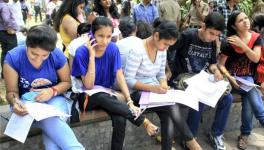
The budget’s most prominent intervention is the provision of free graduate degree education in government arts and science colleges. This policy extends the state’s existing commitment to free education up to the higher secondary level, effectively creating a contiguous, state-funded educational pathway. This radical move builds on the existing policy of free education up to the plus-two level and aims to drastically reduce the financial burden on families. The political and philosophical contrast with other approaches is sharp.
Delhi University delivered its 2026 New Year greetings with increased fees for institution-level facilities from the 2026-27 academic sessions. It is also noteworthy that Minister of State for Education Sukanta Majumdar evaded a question on the data of fee hike that was raised in Parliament. His escapism was ground in the technical argument of universities and HEIs (higher education institutions) maintaining the stats at their end. Of course, this is a rare incident where the ruling dispensation paid due respect to the autonomy of institutions.
Kerala’s approach constitutes an active use of fiscal policy to lower barriers to entry, representing a clear ideological choice in favour of decommodification within the public education sphere.
Integrated Investments in Capability
The budget demonstrates an acute awareness that expanded access must be coupled with enhanced quality to have meaningful impact. Its allocations reveal a multi-pronged strategy targeting technological integration, pedagogical support, and foundational welfare. It meticulously allocates funds to ensure that access is coupled with excellence. Building on Kerala’s top position in the National Education Sector rankings, it dedicates specific, substantial resources:
Technology Integration: The budget highlights that 45,000 classrooms (Grades VIII-XII) have been made tech-friendly, with computer labs in primary schools. Artificial Intelligence integration into the state curriculum is supported by the distribution of 29,000 robotic kits. An allocation of ₹38.5 crore to KITE (Kerala Infrastructure and Technology for Education) will strengthen this digital foundation.
Academic & Teacher Empowerment: The "Comprehensive Quality Education Scheme" receives ₹56.25 crore to improve academic standards. A special ₹10 crore is allocated for strengthening teaching faculty. Furthermore, ₹42 crore is earmarked for modernising school infrastructure with digital tools.
Essential Welfare Continuity: The budget allocates ₹410.66 crore for the Mid-Day Meal and supplementary nutrition programme. Kerala State Food Commission Chairperson Ginu Zacharia Oomen’s recent statement that mid-day meals are a right of students must be read with this. It reflects the government's policy alignment with welfare advocacy.
Inclusive Support: The budget sets aside ₹62 crore for institutions caring for children with intellectual challenges.
Social Safety Net—The Scholarship Matrix
A defining feature of the budget is its intricate, multi-layered scholarship and financial aid architecture, designed to intercept students at various points of potential attrition. The aggregate allocation for educational schemes stands at ₹677.11 crore, a ₹90.53 crore increase from previous outlays. This includes ₹242 crore for direct educational assistance and a substantial ₹370 crore for post-matric scholarships in higher education.
Targeted interventions include a ₹163.06 crore package for promotional schemes, the expansion of the Special Enrichment Scheme for tribal students from 40 to 340 schools, and the novel Public Hostel Scheme to address accommodation barriers. Support extends to advanced scholars, with ₹38.76 crore earmarked for fellowships, including a ₹15,000 per month fellowship for PhD scholars without alternative funding. This systematic layering of financial support aims to convert nominal access into sustained educational progression.
Confronting Brain and Economic Drain
To address the annual outflow of ₹8,000 crore spent by Keralites on education and training outside the state, the budget proposes a "Global School" focused on Techno-Economics and Future Technology, with a ₹10 crore initial allocation. Systemic skill development is addressed through allocations to ASAP and the Kerala Academy for Skill Excellence (KASE), alongside plans for a Kerala University for Skill Development & Entrepreneurship. The Chief Minister’s 'Connect to Work Scholarship Scheme' (₹400 crore) aims to benefit five lakh individuals, bridging education and employability.
The budget engages directly with national policy debates. In response to the Central government discontinuing the Maulana Azad National Fellowship, Kerala is launching its own Chief Minister’s Research Fellowship for Minorities (₹11 crore) and a new Overseas Scholarship for Minorities (₹4 crore). It plans to develop the Centre for Development Studies (CDS) into a global-standard institution (₹10 crore) and support 10 Centres of Excellence across universities (₹12 crore).
This stands in contrast to the budget’s critique of the Union government’s funding cuts. It notes that 18 of India’s top 100 colleges are in Kerala, and allocates ₹851.46 crore to implement Higher Education Commission recommendations and the FYUGP. This is contrasted with the reported sharp reduction in UGC funding, where the 2025-26 allocation for higher education is ₹50,077.95 crore, a drop from actual spending of ₹55,932 crore in 2023-24. The budget highlights that the UGC’s 2024-25 budgeted amount is ₹3,335.97 crore, far below the ₹6,324.12 crore actual expenditure in 2023-24, and that the AICTE’s ₹200 crore budget is the lowest in five years, against ₹352.25 crore actual spending in 2023-24. Funding cuts to IIMs, IISERs, and stagnant allocations for agricultural education and Saksham Anganwadi Poshan 2.0 must not be forgotten.
Conclusion
The educational budget is nested within a broader governance framework that emphasises life-cycle welfare, as evidenced by the parallel Gender and Child Budget and Elderly Budget. This reflects an understanding that educational outcomes are influenced by familial and social contexts, including demographic shifts like population ageing.
From the macro-vision of becoming a "Knowledge Society" to the micro-details of robotic kits and hostel beds and every statistic—from the ₹410.66 crore for mid-day meals to the ₹370 crore for post-matric scholarships—serves a strategic purpose in a comprehensive plan.
In a national context where public spending on education faces constraints, this budget presents a bold, data-rich counter-model, arguing through its allocations that investing in accessible, high-quality education is the most critical investment a state can make in its own future.
The writer is an independent researcher in international relations. The views are personal.
Get the latest reports & analysis with people's perspective on Protests, movements & deep analytical videos, discussions of the current affairs in your Telegram app. Subscribe to NewsClick's Telegram channel & get Real-Time updates on stories, as they get published on our website.