





Kashmir: Thinning Snow, Neglected Canals Disrupting Irrigation Systems
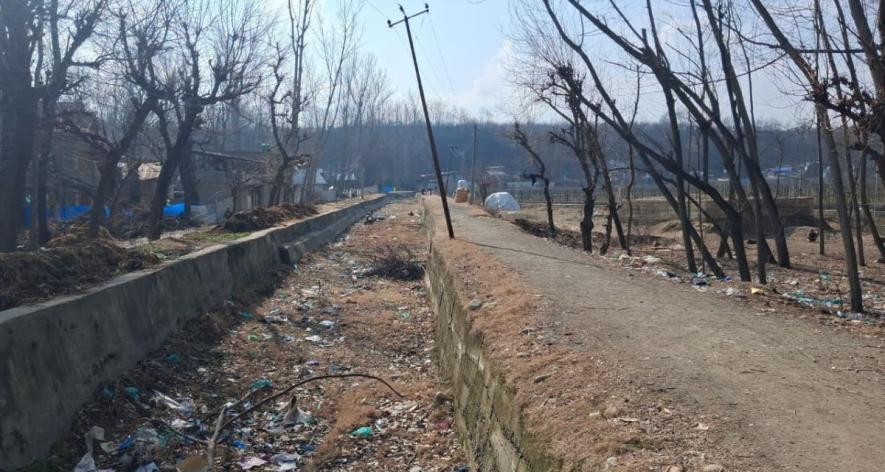
A picture revealing the condition of the dried canals (Photo - Zeeshan Shabir) .
Pulwama, Jammu and Kashmir: In Litter village of south Kashmir's Pulwama district, the canals that once carried water through most of the year now run shallow, reduced to thin, uncertain streams.
For farmers like Bashir Ahmad Kullay (56), the change has not arrived as a single event. It has unfolded slowly, winter after winter, as snowfall has thinned, melted faster, and disappeared earlier than it used to.
"Earlier, rivers and canals had water for most of the year," Kullay said, standing beside a narrow irrigation channel that cuts across his fields. "Now, because snowfall is low, water levels have dropped sharply. Farming has become difficult."
Last year, he recalled, the pattern itself seemed to shift. There was excess water early in the season, followed by a dry July. The snow that should have sustained irrigation into summer had already melted away.
"Water came at the wrong time," he said. "The paddy had just been transplanted. It needs standing water then. But the fields had already started drying. The crops were damaged."
What farmers like Kullay are describing is not just a decline in snowfall, but a deeper breakdown of Kashmir’s irrigation system, one that depended both on snow stored in the mountains and collective management on the ground. Both are now weakening at the same time.
A system under strain
Litter village is surrounded by paddy fields and orchards, with a network of narrow irrigation canals running through the farmland. These canals draw water from feeder streams connected to the Rambi Ara, a river that originates in the Pir Panjal range and flows through parts of Shopian and Pulwama before joining the larger Jhelum river system.
Residents said that the changes are visible not just in the canals, but upstream as well.
Some pointed to illegal extraction of sand, gravel and boulders from the Rambi Ara stream near Lassipora. A local resident said that the mining usually takes place at night.
“Rambi Ara flows past our area, and people extract boulders and gravel from it in Lassipora,” he said. “They bring machines like JCBs and trucks and work during the night. It’s not just one or two tippers, sometimes dozens of truckloads are taken out in a single night. Because of this, the water level has gone down.”
Residents say the reduced water level has affected the amount of water entering irrigation canals in nearby villages.
For generations, irrigation in villages like Litter functioned as a shared system. Snow accumulated in the Pir Panjal mountains through winter and melted gradually, feeding streams that were diverted into canals. These canals, in turn, were maintained both by government departments and by villagers themselves.
Before each agricultural season, residents would collectively clear silt from smaller channels, ensuring water reached fields across the village, including those at the tail end.
That system is now weakening.
Maintenance of the canal network officially falls under the Irrigation and Flood Control Department. Residents say that in earlier years, villagers would also collectively clear silt from smaller channels before the irrigation season began. But farmers say such community efforts have declined over time, leaving most maintenance dependent on government departments.
As that collective system has eroded, delays in state response have become more visible.
Kullay added that maintenance often comes too late. "Canal cleaning is the responsibility of the irrigation department. But the work usually starts during the farming season."
A field supervisor in the irrigation department said: “If we clean the canals too early, they fill with silt again by the time farmers begin transplanting paddy.”
Snow is no longer reliable storage
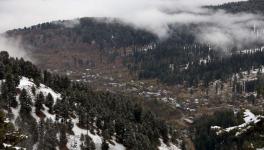
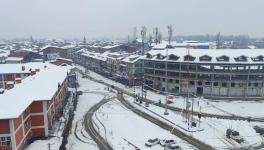
A growing body of research suggests that snow cover in Jammu and Kashmir has been steadily declining, with sharper reductions observed in recent years. This winter offered a stark example. During Chillai Kalan, the 40-day period traditionally associated with the heaviest snowfall, large parts of the Valley recorded a severe precipitation deficit, leaving little snow to sustain water flow later in the season. Without sufficient snowpack, whatever snow does fall now melts quickly, sending water downstream early and leaving little for the months when crops need it most.
"Snowfall patterns in Kashmir are shifting," said Sanjeev Singh Parihar, a water resources engineer who works on hydrology, watershed management, and climate-linked water systems. "A greater proportion of winter precipitation is falling as rain instead of snow, and the accumulated snow is melting earlier than it historically did."
Snowpack, he explained, traditionally acted as seasonal storage. "With reduced snow accumulation and earlier melt, water availability during the peak agricultural season, especially June and July, is declining.” Warmer temperatures are advancing the snowmelt cycle, shifting peak river discharge earlier by several weeks.
"This results in relatively higher flows in March or April, followed by reduced discharge during peak crop water demand months," Parihar said. "For farmers cultivating paddy, which requires standing water during early summer, this timing mismatch creates irrigation stress."
The effect, he added, is a weakening of the natural storage system itself. "Rapid melting produces short-duration high flows rather than sustained baseflow. Streams now see early pulses of water followed by low-flow conditions later in the season."
Persistent problems
For farmers at the tail end of canal networks, the impact is even more severe.
Mohammad Altaf Paray, a 48-year-old farmer from Awantipora, said that last year, water never reached his fields at all.
"We prepared the land, used tractors, did everything," he said. "But our fields are at the tail end. When water reduced, it didn't reach us."
His crops dried up. "Earlier, one kanal would give a profit of twenty to thirty thousand rupees. Last year, instead of profit, we had to bear a loss of five thousand. All the hard work was wasted."
Altaf and other farmers in Awantipora had submitted repeated requests to repair a government-installed pump system meant to supply water to their fields.
The pump exists, but no longer functions effectively.
"The water level has gone down, and the pipe is above the water. It does not work."
Farmers requested that the pipe be lowered to match the new water level. The request remains pending.
"It has been years. Nothing has been done."
This trend has pushed farmers to rely on individual solutions rather than community ones.
Across south Kashmir, farmers are increasingly turning to private borewells which is a costly shift and also encourages the weakening of shared irrigation systems.
Junaid Yusuf (30) installed a borewell on his land at his own expense, spending nearly Rs 1.5 to 2 lakh.
"I arranged the money myself," he said. "I took a loan."
The borewell, he said, is used for irrigation, not for paddy cultivation.
While government support exists, access to it remains uneven.
An irrigation department official, speaking on condition of anonymity, said that under schemes such as the Holistic Agriculture Development Programme, farmers can receive between 50 to 70 percent subsidy on borewell installations.
However, the official acknowledged that this support depends on available funds and application timelines.
Yusuf said he did not receive any subsidy.
"The process takes time. There is a lot of paperwork. You don't know when the money will come."
According to him, even when applications are approved, funds can take six to twelve months to be released.
"You have to spend first and then wait. Sometimes you don't know if you will get the money at all."
Experts say the issue is not only climatic, but also one of management.
"Declining snowpack is a major factor," Parihar said. "But sedimentation in canals, upstream changes, rising evapotranspiration, and inadequate maintenance also reduce effective water delivery."
Deforestation and construction in upstream areas can further accelerate water loss.
"They reduce infiltration and groundwater recharge, and increase runoff velocity. Water drains out quickly instead of being retained."
Experts warn that growing dependence on groundwater may not be sustainable.
"If extraction increases without adequate recharge, groundwater levels could decline," Parihar said. "That could create another crisis."
Changing crops
For farmers, the shift is already visible in their fields. In Pulwama, Shabir Ahmad Bhat (63) said that there was a time when paddy stretched across much of the landscape.
"Earlier, large areas here were under paddy," he said. "But because of water shortage, people are shifting."
"Now people are planting high-density apple orchards. For that, even less water can work."
Experts say such shifts can reduce water demand, but they are not a complete solution.
"Moving to horticulture can be a rational adaptation," Parihar said. "But these crops still depend on reliable seasonal water, and they introduce new economic risks."
In Shopian, Haris Mushtaq Mir (25) said the decline has been visible for several years.
"Where we used to earn ten rupees, now we earn five. If this continues, we may not be able to continue farming."
Back in Litter, Kullay says farmers are adjusting as best as they can — changing crops, reducing land under cultivation, finding new ways to access water.
But adaptation, he says, has limits.
"Farming depends on water," he said. "If water is not there, what can we do?"
Parsa Tariq is a freelance journalist and a member of 101Reporters, a pan-India network of grassroots reporters.
Get the latest reports & analysis with people's perspective on Protests, movements & deep analytical videos, discussions of the current affairs in your Telegram app. Subscribe to NewsClick's Telegram channel & get Real-Time updates on stories, as they get published on our website.