





Imperialism’s Strategy to Escape a Dead-end
Neo-liberalism has brought world capitalism to a cul-de-sac. The reason is the following. The willingness of capital to relocate production from the Global North to the Global South, which has been a hallmark of neo-liberalism, has kept wages down in the Global North, by making the workers there compete against the much lower-paid workers of the South.
At the same time, such relocation does not exhaust the vast labour reserves of the Global South, since the rate of growth of labour productivity in the South increases greatly under neo-liberalism, because of which the wages of the southern workers continue to remain at an abysmally low level. There is, therefore, little increase in the level of real wages across the world, even as labour productivity increases everywhere, resulting in an increase in the share of economic surplus in output in the world economy as a whole, and also within every individual country.
Since a larger proportion out of a unit of income is consumed by the working people than by those to whom the surplus accrues, such a rise in the share of economic surplus has the effect of reducing consumption demand relative to output, and hence the level of aggregate demand, The rise in the share of economic surplus, therefore, gives rise to a tendency toward overproduction, which manifests itself through economic stagnation and higher levels of unemployment (though such unemployment is often camouflaged through a reduction in workers’ participation rate). This is precisely what has been happening to the world economy, since the collapse of the housing bubble in the US.
The stagnation and higher unemployment, however, are not per se the symptoms of the cul-de-sac; it arises from the fact that the State can do little to overcome this situation. The Keynesian remedy that was supposed to provide a cure for all such situations, is utterly incapable of doing so under neo-liberalism.
This is because for larger State expenditure to raise aggregate demand, it must be financed either by a fiscal deficit or by taxes imposed on the rich. If larger State expenditure is financed by larger taxes on the working people, who consume the bulk of their incomes anyway, then there is hardly any increase in aggregate demand. Larger State expenditure of, say, $100, if financed by an equal amount of taxes on the working people, would not raise aggregate demand. Since the working people would have consumed these $100 anyway, all that would happen in this case is a change in the nature of demand, away from workers’ consumption toward what the State demands, but no increase in aggregate demand, and hence no relief from stagnation and unemployment.
Finance capital, however, is opposed to both fiscal deficits and larger taxes on the rich (within whose ranks the financiers figure prominently); and since the State remains a nation-state while finance capital is globalised under neo-liberalism, the State must listen to the dictates of finance, for otherwise there would be an outflow of finance from the economy, inducing a crisis.
Thus, the only way that State intervention can overcome the predicament to which neo-liberalism has brought national economies, is foreclosed by neo-liberalism itself, owing to the unrestricted cross-border financial flows that it entails. The cul-de-sac, therefore, consists in this: neo-liberalism has created a crisis that cannot be overcome within neo-liberalism itself.
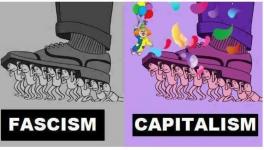
The way that capitalism has dealt with this cul-de-sac until now is by promoting neo-fascism, by bringing about a corporate-fascist alliance that produces a distractive discourse by “othering”, and creating hatred against a religious or ethnic minority. This seeks to keep the working people divided and hence prevent any challenge to the hegemony of monopoly capital within countries afflicted by stagnation and higher unemployment. Even neo-fascism, however, cannot bypass economic issues forever; sooner or later it must be seen to have an economic agenda. And US President Donald Trump clearly has such an agenda.
Liberal opinion makes several assertions: it denies any crisis; it does not see any connection between the crisis and the emergence all over the world of Trump-like neo-fascists; and it dismisses Trump’s actions entirely as the deeds of an unbalanced person. The point at issue, however, is not whether Trump is unbalanced or not; the point is how we see his actions in the context of the cul-de-sac in which neo-liberal capitalism is caught.
Trump’s strategy envisages the US extricating itself from the neo-liberal regime while forcing the Global South to remain entrapped within it. This is clear from his tariff aggression, and the trade treaties he is pushing down the throats of countries, such as India, with this aggression. The treaty with India, for instance, stipulates not only that the US would be charging higher tariffs on Indian goods compared with what prevailed earlier, while India charges much lower tariffs than earlier on imports from America, but also that India would be obliged to buy specified, and much larger, magnitudes of American goods by specified dates.
Neo-liberalism that apotheosizes the “market” should in principle be inimical to fixing such targets for import amounts; by fixing them. Therefore, Trump is going beyond neo-liberalism as far as the US is concerned. But there is no similar target fixed for the magnitude of imports that the US should be buying from India by any specific date; that is a matter left to the “market”. The trade treaty, therefore, amounts to an agreement whereby the US is not obeying any neo-liberal diktat while India is. And exactly the same holds with regard to the differential tariff rates proposed within the treaty, that India should be open to virtually free imports of American goods while the US would protect itself through tariffs against Indian goods.
The purpose of this trade strategy is to shift the location of certain economic activities from India, and other countries of the Global South that would be subject to similar treaties from the US, to the US itself. It seeks, in other words, to overcome stagnation and higher unemployment in the US by exporting such stagnation and unemployment to countries of the Global South. It thus seeks to pass the burden of the crisis onto the shoulders of countries of the Global South.
Such unequal treaties are reminiscent of the colonial era. Trump’s strategy, therefore, can be seen as re-enacting a colonial scenario, or as an attempt at recolonising the world. Exactly the same can be said about the current US attempt to take control of the mineral resources, including in particular the oil resources, of the Global South.
Political decolonisation in the wake of the Second World War had been the precursor of the far more difficult process of economic decolonisation in countries of the Global South, by which they had sought to take control of their natural resources; the success they had achieved with regard to economic decolonisation had been due in no small measure to the support of the Soviet Union. If neo-liberalism had started a reversal of this process, the Trump strategy seeks to complete this reversal. The US assault on Venezuela (which has the second largest oil reserves among countries) and on Iran are indicative of this attempt at reversing economic decolonisation.
This attempt explains why the rules-based international order is being subverted by the US. Of course, an attempt at recolonisation can occur even within a rules-based international order, such as, for instance, what the neo-liberal regime had signified. But if the cul-de-sac caused by the neo-liberal regime is to be overcome through a jettisoning of neo-liberalism in the US (and other countries in the Global North) while its application in the Global South continues apace, then going beyond the rules-based international order becomes absolutely necessary for imperialism.
This imperialist strategy for overcoming the cul-de-sac of neo-liberalism betrays at the same time its inability to usher in a solution that can promise to benefit all. It amounts, in other words, to an admission that the system has exhausted its potential for even promising an improvement in the living conditions of all, that no going beyond neo-liberalism is possible for the system as a whole; some countries can go beyond neo-liberalism, but only by subjecting others to even greater thraldom under it.
The question that immediately arises is: why do governments of the Global South agree to such unequal trade treaties and the recolonisation that such treaties typify? The answer lies in the fact that while the working people, the petty producers and even the small capitalists in the Global South would suffer because of such recolonisation (the Indo-US trade treaty, for instance, would be particularly harmful for the Indian peasantry), the monopoly bourgeoisie that is closely integrated with metropolitan capital will not.
On the contrary, it is likely to be a beneficiary; and governments in the Global South, including and in particular the neo-fascist ones, cater to its interest. The project of recolonisation, in other words, becomes possible because of a fracturing of the earlier anti-colonial class alliance that had brought about decolonisation.
The writer is Professor Emeritus, Centre for Economic Studies and Planning, Jawaharlal Nehru University, New Delhi. The views are personal.
Get the latest reports & analysis with people's perspective on Protests, movements & deep analytical videos, discussions of the current affairs in your Telegram app. Subscribe to NewsClick's Telegram channel & get Real-Time updates on stories, as they get published on our website.