






Huge AI Data Centre Turns Rural Utah Into National Flashpoint
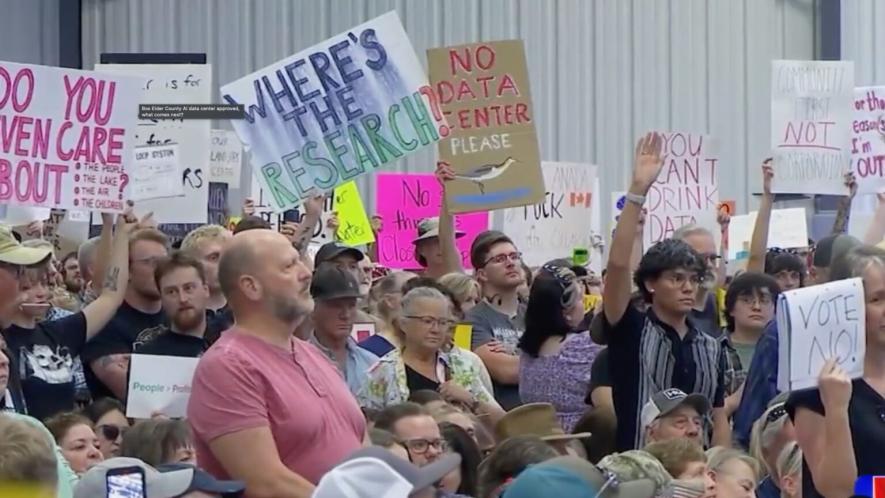
Protestors voice opposition to an approved 40,000 acre data center in rural Utah at the Box Elder County Commission meeting on May 4. Photo: screenshot
“Shame! Shame! Shame!” chanted over a thousand voices on May 4, at the County Commission meeting of Box Elder, a rural county of Utah, as the three commissioners collected their things and quickly made their way toward the exit. Police moved toward the crowd as chants continued:
“Who are you protecting?” and “People over Profit!”
The county commissioners had just voted to approve one of the world’s largest data centers. A 40,000-acre complex known as the “Stratos Project” is now moving forward in the rural area. These data facilities, although typically much smaller, are the essential infrastructure powering the AI technology boom.
Backed by celebrity investor Kevin O’Leary (known internationally for the television show “Shark Tank”) and Utah’s Military Installation Development Authority (MIDA), the project would be roughly the size of Washington D.C. (160 square-kilometers).
This hyperscale data center is set to consume 9 gigawatts of power. More than double the total energy consumption of the entire state of Utah, relying solely on natural gas-fired energy generation. Reports indicate this would increase the state’s emissions by 50%. An estimated 16.6 billion gallons of water per year would also be required to operate the facility’s turbines. The quantity of water isn’t the only concern, but also the source. Stratos would have to tap water sources that environmental groups warn will impact the Great Salt Lake, the largest saline lake in the Western Hemisphere and a critical ecological hub for millions of birds and other species. Warmer winter temperatures have reduced the desert state’s snowpack, the primary water source for residents and the Great Salt Lake. As Utah’s water crisis deepens, the shrinking lake is approaching record-low water levels.
But the data center is now facing its first major wave of organized resistance.
Thousands challenge water use for massive data center
After the commissioners approved the project, nearly 4,000 Utahns filed protest responses with the Utah Division of Water Rights against the project’s application for water rights to a direct tributary of the Great Salt Lake. Appeals cited concerns over worsening drought conditions, the ecological collapse of the Great Salt Lake, rising energy costs, toxic dust from the drying lakebed, and what critics describe as a rushed and opaque approval process with no community input. The application was subsequently withdrawn on May 7.
For many residents, the stakes in this conflict couldn’t be higher. With public health and the environmental stability of the region itself on the line.
“We’re not here to subsidize our own death,” Natalie Clark, a local activist and one of thousands who filed a protest, told Peoples Dispatch.
Clark accused state officials of acting as “brokers for billionaires” rather than “stewards of our desert.”
Bar H Ranch (which owns roughly one-third of the land tied to the proposed project and has historically used the water in question) filed the application to convert 1,900 acre-feet from Salt Wells Spring from agricultural to industrial use for the data center. It has expressed intent to refile the application soon. The move “effectively restarts the administrative process and skirts thousands of community protests,” warns Sierra Club Utah, one of the many environmental groups organizing against the data center.
Water conservation group Grow the Flow, says Bar H and the developer intend to “sidestep the public input process by withdrawing their application and resubmitting later”.
The project will ultimately require access to more than 10,000 acre-feet of water, which developers are seeking through multiple sources.
County approves project despite mass backlash
Over 1,000 Box Elder County residents attended the commission meeting on May 4 to voice their opposition to the massive data center. The three-member commission spoke about the benefits of the development and then went into a back room to make the vote, which was unanimous in favor of the project.
Commissioner Tyler Vincent defended the vote, claiming the agreement reflected “thoughtful consideration of long-term economic opportunity, infrastructure planning, and responsible stewardship.”
Clark, who was at the meeting, told Peoples Dispatch that there was no space for public comment:
“Officials were unwilling to engage with a single argument from any of the constituents. That’s part of the most frustrating thing. They didn’t allow the public to even state their claim, make their arguments, they wouldn’t engage with it in the slightest.”
After the room erupted in anger, “the police immediately tried to rush all of us out of the building as if that decision wasn’t just a blatant disregard for the life of every person in that room and in the state.”
Refusing to back down on the project after the vote passed, O’Leary later dismissed the mass outrage:
“We think over 90% of the protesters are actually not people that live in Utah.”
Utah, MIDA, and the battle over who controls AI
Beyond environmental concerns, the conflict over the “Stratos Project” is increasingly becoming a broader political struggle over who controls the infrastructure behind the AI economy and how quickly massive private developments can bypass democratic oversight.
Arguably the most unique aspect of the city-sized data center in Utah is how unusually fast the project was approved, compared to the average 5-year timeline.
An initial meeting took place between O’Leary and Utah Governor Spencer Cox in January 2026. The Box Elder County Commission approved the project five months later.
The breakneck speed of the process was only possible because of a zoning loophole called the Military Industrial Development Authority (MIDA).
Utah’s State Legislature created the entity in 2007, to support Hill Air Force Base in Davis County and the Utah National Guard. It acts as its own “municipality”, fast-tracking development and capturing tax revenue for military needs by leasing land to private developers. Taxes from these projects ensures a steady stream of revenue that keeps Hill Air Force base out of danger of closing, like it almost did in 1995.
MIDA has the ability to grant massive tax cuts, like 80% off property taxes and energy taxes reduced from 6% to .5%, that a private developer could never get on their own.
Locals argue that the involvement of this entity represents a “blatant disregard for democracy”.
Clark says, “MIDA was used to bypass zoning and environmental reviews. They’re rushing it through so quick with no public feedback, not listening to any of the constituents that they were elected to represent.”
However, this zoning loophole has never been used to accelerate a project of this scale or potential impact.
In the past, MIDA has backed projects like the 235-acre Utah Data Center at Camp Williams, the Falcon Hill Aerospace Research Park near Hill Airforce Base, and a military recreation development in Wasatch County.
Many residents argue that the military connection to the “Stratos Project” is “legal fiction” used to justify the accelerated timeline of O’Leary’s massive data center.
O’Leary, the Box Elder County Commissioners, and others behind the project have claimed that the data center will generally support national defense by providing secure computing power. They’ve also claimed the revenue will support Hill Air Force base and the Utah National Guard, touting “military readiness” for the state and “national security”.
But for residents, these benefits don’t feel as clear as the tax breaks and sheer speed of approval for what is ultimately a massive private investment.
AI development nationally sparks local opposition
Across the United States, the rapid expansion of AI infrastructure is transforming data centers from relatively invisible technology facilities into major political flashpoints.
As projects expand, residents across the country are increasingly organizing against them over concerns ranging from rising utility prices and environmental degradation to noise pollution and water scarcity.
In Michigan, the developer behind the USD 16 billion “Stargate” data center sued an entire rural township after its board rejected the project’s rezoning request. The project’s advancement, despite near-unanimous opposition across Saline Township, ignited wider backlash. In the aftermath, at least 19 Michigan municipalities have now enacted moratoriums on new data centers as of February.
The “Data Center Hub” in the United States however, is the state of Virginia. Its northern region is one of the founding homes of the internet, equipped with unmatched fiber optic connectivity and infrastructure, low-cost energy, and affordable land, not to mention data-center friendly tax incentives. With 600 data centers and counting, resistance has become increasingly organized, and is reaching a tipping point. About 46 billion USD in projects have been delayed in Virginia and 900 million USD in projects completely blocked.
Along with Michigan and Virginia, states like Illinois, Ohio, and New Jersey have suffered increased energy prices and water supply concerns after data centers became operational.
The recently approved “Stratos Project” in Utah, however, is unprecedented. The 160-square-kilometer project is expected to consume enough electricity to power the entire country of Finland, relying on a natural gas-fired plant supplied by the Ruby Pipeline in the area.
Despite the ecological crisis the state is already in, amid the shrinking Great Salt lake and persistent drought conditions, Governor Cox is one of the strongest proponents of the project:
“I’m so tired of our country taking years to get stuff done. It’s the dumbest thing ever. We think that taking time makes things better or safer. It absolutely does not.”
On the other hand, he has already begun warning of water restrictions, saying “this is a collective effort”.
Critics of the governor argue that Cox will directly profit from the development of the data center through his family’s fiber optics business, CentraCom.
A growing movement takes shape in Utah
Yet, as the situation develops, opposition is expanding to include public protests, legal challenges, and political organizing.
“I really do feel like people can build the power to influence this,” says Clark.
“We are already seeing other states doing the exact same thing that we need to do … We need to get lawsuits for open-meeting acts, we have to challenge MIDA as a whole, challenge the conflicts of interest all the way down to donations made to certain commissioners, filing ethics complaints. There should be no stone left unturned.”
Alongside the thousands of protests filed against the water application, residents of Box Elder County have already begun organizing a citizen’s referendum. Organizations like Stewardship Utah are helping to coordinate their petitions and legal action statewide. Better Utah, a local advocacy organization, launched a petition demanding the Utah Senate Ethics Committee investigate Senate President Stuart Adams over donations he received and connections to the project. Meanwhile, members of Utah’s landscaping and gardening community called for a boycott of J&J Nursery, owned by Senator Jerry Stevenson, who also sits on the MIDA board.
Various environmental, progressive, and political organizations also released statements calling for increased resistance against the data center.
“People are uniquely fired up. The resistance is strong. We just need to really, really keep pushing the momentum,” Clark said.
As AI companies and investors race to secure the land, water, and energy needed for the next generation of computing infrastructure, conflicts like the one unfolding in Utah are increasingly becoming national political battles over environmental stability, public oversight, and who ultimately benefits from the AI boom.
Courtesy: Peoples Dispatch
Get the latest reports & analysis with people's perspective on Protests, movements & deep analytical videos, discussions of the current affairs in your Telegram app. Subscribe to NewsClick's Telegram channel & get Real-Time updates on stories, as they get published on our website.