





How Vijay Rewired Tamil Politics
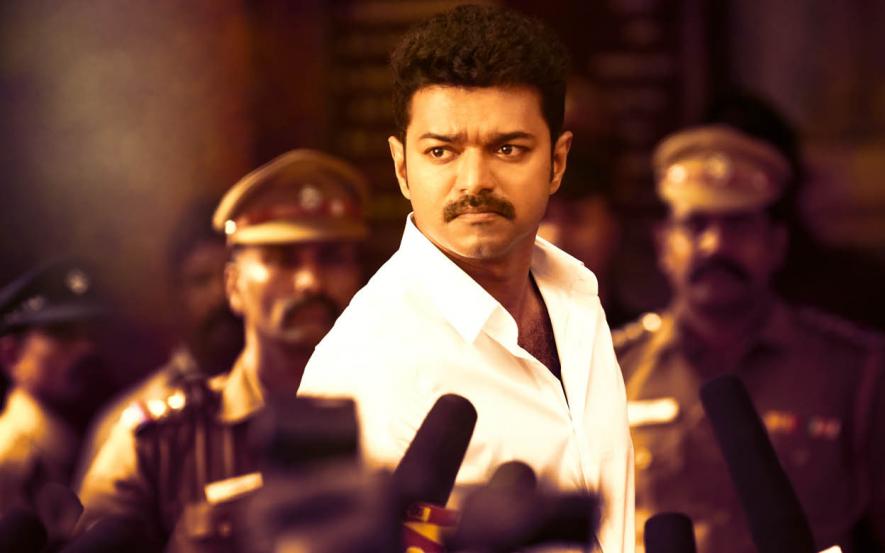
The politics of Tamil Nadu has long been characterised by a complex interplay between Tamil identity and star politics, often described as a mysterious spiral staircase. This article examines the current phase of that trajectory, one marked by anti-foundationalism and ideological emptiness, now led by the Chief Minister Joseph Vijay. Political analysts have questioned how Vijay managed to achieve electoral success where Kamal Haasan and Rajinikanth could not. However, political realities have since transcended these speculative frameworks and conventional analysis.
Ideology has occupied an ambiguous position throughout the history of Tamil politics. Since Periyar’s entry into politics during the era of caste dominance, he advanced a subversive and exceptionally strong ideological framework. Nevertheless, his mass support also stemmed from his extraordinary performative charisma.
Periyar’s influence was significantly greater than that of Rajaji. Annadurai’s 1949 break from Periyar’s Dravidar Kazhagam(DK) rested on three fundamental disagreements, historians note.
First was the question of Indian independence. Periyar termed 15 August 1947 a “day of mourning,” fearing it would mean domination by the “Aryan North.” C.N. Annadurai disagreed. In an article in Dravida Nadu, he argued that the day marked the end of colonial rule and should be celebrated as a national achievement rather than solely that of Aryan North.
Second, Periyar’s call to boycott democratic elections was met with opposition. When the DK resolved to stay out of electoral politics, Annadurai walked out of a party meeting in 1948, signaling his intent to pursue a parliamentary path.
Third, Annadurai believed Periyar’s rigid atheism could not win mass support in a democracy. Political pragmatism, he felt, required a more flexible stance to mobilise the wider electorate. These rifts culminated in Annadurai founding the Dravida Munnetra Kazhagam (DMK) in 1949. The DMK, under Annadurai, adapted Periyar’s ideology to the exigencies of electoral politics.
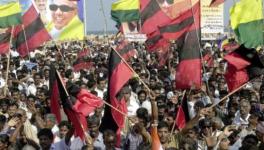
M. Karunanidhi, and M.G. Ramachandran (MGR), a politician of Malayali origin whose prominence stemmed from his cinematic dialogues, were political products of this parliamentary turn. Their eventual split led to the formation of AIADMK. By this point, performative and demonstrative modes of politics had become pervasive in Tamil public life.
A historical analogue to the contemporary Tamil political landscape can be found in the electoral contest between MGR and M. Karunanidhi. At the time, Karunanidhi was dismissive of MGR’s political strength, framing his linguistic and cultural identity as a political liability. But MGR emerged politically successful while the ideological vision of the Dravidian movement resided with Kalaignar Karunanidhi.
Tamil Nadu experienced a period of near-total political and cultural immersion in the persona of M.G. Ramachandran, arguably the most consummate performer of his era. While Sivaji Ganesan was venerated by Tamils as Nadigar Thilagam — the “crest jewel of actors”—for his classical thespian mastery, MGR transcended cinema to become Makkal Thilagam, the “people’s icon.” The electorate remained captivated by MGR’s performative politics and populist image from his ascent in 1977 until his death in 1987, illustrating the unique convergence of film stardom and state power in Dravidian politics.
Tamil identity and Dravidian ideology constituted the core of M. Karunanidhi’s political identity. Despite successive electoral defeats during the M.G. Ramachandran era and subsequently under J. Jayalalithaa, M. Karunanidhi repeatedly re-emerged by mobilising this Dravidian substratum. Yet, crucially, even after MGR’s demise, electoral power in Tamil Nadu continued to be contingent on consummate political performance.
This performative capital was absent in M.G. Ramachandran’s widow, V. N. Janaki, but was possessed by his protégée and political heir, J. Jayalalithaa. Her innate virtuosity—a hyper-dramatic, deeply emotive mode of public performativity— constituted the realised power that fashioned her into Puratchi Thalaivi, the Revolutionary Leader. She not only inherited the party but also the stature of the MGR leadership title (puratcithalivar).
The period between 2016 and 2018 was politically very fragile, where Jayalalitha died, AIADMK split, Karunanidhi died, and the Bharatiya Janata Party (BJP) tried to broker power via OPS/EPS. In 2019, DMK won the Lok Sabha elections, and in 2021, the Assembly elections.
Following M. Karunanidhi’s death, M. K. Stalin consolidated his leadership by fully embracing his father’s Dravidian legacy. Under Stalin, the DMK has articulated a contemporary form of Dravidianism that positions itself as welfarist and structurally resistant to the inroads of Hindutva and its associated project of cultural nationalism, thereby reasserting a distinct Tamil political ideology.
The emergence of Vijay, styled as Thalapathy, as a political actor must be understood in light of two contextual factors specific to Tamil Nadu. Unlike Rajnikanth, Vijayakanth, or Kamal Haasan, he is relying solely on personal charisma. Vijay appears to be deploying a model of calculated social engineering, supported by a professionalised organisational apparatus systematically mapping caste, regional, and youth constituencies.
There’s no easy explanation. A big chunk of Tamil Nadu’s new-gen voters doesn’t carry the weight of old Dravidian, Left, or nationalist ideologies. They, unlike the older generations, have no fixed loyalty-not to DMK, not to AIADMK, not even to Stalin. One consistent political behaviour observed in Tamil Nadu is resistance to Hindutva politics. This is primarily due to the history of Dravidian politics, which resists North-centric political imaginations. This does not point to a lack of political concerns. There was discontent about the large-scale corruption and dynastic power politics. But the political choice was limited to alternating power between the Dravidian majors.
There was a clear vacuum. It was this vacuum that Vijay capitalised on, cultivating a political class disillusioned with the existing system. He emerged as the protagonist-saviour of the Tamil masses, particularly the youth, who have not had meaningful political exposure.
The educational spaces in Tamil Nadu have been an instrument of depoliticisation. Student politics on campuses has been largely curbed, with administrations exercising tight control. Elected student bodies are largely absent in the state. It is a paradox that the Dravidian movements, with a strong history of student activism, failed to see the students’ movement as a significant need in contemporary politics.
This vacuum has eroded ideological engagement, ceding space to reel-politics. Vijay and his team have made easy inroads among Gen Z youth and corporates. It’s a direct play for the post-ideology voter. That voter doesn’t care about Periyar vs. Hindutva. They care about “Will my degree get me a job when ChatGPT exists?” Vijay is saying: “I understand that fear, and I’ll make the state answer it.” His manifesto promises a Ministry of Artificial Intelligence.
Even all that blank slate is what Vijay targeted, and he did it with a playbook that looks more foreign than MGR’s. Vijay has eschewed traditional press conferences and routine media debates, which minimised the need to cut out the middleman, avoid traps, and don’t give rivals free soundbites. Instead, he adopted a strategy of direct outreach, using social media platforms to get his message across to the public.
Through an institutionalised digital apparatus branded as ‘Voice of Commons,’ TVK deployed algorithmically optimised short-form video content and reels targeting youth and first-time voters. This IT wing functions as a precision media unit, circumventing legacy gatekeepers to establish direct affective communication with digitally native electorates.
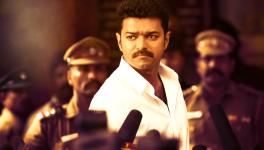
Vijay built his political capital in three film phases. His on-screen evolution from romantic protagonist to cinematic protector and saviour of the masses transformed his star persona into a template for political leadership. This framework turns movie fandom into mass political mobilisation, without politicising them. The saviour hero replaces the need for an ideological legacy. MGR’s political model is updated for today’s young Tamil audience.
Vijay converted his Vijay Makkal Iyakkam from a conventional fan association into a decentralised grassroots political network, the Tamil Vetri Kazhagam (TVK). Eschewing high-expenditure paid advertising, he restructured these cadres as ‘virtual warriors,’ thereby substituting financial capital with organised digital labour in political mobilisation. The strategies were fresh, whereas the conventional political frameworks failed to recognise them.
Vijay does politics like a movie trailer. Every entry is planned-lights, music, perfect visuals and his public appearances are curated as high-production visual events projecting the persona of a ‘calm leader.’ No rambling speeches. Just short, scripted lines that stick. It’s marketing, not old-school rally talk. How long this ‘model’ will succeed depends on how well Vijay responds to the real world of governance and the compulsions of pragmatic politics.
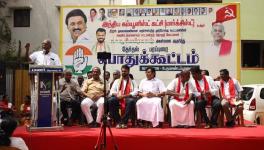
However, Vijay has certainly changed Tamil politics. A coalition government in Tamil Nadu, unimaginable until these elections, is now a reality. Alternating power in a bipolar contest among the Dravidian majors is surely a matter of the past. Long-standing alliances are cracking. The taste of power among political minors will raise political aspirations. Given the current political realignments witnessed in the state, power politics will never be the same in Tamil Nadu.
Dr. Kumari Sunitha V is an Assistant Professor & Head, Department of Philosophy, Madras Christian College & Dr. P.K Abdul Rahiman is Assistant Professor & Head, JBAS Centre for Islamic Studies, University of Madras. The views are personal.
Get the latest reports & analysis with people's perspective on Protests, movements & deep analytical videos, discussions of the current affairs in your Telegram app. Subscribe to NewsClick's Telegram channel & get Real-Time updates on stories, as they get published on our website.