





The Greenland Question
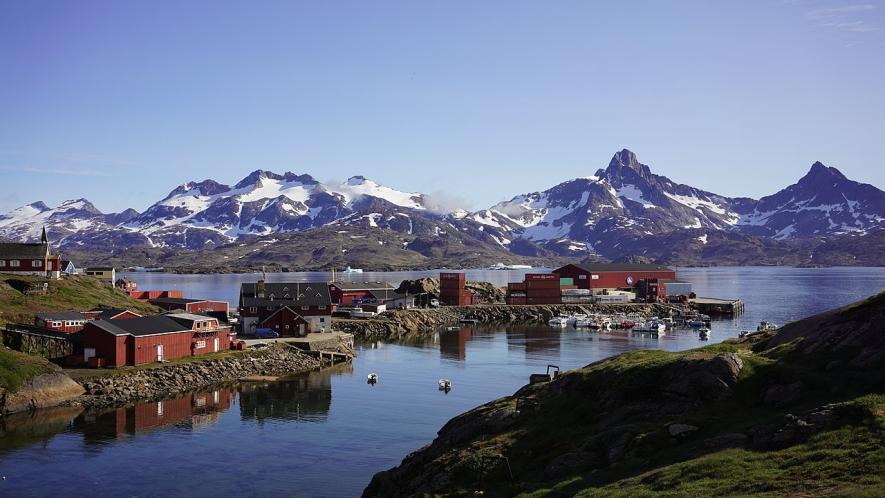
Harbor in Tasiilak, Greenland. Photo: Ray Swi-hymn / Wikimedia Commons
People around the world think of Greenland as a big, empty, white space that is cold, isolated, and on the edge. In fact, it is becoming one of the most strategically important areas of the twenty-first century. Climate change, politics over resources, militarization of the Arctic, and issues of sovereignty are all coming together on this huge island, which is a sign of bigger changes in the world.
Greenland is the biggest island in the world, covering almost 2.1 million square kilometers. An ice sheet covers about 80% of its surface, and if it melts, it could have a big effect on sea levels around the world. Greenland is a territory in the Kingdom of Denmark that is nominally autonomous. It has about 56,000 residents, most of whom are Inuit. But its geopolitical importance is much greater than its population size. Today, Greenland is at the crossroads of three global transformations: the climate crisis, the race for vital minerals, and renewed great-power competition in the Arctic.
Climate as Geopolitics
The Arctic is rising faster than any other region on Earth, with Greenland at the epicenter. The island's ice sheet has been shedding bulk at an increasing rate over the last two decades. Melting glaciers are not just a local environmental worry; they are a global problem. Greenland's ice loss contributes significantly to increasing sea levels, which threaten coastal cities from Mumbai to Miami.
There is, however, a more subtle strategic effect besides the rise in sea level. As the ice in the Arctic melts, new shipping routes are slowly becoming available. The Northern Sea Route and other polar routes cut down on travel time between Europe and Asia compared to the Suez Canal. These routes are only open at certain times of the year and are sensitive to the environment, but they are becoming more stable over time.
This changes the geopolitical map. The Arctic is no longer a faraway outpost; it is becoming a more important strategic corridor. Greenland is a natural hub in this growing Arctic architecture because it is between North America and Europe.
Climate change is not only an environmental disaster for Greenland, but it is also a geopolitical catalyst.
The Minerals Question
People all over the world are also interested in Greenland's subsoil, which has important minerals in it. There are rare earth elements, uranium, zinc, and other important minerals buried under its rough terrain. In a time when renewable energy, electric cars, defense technology and semiconductor production are all changing, these minerals are no longer just things to sell; they are tools of power.
A small number of countries control most of the world's supply of rare earth elements. Governments in the West have been looking for other ways to lower their dependence on certain things. One option is Greenland, which has unexplored reserves. But getting things out of Greenland is not easy or politically simple. Mining projects have to deal with bad weather, high costs for infrastructure, and heated discussions within the company. Greenlanders are especially worried about the environment because they see large-scale mining as both a way to become economically independent and a threat to fragile ecosystems and traditional ways of life.
This tension is very important for Greenland's future. Diversifying its economy beyond fishing, which is currently the main export, could help it become more independent in the long run. But if resource extraction isn't controlled, it could lead to cycles of dependence and environmental destruction. The question isn't if Greenland has resources, but how it chooses to use them.
Autonomy, Identity and Independence Debate
Greenland gained home rule in 1979 and increased self-governance in 2009, giving it power over most internal affairs. Denmark retains control over foreign, defence, and monetary policies. However, the Self-Government Act recognizes Greenlanders as a distinct people under international law and provides a legal road to independence if they want to pursue it.
The independence question is structural rather than rhetorical. Many Greenlandic political parties favor eventual sovereignty. But freedom necessitates economic sustainability. Denmark currently pays major annual subsidies, which account for a significant amount of Greenland's governmental budget. Any progress toward full statehood would necessitate replacing this fiscal support.
United States and Arctic Security
Greenland's strategic relevance isn't new. Due to the island's proximity to the Soviet Union, the United States maintained military facilities there during the Cold War. Pituffik Space Base (previously Thule Air Base) remains a critical component of the United States' missile warning and space surveillance systems.
Geographically, Greenland is at a critical transatlantic crossroads. Any intercontinental ballistic missile trajectory between North America and Eurasia crosses Arctic airspace. Greenland is part of Washington's bigger Arctic defense strategy. In recent years, the United States' relationship with Greenland has increased. Diplomatic outreach, economic collaboration, and infrastructure conversations all indicate increased US interest. While previous plans to "purchase" Greenland aroused controversy, the fundamental reality is that Washington perceives the Arctic as a theater of strategic conflict.
Even though Greenland gets a lot of attention from the outside world, its economy is in bad shape. There isn't much infrastructure, and villages are spread out along the coast. To get from one town to another, you often have to fly or boat. Extreme weather makes it harder to build and move things around.
Fishing, especially for shrimp and halibut, is still a big part of the economy. Tourism is slowly growing, thanks to people's interest in seeing the Arctic and going on adventure trips. But in order to grow tourism without hurting fragile ecosystems, rules need to be thought out ahead of time.
Demographic pressures add another layer. A small and aging population makes it harder to find workers. Limits on education, healthcare, and administrative capacity affect the paths of development.
So, even though Greenland may seem strategically important, it doesn't have a lot of internal capacity. One of its main problems is bridging the gap between geopolitical importance and economic stability.
Greenland as an Important Strategic Point
Greenland isn't a strong country. There aren't a lot of people, factories, or soldiers in it. But its location, wealth, and climate make it an important part of a world that is changing. Three structural trends have come together on its shores:
- Climate change is changing the Arctic's physical features.
- The change in the world's energy makes resources more competitive.
- Geopolitical conflict as big countries change their plans for the Arctic.
Greenland's ability to adapt to these changes will decide if it becomes an independent player in the Arctic, a semi-autonomous resource frontier, or a carefully balanced partner in the Danish realm.
India and other rising powers that keep an eye on Arctic dynamics can learn a lot from Greenland. The Arctic is no longer cut off from problems in the Global South. Indian coastal cities are affected by rising sea levels. The goals of renewable energy are affected by the supply chains of rare earths. Strategic competition in the polar regions has an impact on global stability.
So, Greenland is more than just a frozen island. It is a place where the climate crisis, strategic autonomy, and resource politics all come together.
The real question in the next few decades won't be if Greenland matters; it already does. The question is whether the new Arctic order will be based on working together and being sustainable or on competition and taking things out of the ground. The ice is melting. Strategic calculations are getting stricter. Greenland is in the middle of both of these things.
Anusreeta Dutta is a columnist and climate researcher with experience in political analysis, ESG research, and energy policy.
Get the latest reports & analysis with people's perspective on Protests, movements & deep analytical videos, discussions of the current affairs in your Telegram app. Subscribe to NewsClick's Telegram channel & get Real-Time updates on stories, as they get published on our website.