





As fragmented farms become harder to cultivate, Uttarakhand farmers look to land consolidation
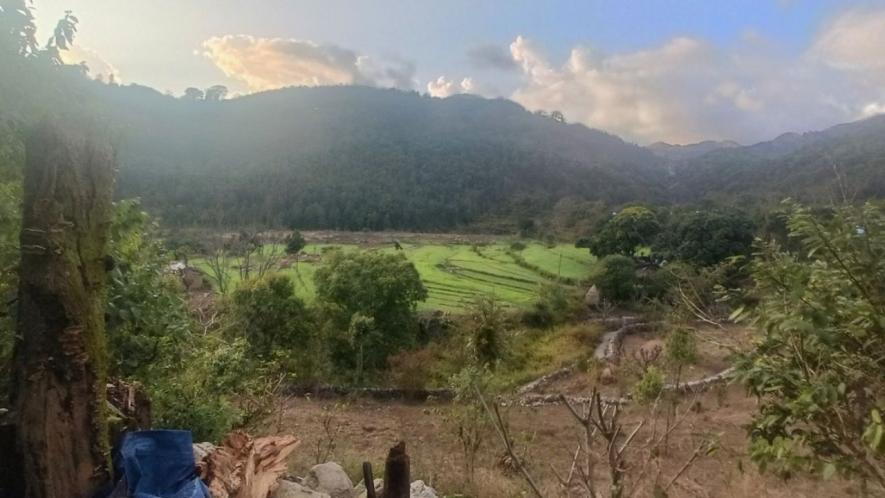
Agriculture field at Kamanda Palla village in Pauri Garhwal, Uttarakhand (Photo - Inder Bisht, 101Reporters)
Noida, Uttar Pradesh: Gopal Negi, in his 40s, has to lug a power tiller across the more than a dozen plots he owns in Kamanda Palla village in Pauri Garhwal district, with each field at least 300 metres apart.
For Negi, the inconvenience outweighs the value of irrigated land. He told 101Reporters he would gladly exchange his distant irrigated plots even for non-irrigated land if they were adjacent to his other fields.
His predicament reflects a broader challenge confronting farmers in Uttarakhand’s hills. Buffeted by frequent wildlife raids and the impracticality of fragmented landholdings, residents of the state’s depopulated villages have begun warming to the idea of government-led land consolidation.
Championed by social activist Ganesh Gareeb from the 1980s to the early 2000s, the concept aims to improve agricultural efficiency by merging scattered land parcels and redistributing them into larger, contiguous holdings.
Only Punjab, Haryana and Uttar Pradesh have implemented land consolidation in India, with the latter continuing a process that began in the 1950s.
Successive governments in the newly formed state of Uttarakhand also sought to translate the idea into policy during the 2000s, said Dehradun-based activist Kapil Dobhal. However, progress was hampered by inaccurate land records and resistance from villagers.
At the heart of that resistance is the redistribution of ancestral holdings, a deeply sensitive issue in communities where families have cultivated the same plots for generations. Many fear they could be allotted less fertile land or fields located farther from their homes, undermining support for the process.
Yet the growing practical difficulties of farming in the hills are prompting some communities to reconsider.
Challenges of fragmented landholdings
The disadvantages of fragmented landholdings extend well beyond the inconvenience of distance. Villagers said scattered farms also make mechanised farming inefficient.
To reduce dependence on animal-drawn farming, the government has promoted two-wheel walking tractors, or power tillers, through a subsidy of Rs 60,000, said Chaman Negi, an electrician in Roorkee who visits his village every two months to tend his fields. Unlike bullock-drawn farming, the machines need only one operator, and in villages hollowed out by migration, many households have adopted them to cope with labour shortages. But Negi said the tillers are often underused because fragmented holdings make them cumbersome to move between fields, and repair services are hard to find nearby.
Fragmentation also makes it harder to guard crops from wildlife. For the past three years, herds of elephants — moving in from the buffer zone of the Corbett Tiger Reserve along a nearby seasonal river — have crossed the village almost nightly, raiding paddy and wheat, the region's main crops, Negi said. Villagers burst firecrackers to drive them off, but the animals rarely return to the same field twice, so keeping watch is a losing battle. "We can't put up a machaan (watchtower) in every field," Negi said. "If our landholdings were consolidated, we could deploy firecrackers and other deterrents collectively." Some villagers said they would also risk growing crops elephants find less appealing — if only their holdings were larger.
The toll of repeated crop losses has pushed a steady stream of residents out of the village. Mahavir Rawat, 42, moved to Noida five years ago after wildlife incursions made farming unviable, a problem which worsened, he said, as neighbouring families left and their abandoned fields stopped buffering his own. "Earlier, our fields were surrounded by cultivated plots, so animals raided those first," he said. "As more families left, the animals began targeting what was left." A consolidated holding, he said, would let him fence his land effectively, and maybe offer enough of an incentive to return.
Similar problem, higher up
The push for land consolidation is gaining ground in villages higher up in the Himalayas too, where wildlife damage now threatens medicinal-plant cultivation, one of the few livelihoods that has drawn people back to their native villages.
For years, residents of Ghes village in Chamoli district earned good incomes growing medicinal herbs like kutki (Picrorhiza kurroa) on scattered plots and wild animals mostly left the crop alone, so cultivation expanded steadily. That changed with the arrival of a beetle locally called gubraila, which in turn draws wild boar. Pesticides are banned in medicinal-plant farming, so farmers have had no way to contain the infestation — boars digging for the beetles often uproot entire plants.
"I saw nearly a 90 percent decline in kutki production this year," said Mohan Bisht, who returned from Dehradun to take up medicinal-plant cultivation. "Earlier I harvested nearly 100 kilograms of dried kutki annually. This year it's collapsed to 10 kilograms."
The losses threaten to reverse the modest gains the crop had made in slowing migration. "Several cultivators based in Delhi and Dehradun own fields here and travel back periodically to tend them," said Prakash Singh. "But if this continues, they may lose interest." Like farmers in the lower villages, residents here believe consolidation would let them protect larger, contiguous holdings from wildlife and expand cultivation. "Consolidated land parcels would also let us scale up production," Bisht said.
Mismatch
Despite growing interest, translating the idea into practice remains a formidable challenge. A law enabling land consolidation in Uttarakhand was enacted in 2016, but implementation has stalled. Updating land records is a critical prerequisite, officials said and the state's mountainous terrain has complicated efforts to map holdings accurately.
"Outdated land records continue to list multiple owners for ancestral holdings," said State Land Consolidation Officer Sunil Kumar Anil. Surveys are hampered by difficult access, ridges and valleys that obstruct sightlines, irregular plot boundaries from terraced farming, and landslides and erosion that render old maps and boundary markers unreliable. Jai Negi of GIC Survey, which conducted one such exercise, said the technology available at the time made things worse: dense vegetation kept drones from capturing exact coordinates, and many traditional boundary markers had simply disappeared.
Technical hurdles are only part of the problem, officials and advocates said; building public trust matters just as much. "Several governments considered the idea but did not take enough steps to promote it and educate people about its benefits," said activist Dobhal. "As a result, many villagers either remained unaware of it or opposed it."
After years of limited progress, the Uttarakhand government approved a voluntary land-consolidation program for the state's mountainous regions in May 2026. The initiative will cover 275 villages across 11 hill districts over five years, with five villages taken up annually in each district. To limit conflict, only villages free of major land disputes are eligible, and each must either have at least 10 hectares available for consolidation or written consent from at least 25 landowners.
"There are multiple challenges in carrying out land consolidation in the mountainous parts of the state," says Naresh Durgapal, joint director of Uttarakhand's Consolidation Department. "Apart from the small size of land parcels, they are often jointly owned by multiple people." Known locally as gol khata, such joint holdings are recorded as a single undivided property shared by several owners, requiring every co-owner's consent for any sale or transfer — and with boundaries and usage rights often poorly defined, disputes are common. Large-scale migration compounds the problem, Durgapal says, since tracking down all co-owners for consent can be difficult.
To address this, the state has launched a pilot survey in five villages. "Latest scientific tools such as drones and GPS are being used for aerial surveys, followed by ground verification," says Anup Singh of the Uttarakhand Board of Revenue, who is leading the project — a marked improvement, he says, over traditional chain surveying, which is prone to error on uneven terrain. Based on the results, the exercise will be expanded statewide. "The last land settlement in Uttarakhand was conducted in 1960. Since then, significant physical changes have taken place," said Sunil Rawat, a revenue sub-inspector in Pauri Garhwal. "There is a clear need to update land records to obtain an accurate picture of current landholdings."
The limitations of smaller fixes
Not everyone is convinced consolidation alone can address the deeper structural problems facing Uttarakhand's rural economy. Dehradun-based rural development specialist BP Maithani argues it may improve farm management and help farmers protect crops from wildlife, but is unlikely to transform agricultural incomes on its own. "The average agricultural holding in Uttarakhand is about 20 nali [roughly one acre]," he says. "Even after consolidation, most holdings would remain too small to support viable commercial agriculture."
Instead, Maithani advocates land-pooling — combining individual holdings into larger, contiguous parcels suited to commercial-scale farming, with farmers as shareholders and a farmer-producer company managing cultivation and marketing. Such a model could enable mechanisation, cut production costs and improve market access, he said, but it would need substantial upfront investment and a five-to-six-year gestation period before returns materialise. For most villagers, though, the immediate appeal isn't commercial-scale farming — it's making agriculture manageable again. Whether through consolidation or the more ambitious land-pooling Maithani proposes, many in Uttarakhand's hills see bringing fragmented fields together as essential to sustaining agriculture, protecting crops, and holding on to a foothold in their ancestral villages.
(Inder Bisht is a freelance journalist and a member of 101Reporters, a pan-India network of grassroots reporters.)
Get the latest reports & analysis with people's perspective on Protests, movements & deep analytical videos, discussions of the current affairs in your Telegram app. Subscribe to NewsClick's Telegram channel & get Real-Time updates on stories, as they get published on our website.