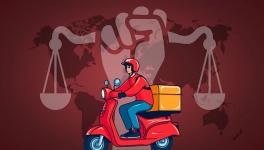






Flexibility to Insecurity: Gig Workers’ New Year’s Strike

Image Courtesy: The Leaflet
Over the past few years, critiques of the gig economy have warned that gig platforms market worker insecurity as flexibility. That algorithms do not eliminate either control or biases, these strengthen them. That the language of partnership masks the erosion of labour rights. Those warnings emerged from workers’ testimonies of falling pay, sudden deactivations, dangerous delivery targets, and lives lived under constant uncertainty. The nationwide strike by gig workers on New Year’s Eve is the clearest confirmation that these warnings were not teething problems of a new sector, but structural features of platform capitalism.
As people across the world prepare celebrate the arrival of the New Year, orders surge, delivery timelines shrink, algorithmic pressure intensifies, and the risks borne by workers multiply: long hours, reckless speeds, winter fog, fatigue, and unpaid waiting time. The strike, timed deliberately on this night of abundance, is a direct challenge to the conditions under which platform profits are extracted. On this very eve, tens of thousands of gig workers across India logged off delivery apps in protest.
The call of the strike is simple, workers demand dignity. This strike is a call for an end to the 10-minute and ultra-fast delivery model; minimum and predictable earnings; protection against arbitrary ID blocking; social security; and legal recognition as workers. Mere demands for survival. In an economy that celebrates convenience and speed, gig workers are asking for safety and stability.
Read Also: India's Gig Workers Need Labour-Sensitive Data Protection Law
Gig workers do not occupy work places, their labour is dispersed, individualised, and algorithmically managed. Their only collective weapon is withdrawal. Logging off is both a refusal and a revelation. This strike is significant because it exposes the myth that platforms are technological entities, it shows clearly that without labour, there is no delivery, no convenience. When the invisible labour refuses to be compliant, the platforms’ promise of seamless convenience crashes.
Platform capitalism represents a new technological form of surplus value extraction, it extracts value not only by extending working hours but also by intensifying labour within time itself. The 10-minute delivery promise is a classic example of labour-time compression. Workers are forced to deliver more, faster, and under riskier conditions, without commensurate compensation. The cost of accidents, health deterioration, and exhaustion is externalised to workers and their families, while profits are internalised by capital.
Algorithms function as capital’s new foremen. They allocate tasks, set pay, impose penalties, and discipline refusal, all while maintaining the illusion of neutrality. The worker appears free, able to log in and out, but this freedom is hollow. Refusal is punished through ratings, reduced visibility, or deactivation. A blocked ID is not a technical glitch; it is a financial penalty. The labour process is tightly controlled, but responsibility is endlessly deferred.
As the world celebrates, this contradiction becomes painfully visible. In some homes, food is ordered in excess, consumed and wasted without thought. In others, families wait anxiously for the night’s earnings to determine whether rent can be paid, fuel purchased, or meals stretched another day. While fireworks light the sky, many delivery workers return home calculating losses rather than gains. Celebration and hunger coexist in the same city, sustained by the same economic system.
The guise of self-employment allows this system to persist despite all flaws. Terms like ‘partners’ effectively exclude gig workers from labour law, obligations of social security, accident compensation, maternity benefits, and income protection. The policy acceptance of this guise reflects a broader alignment with a growth model that privileges platform capital and consumer convenience over worker welfare. Informalisation here is not a leftover of underdevelopment; it is a deliberate outcome.
Read Also: Gig Workers Amid Rising Air Pollution
This strike marks a moment of class assertion in a sector designed to prevent collective identity. By withdrawing their labour on the most profitable night of the year, gig workers expose the fragile foundations of a system that promises convenience while normalising exploitation of the worker.
The structural problems that these workers face, namely, income volatility, algorithmic punishment, unsafe speed mandates, and legal invisibility, have been documented repeatedly. Earlier discussions on platform labour, including analyses of gig pensions and social security, bring out that voluntary codes, incentive tweaks, and festive bonuses cannot repair an employment model built on systematic risk transfer and regulatory evasion. What is required is a decisive policy shift that recognises gig work as work, and gig workers as workers.
The issue that needs to be urgently addressed is the steady withdrawal of collective responsibility for worker welfare. Pensions without income security, health cover without employment protection, and insurance without accountability merely convert social rights into private risks. They do not address precarity; they manage it.
The New Year’s Eve strike pushes the debate beyond tokenism. It demands a framework in which social security is treated as a public good, not a market opportunity. At the least, the resolution requires bringing platform labour squarely within the ambit of labour law, instituting minimum pay floors indexed to time and distance, banning arbitrary deactivations, mandating platform contributions to health insurance, accident compensation, maternity benefits, and old-age security; and regulating delivery timelines in the interest of worker safety. Algorithmic management must be made transparent and contestable, with mechanisms for individual appeal and collective representation.
Saying that platform workers juggling precarious jobs and uncertainties are self-employed partners of the gigantic platform operators is a farce, and it must be recognised as one. This farce has become the central instrument through which insecurity is normalised. Workers must be recognised as workers and their welfare should be prioritised via policies that assure that a fair part of value created by the workers go back to them.
The strike also signals something deeper. By withdrawing their labour on the most profitable night of the year, gig workers are no longer merely reacting to hardship; they are naming the system that produces it. This protest is not only against speed or falling pay, but against a growth model that celebrates convenience while tolerating exhaustion, and fear among those who sustain it. This is a moment of class assertion in a sector designed to prevent collective identity.
The question before policymakers is, therefore, no longer whether platform capitalism needs regulation, but whose lives policy is willing to protect. Until social security is reclaimed as a right rather than an individual gamble, and labour dignity is placed above consumer convenience, such strikes will become the language through which the new working class of the digital economy speaks.
Shirin Akhter is Associate Professor at Zakir Husain Delhi College, University of Delhi. The views are personal.
Get the latest reports & analysis with people's perspective on Protests, movements & deep analytical videos, discussions of the current affairs in your Telegram app. Subscribe to NewsClick's Telegram channel & get Real-Time updates on stories, as they get published on our website.