





Ethanol Blunder: Feeding Vehicles Instead of People?
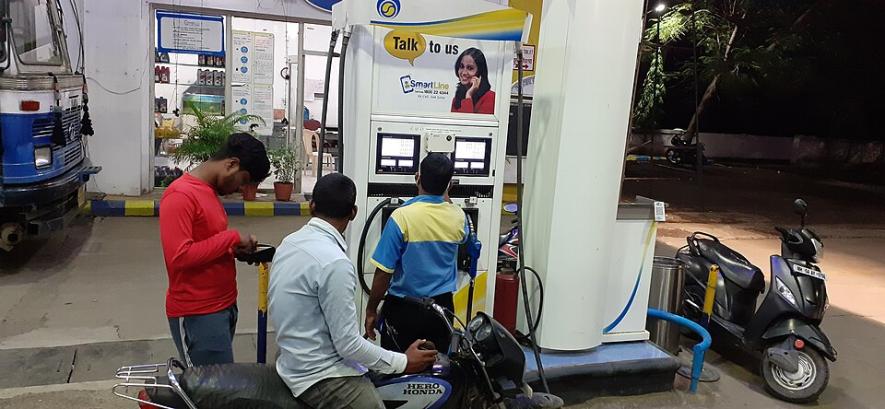
Representational image. Image Courtesy: Wikimedia Commons
The Union Ministry of Road Transport and Highways announced in late-April new rules governing the use of significantly higher proportions of ethanol in petrol blends for automobiles than the currently mandated 20% ethanol blended petrol (EBP 20 or E20). This paves the way for introduction of blends such as E28 or E85 as well as E100 or pure ethanol.
The promulgation has been followed by a rapid-fire chorus of statements from other ministries, such as Petroleum, Power and Industry, all championing high-ethanol blends. Pure bio-diesel or B100, as well as aviation fuel from ethanol, are also included, but will not be discussed here.
The impending policy and roll-out are touted as major measures to reduce dependence on imported oil, save on foreign exchange outflows and promote self-reliance, notably in the context of the current crisis in West Asia and the Strait of Hormuz. In the familiar pattern, even evidence-backed critiques have been attacked as “paid campaigns” and anti-national.
The new direction is a major shift from earlier ones originating in the 1990s, rolled out under the National Policy on Bio-fuels as amended in 2022, and the NITI Aayog report of 2021 laying out a roadmap for mandatory nationwide distribution of E20 fuel, accelerating it from the 2030 to 2025. This has been achieved speedily, admittedly with substantial savings in oil imports and related payments outflows.
However, even at 20% ethanol dosing or E20, significant costs have been imposed on the food basket (since most ethanol feedstock is crop-based), the environment, shifting cropping patterns and water stress in agriculture. Additionally, the hapless automobile owner has been compelled to incur higher costs on fuel, engine modifications and maintenance. These issues have been discussed in detail earlier in these columns.
However, higher ethanol blends up to E100 magnify all these above impacts manifold. The auto industry will also be substantially disrupted. The aggressive push for high-blend ethanol will also impede India’s transition to electrification and decarbonisation of transportation, with serious consequences for India’s technological capabilities and development.
Changes in Auto Industry
Ethanol is corrosive and hygroscopic, i.e. absorbs water, and causes wear on fuel-related parts, such as fuel injection systems, hoses, seals etc and also increases maintenance downtime and costs. While automobiles made in or after 2023 were fully compatible with E20, the vast majority of older two-wheelers (2W) and four-wheelers (4W) on Indian roads are not. Some auto manufacturers supplied upgrade kits and re-tuned the engine for the E20. All these additional costs had to be borne by vehicle users.
Beyond 20%, higher ethanol blends require major changes in the engine at the manufacturing stage itself. Since there cannot be different engines for varying blend percentages, automobiles have to be flex-fuel vehicles (FFV) that can handle all ethanol blends from pure petrol to E100. These engines have advanced sensors that assess the type of fuel, and adjust the fuel injection and combustion processes accordingly, besides being equipped with appropriate fuel-related materials and components.
In Brazil, which is often cited as a role model for India, incorrectly for many reasons, almost all vehicles are FFV. The Brazilian auto industry has been evolving since EBP was introduced after the first oil shock in the 1970s, and most fuel pumps now offer both the mandatory minimum E32 blend and E100. India does not have FFVs to date, although some companies such as Tata Motors are reported to have models ready. The industry will have to make major changes quickly to roll out FFVs, which are likely to raise costs by around Rs.25,000 more for cars and Rs.12,000 for 2W.
A less discussed aspect is that such a major policy push with favourable regulations and incentives would seriously hamper electrification of the transport sector. The auto manufacturing and services industries, as well as EBP fuel supply systems, would be comfortable with EBP in an essentially same ecosystem, whereas EVs call for transformation across transportation. But this is false comfort and only delays the inevitable. EBP and petrol are both hydrocarbons, even if the former is plant-based, and both run on internal combustion engines (ICE) producing carbon-based exhaust gases albeit less with EBP.
Further, even the best ICE vehicles convert only around 40% of fuel energy into mechanical power, whereas EVs convert 80-90% of the electrical energy supplied. If India postpones transition to EVs by, say, 10-20 years due to major policy push for EBP and FFVs, the country would lag far behind others in energy efficiency, decarbonisation and technological capabilities in EVs, and in the global value chain.
High-Blend Fuels
Running costs of E85 or E100 fuel are likely to be higher for users. Government propaganda has tried its best to muddy the picture by talking about fuel efficiency and octane number. The metric that really matters is the energy content or calorific value of ethanol compared with petrol. Ethanol has only 65% of the energy content of petrol. In other words, a car user will have to fill about 15.4 litres of E100 ethanol to get the same amount of energy or mileage as 10 litres of petrol, incurring proportionate penalties for lower blends.
The NITI Aayog’s roadmap had, therefore, asked for tax relief on E20 fuel to compensate consumers, but the government refused, stating that weighted average cost of ethanol is currently higher than that of petrol, knocking out a major rationale for EBP.
Looking at the Brazil case again, data shows that ethanol prices there are about 30% less than petrol, and the government strives to maintain that, with car drivers advised to seamlessly switch to E100 only when its price drops to 70% that of petrol. In India, the government provides generous incentives to sugar mills and ethanol distilleries, and procures ethanol at high administered prices, compelling users to pay as much or more for ethanol as for imported petrol even during crises such as now.
Aviation Fuel
The inclusion of ethanol for aviation fuels in the new rules has raised a minor storm and some misplaced criticism and alarm for being dangerous. Use of bio-ethanol is among several options being actively developed internationally, and even used in flights, by the aviation industry in pursuit of the decarbonisation targets set by ICAO.
Ethanol cannot be used directly in aircraft engines, but requires to first be converted to a usable form, chemically similar to aviation grade kerosene through a process called Alcohol-to-Jet or ATJ. After conversion, it fully conforms to ASTM International standard D7566 and can be used in up to 50% blends. The current proposal in India is for only 1% blend by 2027 going up to 5% in 2030.
Given the serious difficulty with alternative energy sources, such as batteries or hydrogen for large airliners, and given scarcity of bio-ethanol and the structural problems associated with using agricultural resources, the hard-to-abate aviation sector rather than terrestrial transportation is perhaps the better choice.
Pressure on Agri and Food Crops
In a tragic policy myopia, the new policy shift toward higher-blends such as E85 or even E100, will shift almost the entire burden of India’s transportation energy from imported fossil fuel on to the domestic agriculture sector with multiple serious consequences.
The initial 10% EBP in India was almost totally based on sugarcane molasses, a by-product of the sugar industry from which alcohol was made for various end-uses including for industries, including pharma and potable alcohol. As E20 was rolled out, this source proved inadequate, so sugar mills were permitted to divert cane juice directly for ethanol production. India witnessed imbalance in demand and supply of sugar, and started importing ethanol. To achieve E20, ethanol distillery capacity has been aggressively expanded through subsidies and price incentives.
Currently, India has a capacity of almost 20 billion litres and uses only around 10 billion litres for supply of E20. This huge over-capacity has made the distillery industry one of the major drivers behind the government’s EBP push. E20 has expanded the supply chain far beyond sugarcane, which is constrained by high demand for sugar and near-saturation of cultivated area.
Today, cane accounts for around 40% of ethanol, while maize accounts for close to 50%, while different millets, ‘spoiled’ rice and wheat, and tiny quantities from crop residues constitute the rest. Rice, meant for distribution under government schemes, has also been used, and is likely to be used now in greater quantities as demand gallops. “Surplus” of rice and wheat will undoubtedly be cited, which actually masks poverty and lack of purchasing power of the poor.
Maize cultivation has undergone significant transformation compared with five years ago when it was not used as ethanol feedstock. Now due to higher demand, the area under maize has risen by close to 10%, mostly at the cost of pulses and oilseeds in which India remains deficient. The demand for ethanol has also diverted maize away from poultry feed, posing challenges for the poultry industry. India has now become a net importer of maize from being an exporter earlier! Research in the US, the world’s largest ethanol producer, mainly from maize, has revealed many disadvantages, such as the rise in grain prices, increased fertiliser use, and higher emissions from land use change.
There is much talk of 2G ethanol from non-food sources, such as crop residue, but costs are high and the quantities involved are small, even if stable supply chains could be set up, difficulties of which have been exposed in efforts to tackle stubble-burning.
Inevitably, the feedstock for high-ethanol blends will increasingly shift to grain. The planned four-fold increase in ethanol demand for E85 or E100 will bring major changes in cropping patterns and in the food basket especially for India’s poor. Is Indian agriculture now to be used to feed vehicles rather than its people?
The writer is with the Delhi Science Forum and All India People’s Science Network. The views are personal.
Get the latest reports & analysis with people's perspective on Protests, movements & deep analytical videos, discussions of the current affairs in your Telegram app. Subscribe to NewsClick's Telegram channel & get Real-Time updates on stories, as they get published on our website.