





End of MGNREGA Will Deepen Poverty
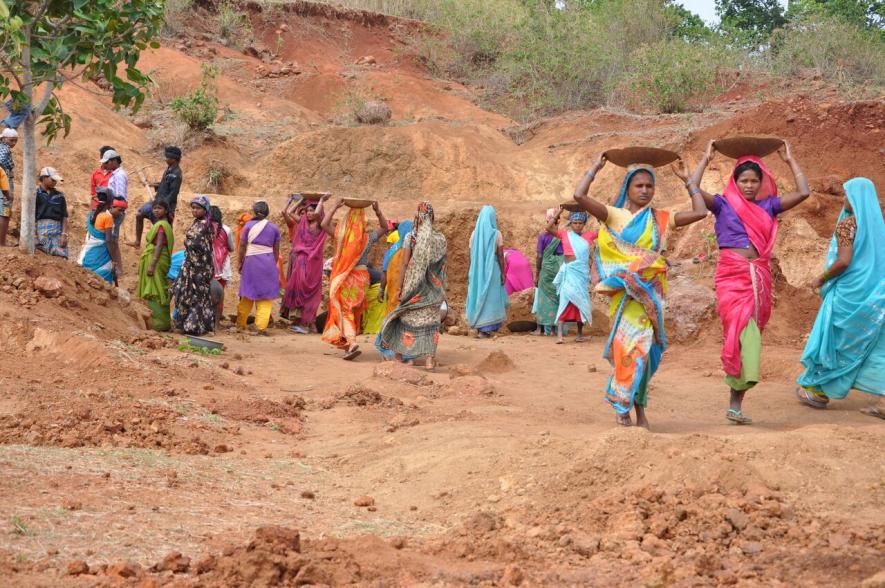
Image Courtesy: The India Forum
The debate around renaming MGNREGA (the national rural employment guarantee Act) is the debate around the idea that the Indian State owes its rural working poor a right to work, a protection against hunger, and a minimum floor of dignity when the labour market offers only insecurity. MGNREGA mattered because it was not framed as charity. It was framed as a legal entitlement. It turned “poverty relief” into a claim that could be placed before the State. For a rural household living on the edge of subsistence, that difference is not philosophical; it is material. It shapes whether the worker is compelled to accept whatever wage a contractor dictates, whether a woman has any option beyond coercive farm labour, whether a family can buy medicines when illness arrives, whether a child stays in school or is pulled into work.
End of MGNREGA
Let us begin with the simplest fact of our political economy; India remains a country where mass vulnerability is normalised. If around 80 crore people still depend on the Public Distribution System (PDS) for basic food security, it is an admission that wages, livelihoods, and employment stability have not kept pace with the rhetoric of growth. PDS prevents starvation, but it does not pay for vegetables, cooking fuel, medicines, transport, rent, school fees, notebooks, data packs, or the interest on accumulated debt. Food transfers can keep a household alive; they cannot keep it secure.
This is exactly where MGNREGA historically functioned as a critical bridge. The scheme did not make people prosperous. It protected them from sliding into destitution. That protection becomes even clearer when one recalls the scale: about 12.5 crore workers are enrolled under MGNREGA. This is not a small beneficiary base. It is a vast segment of working India, landless labourers, marginal farmers, women balancing paid work with unpaid care, Dalits and adivasis historically locked out of secure employment, elderly workers with failing bodies but no pension, migrants who return when urban work collapses, households that are one illness away from hunger.
When the job guarantee is weakened or replaced by a framework that no longer guarantees work on demand, the consequence is not simply “less employment”. The consequence is more poverty; deeper, harsher, and more coercive.
First Structural Shift: From Right on Demand to Allocation on Permission
MGNREGA’s core promise was demand-driven employment: the household could demand work as a matter of right. It was not supposed to be contingent upon whether the State happened to “open work” in that region at that time, or whether budgetary headroom existed in the moment.
What is being proposed now, in substance, is a reversal, employment becomes dependent on centrally determined allocations, administrative notifications, and fiscal ceilings. Now demand has to fit the budget envelope, now work exists only if it is “sanctioned” within an annual cap and now the right to work turns into a rationed programme. It becomes a benefit one may or may not receive, rather than a claim one can insist upon.
The Second Shift: Unequal Citizenship
Another deeply troubling movement is toward geographically selective coverage through notified rural areas. The moment a programme becomes notification-based, it becomes politically and administratively discretionary. Some regions will remain covered, others will be partially covered, and some may be excluded through procedural convenience. A job guarantee that is not universal is not a guarantee. It becomes, a targeted scheme, vulnerable to:
- uneven state capacity,
- political favouritism,
- bureaucratic delay,
- and the gradual shrinking of coverage without legislative confrontation.
The poorest and most marginal regions are often the ones with the least administrative capacity and the weakest political leverage. They are also the regions that need the guarantee the most, and they are the ones that will be excluded most often.
The Third Shift: Unequal Implementation
When cost-sharing is altered in a way that increases State burden, the practical consequence is predictable, states with weaker revenues and greater distress will be forced to ration work, delay payments, or quietly reduce employment guarantee. This creates a cruel geography of protection: the states with the greatest need will be least able to fund the scheme robustly.
In a country like India, the labour market is not a level field. Fiscal federalism is not neutral. When the Centre withdraws responsibility and asks states to carry a larger load, it is not cooperative federalism, it is outsourcing poverty to the weakest institutions.
The Fourth Shift: ‘Mission-Mode Development’
MGNREGA was meant to secure livelihoods through locally relevant, labour-intensive work, rooted in local priorities. Reframing the programme as a development mission, emphasising “asset creation”, “convergence”, “infrastructure outcomes”, “targets”, changes the moral centre of the programme.
The problem is not that assets are unimportant. The problem is that when the logic becomes mission-mode, the worker’s need for employment ceases to be the organising principle. The State begins to prioritise what is auditable, visible, and centrally legible over what is locally necessary and livelihood-protecting.
Read Also: https://www.newsclick.in/systemic-agrarian-crisis-changing-contours-farm-workers
In mission-mode governance, the programme’s success is measured by dashboards, photographs, geo-tags, and completion certificates, while the worker’s most basic questions of work and wages remain unanswered.
The Fifth Shift: Exclusion by Design
Digital systems are presented as instruments of transparency, while in practice, they frequently become instruments of denial. Mandatory biometric attendance, Aadhaar-linked payments, app-based monitoring, and increasing dependence on digital compliance can convert the right to work into a fight to get authenticated.
Most poor households do not have access to stable digital infrastructures. Connectivity fails. Biometrics fail. Linking errors happen. Mapping errors persist. Women often do not control phones. Elderly workers have worn fingerprints. Migrant households face documentation mismatches. The poorest are the least able to navigate grievance redressal.
When wages are delayed, it is not just a line-item in an audit report. It is an empty kitchen. When a payment is denied due to a technical mismatch, it is not “efficiency”; it is hunger, debt, humiliation. When the scheme becomes technology-gated, exclusion becomes structural and poverty deepens quietly.
Most Economically Revealing Change: 60-Day “no Work” and Wage Suppression
The mandatory 60 days of no work during peak agricultural seasons is perhaps the clearest signal of what is being redesigned. It should be analysed not only as an administrative clause but as a direct intervention in rural wage formation.
MGNREGA historically operated as a competing employer. Its presence in the rural labour market strengthened workers’ bargaining power and set a minimum outside option. Even when MGNREGA wages were modest, the existence of an alternative mattered. It meant a worker could refuse the most exploitative terms, or at least negotiate.
When the State legally suspends public employment during the period when agricultural labour demand peaks, the rural workers lose the bargaining power that would have arisen due to high demand. Workers are pushed back into the agricultural labour market in larger numbers, expanding labour supply at the critical moment. This moderates peak-season wage increases and restores employer dominance.
Thus, the clause functions as a wage-disciplining tool. It does not merely “avoid labour shortages”, it ensures that labour remains available to private employers on terms shaped by employer power, not worker choice.
Who Bears the Wage Shock?
Landless labourers bear the shock immediately, they have fewer options, lower bargaining power, and higher pressure to accept whatever wage is offered.
Women workers bear it even more harshly: MGNREGA has been one of the few work options that is relatively local and predictable, and somewhat compatible with care responsibilities. Peak-season agricultural work is often more coercive, mediated by contractors, with longer hours, delayed payments, and intensified labour. When public employment is withdrawn, women are either pushed into more exploitative farm work or pushed out of paid work altogether, deepening the discouraged-worker effect and reinforcing gendered dependency.
The clause also risks producing a vicious cycle. Once peak season ends, labour demand drops. Workers then face an even more slack labour market. Unless public employment restarts smoothly and in sufficient volume, rural wages face downward pressure even after harvest. In many parts of India, cropping patterns are staggered and regional peaks vary; rigid “no work” blocks can create arbitrary periods of income collapse.
Wage Compression and Poverty
This rural wage suppression should not be read in isolation. It is part of a wider political economy that is compressing wages from both ends.
Public-sector wage ladders that once offered stability and dignity to skilled and semi-skilled workers have been weakened through contractualisation, rationalisation, and an ideology that treats wage growth as a fiscal burden rather than an investment in social stability. Skilled workers experience stagnation despite qualifications, while job security is eroded and employment becomes precarious.
Read Also: https://www.newsclick.in/mgnregs-disempowering-people
Dismantling MGNREGA’s effective guarantee erodes the wage floor for unskilled and casual labour. It removes a crucial outside option, suppresses agricultural wages through seasonal shutdowns, and deepens dependency on informal, coercive labour markets.
What emerges is a labour market squeezed from both ends:
- skilled workers face stagnation and insecurity despite education and experience,
- unskilled workers lose the last institutional buffer that prevented wages from collapsing altogether.
This is not accidental drift. It is a coherent policy orientation. When MGNREGA ends as a real guarantee and survives only as a rationed, notified, technology-gated programme, poverty will rise, even if PDS continues.
Poverty is not only hunger. Poverty is the inability to withstand shocks. It is debt. It is untreated illness. It is kids withdrawn from school. It is malnutrition masked by cereal consumption. It is families selling assets, migrating under coercion, and accepting humiliating work terms because there is no fallback.
MGNREGA wages often fund what PDS cannot, healthcare costs (especially catastrophic out-of-pocket spending), transport to hospitals and schools, essential non-cereal nutrition (milk, eggs, vegetables), educational expenses, repayment of informal debt, basic dignity expenses that keep households functioning.
Remove that income support and households slide into deeper vulnerability. And once households fall, the fall is not smooth. It is steep. The first shock triggers the second, debt leads to distress migration; migration leads to family fragmentation; fragmentation leads to school discontinuation; discontinuation leads to generational reproduction of poverty.
The Hardest Hit
The vulnerable and minor sections will be hit hardest not because they are inherently vulnerable, but because the economy and society have made them so through landlessness, discrimination, exclusion from stable jobs, and weaker access to state power.
- Dalit and adivasi households: more likely to be land-poor or landless, more likely to face labour market discrimination, more dependent on public employment as a protective floor.
- Women-headed households: more fragile income structures, heavier care burdens, fewer bargaining resources.
- Elderly and disabled workers: limited ability to migrate, greater reliance on local work options.
- Muslim artisans and rural workers in communally polarised regions: often constrained in labour markets by discrimination and insecurity, making State-backed work options even more crucial.
- Migrant workers: the first to lose urban income during downturns, the first to return to villages, and among the most dependent on a functioning job guarantee when the city collapses.
In each case, the loss of a guarantee does not simply reduce income. It increases coercion. It increases dependency. It strengthens the informal power of contractors and local elites. It turns the worker’s body into the last remaining asset.
The Policy Reversal
This is why renaming matters. It is not a sentimental attachment to a title. It is the cultural face of a deeper institutional retreat, away from rights, away from decentralised social protection, away from labour dignity.
When a State withdraws from being an employer of last resort while 80 crore people remain dependent on food support, it is not moving toward Viksit Bharat. It is moving toward a model where survival is stabilised at the level of ration grain while wages are disciplined, employment is made uncertain, and poverty is managed rather than confronted.
In policy debates, the worker is often reduced to a statistic -- 12.5 crore enrolled, so many person days generated, so many assets created. But the lived truth is quieter and harsher. For millions of households, MGNREGA is the difference between negotiating with the labour market and being crushed by it. It is the difference between paying for medicine and postponing treatment. Between keeping a child in school and pulling them into work. Between eating only grain and eating something resembling a meal.
Ending MGNREGA as a genuine guarantee will not create better jobs. It will push people into deeper poverty, greater debt, and more coercive labour relations. And the hardest hit will be those who have always borne the weight of India’s inequality: the landless, the marginalised, the minorities, and women whose labour is extracted both inside and outside the home.
Shirin Akhter is Associate Professor at Zakir Husain Delhi College, University of Delhi. The views are personal.
Get the latest reports & analysis with people's perspective on Protests, movements & deep analytical videos, discussions of the current affairs in your Telegram app. Subscribe to NewsClick's Telegram channel & get Real-Time updates on stories, as they get published on our website.