





Domestic Fault Lines That Will Decide India’s Next Decade
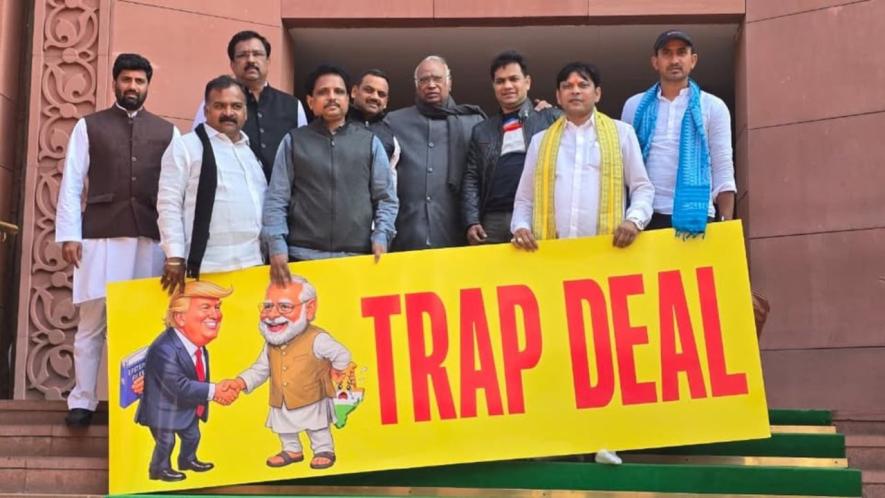
Image Courtesy: Indian National Congress/Facebook
India seems to be entering a confident time in the news around the world. Trade talks are coming to an end, strategic ties are getting stronger, and the country is being seen more and more as a stabilising force in an unpredictable world. People in Washington, Brussels, and New Delhi see India as a major player rather than a wise balancer. But beneath this outward push is a quieter, more important question: Can India's own political and institutional systems keep up with the speed and scale of its rise?
Recent trends show that India's next 10 years will be more about unity at home than about ambitious foreign policy. When India finally signed a free trade deal with the European Union, its strategic position changed a lot. After years of talking about it, India has decided to take a bigger role in an economic union based on rules. This is happening when globalisation is having a hard time. The choice shows confidence—India is no longer just dealing with unstable geopolitics; it's also proving itself to be a reliable economic partner in a time of rising protectionism and broken supply chains.
However, having a business deal doesn't mean you'll automatically be successful in terms of strategy. How well they do things at home determines how powerful they are. The agreement will help or hurt India's economy depending on how well it follows rules, protects workers' rights, protects the environment, and lets small and medium-sized businesses compete. If you agree with others but aren't ready on the inside, your strategy success could turn into stress about how to run things.
India's domestic affairs are becoming clearer as this pattern of strong projection abroad and unresolved tensions at home becomes more obvious. People used to be able to talk about the economy and make deals during the Budget Session of Parliament, but now it is getting more and more disruptive and showy. It's not enough to just be polite in Parliament. When debates in Parliament stop working, the social basis for economic policy is lost. Growth is no longer something we all go through; it's just a number.
India's leaders often use big numbers like GDP growth, infrastructure growth, and digital penetration as proof that things are getting better. People are still worried about the quality of jobs, the suffering of people in rural areas, the damage to the environment, and the unfair distribution of welfare, even though these measurements are important. These tensions remain politically unaddressed without robust parliamentary oversight, exacerbating the chasm between policy objectives and public trust. The difference is shocking.
India speaks a language of long-term planning and strategic clarity around the world. Institutions meant to slow down, examine, and improve authority are under a lot of stress at home. The executive branch moves quickly, but the legislative and deliberative processes are slower. Decisive leaders do not cause democracies to fail. They fail when being responsible is replaced by being decisive.
The iconography of Republic Day showed this split. The focus on improving technology, protecting the country, and having a wide range of cultures showed confidence and pride in the country. But symbolism can't take the place of how well an institution works. Over time, credibility fades when defence is improved without strict fiscal discipline or cultural representation is improved without strong political involvement. A nation that is strong but doesn't have reliable institutions is weak.
The difference is shocking.
When you put all of these things together, they point to a bigger problem with the structure: asymmetry. India's foreign power is growing faster than its ability to make democracy stronger at home. This is a failure of sequencing, not of ambition. When you get power without institutional depth, it's harder to keep it over time. Politically unstable growth happens when it happens without any planning.
The problem is not overreach; it's imbalance. When a country's reputation grows around the world but its own systems get worse, the government depends more on performance than on consent. In the short term, this might help things run more smoothly, but in the long term, it could hurt stability. India's long-term growth will depend less on how well it is known in the world of diplomacy and more on whether Parliament, regulatory agencies, and the courts keep acting as go-betweens for the government and the people.
This isn't just a problem in India. Executive centralisation, limited discussion, and a growing intolerance for dissent are problems that democracies all over the world are having. But because India is so big, both successes and failures stand out more. The way politicians act in the future will be based on the shortcuts they take today. Over time, it is harder to fix problems with procedures than with the economy.
Because of this, the health of Parliament is just as important as any trade deal or military alliance. Governance is not hurt by scrutiny; in fact, it is what makes governance legitimate. Budget talks, committee reviews, and negotiations in the legislature are not a waste of time; they are what keep things stable. Economic reform that doesn't follow democratic processes may work, but they don't last long.
The same case is becoming more relevant to foreign policy. Now, trade partners and strategic allies look at the quality of governance as well as the size of the market and the strength of the military. Regulatory uniformity, judicial independence, and institutional transparency are no longer just things that are important to the US; they are also things that give the US an edge. Democratic strength has become a part of national strength.
India is at a normal but important point: between speeding up and settling down. The problem isn't between strength and democracy; it's between short-term momentum and long-term legitimacy. For the next ten years to be remembered as a time of national growth instead of reckless claims, the country's internal unity must match its external goals.
India has a lot of skill, confidence, and opportunities. We still need to see if its institutions will have the time and space they need to do their important but not very exciting work. In the end, India's rise will depend on how consistent it is, not how fast it is.
The writer is a columnist and climate researcher with focus on political analysis, ESG research, and energy policy. The views are personal.
Get the latest reports & analysis with people's perspective on Protests, movements & deep analytical videos, discussions of the current affairs in your Telegram app. Subscribe to NewsClick's Telegram channel & get Real-Time updates on stories, as they get published on our website.