





Delhi's ‘World-Class’ Dream, MCD's 1957 Secrecy
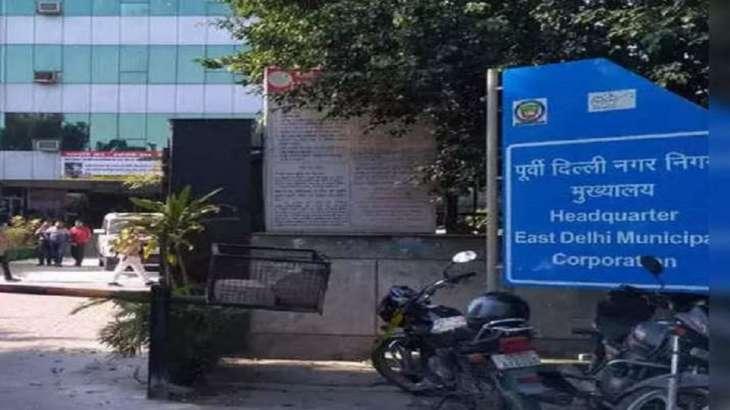
Representational Image. Image Courtesy: PTI
We, the citizens of Delhi, are told to aspire. We are promised a "world-class city," a capital that can stand shoulder-to-shoulder with New York or London. We watch global elections and discuss the granular details of American mayoral races, aspiring to that level of civic engagement.
But back home, in the national capital of the world's largest democracy, the reality is a sham. The powerful and well-funded municipal body in India, the Municipal Corporation of Delhi (MCD), seems to operate as a secret society.
The "world-class" rhetoric stops at the doors of the MCD's Civic Centre. For decades—long before the RTI Act of 2005 and continuing brazenly after the DMC (Amendment) Act of 2022—the corporation has systematically refused to make its most basic legislative records public. The resolutions of the MCD House and the decisions of its Standing Committee, which control thousands of crores of public funds, are treated as state secrets. This isn't an allegation; it's an official, documented admission.
The Smoking Gun: ‘No Rules, No Resolutions’
This writer’s recent efforts have pulled back the curtain, not on the resolutions themselves, but on the MCD's official policy of hiding them. The evidence is as damning as it is bureaucratic:
1. The Listening Post, Public Grievance Portal: A grievance filed on the Delhi’s Lieutenant Governor's portal (No. 2025019461) regarding the non-publication of resolutions was summarily closed. The official reply? "No such record has been uploaded on the website till now". The excuse provided is the "website updating work... after the unification" —a pathetic alibi for ignoring a statutory duty that has existed for nearly two decades.
2. The RTI Admission: A formal RTI reply (No. PIO/MS/2025/D-703) from the MCD's Public Information Officer makes two shocking, plain-text admissions:
A. That there are "no rules and guidelines that govern the publication of resolutions passed by MCD on its official website".
B. And crucially, that "no Resolution passed by the Standing Committee and the House are published on the MCD Website".
Let this sink in. Seventeen years after the RTI Act—which mandates suo motu proactive disclosure of all minutes and decisions under Section 4(1)(b) —the MCD's official position is that it has no rules to follow the law, and therefore, it doesn't.
This opacity is the law of the land in Delhi's municipality. It has survived the trifurcation of the MCD and, ironically, has been strengthened by its "unification" in 2022, an amendment that specifically emphasised e-governance and "digital access to records, proceedings, and municipal decisions".
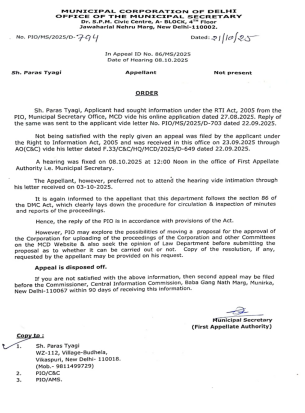
The bureaucratic contempt for the law is complete. When a First Appeal (ID No. 86/MS/2025) was filed against this secrecy, the First Appellate Authority did not order compliance. Instead, in an order dated October 21, 2025, the authority meekly suggested that the department "may explore the possibilities of moving a proposal" to... follow the law.
The High Cost of Silence
This is not a trivial matter of administrative housekeeping. This is the bedrock of all corruption and dysfunction. When the MCD admits it has "no rules" for publishing its financial and legislative resolutions, it renders all oversight impossible. How can the public, the media, or even the GNCTD—which provides substantial Grants-in-Aid —know how public money is being allocated and spent? This secrecy is the "sole reason for the unnecessary litigations that overburdens the Hon’ble Courts" and forces them to say that MCD should be shown the door or face dissolution if it can’t manage its affairs and meet its basic responsibilities.
If this is the state of governance in the national capital, under the direct gaze of Parliament, the Supreme Court, and a hyper-active media, what can we possibly expect in the rest of the nation? But the more urgent question is: why has this been allowed to continue?
Delhi is home to a cottage industry of think-tanks, urban affairs "experts," and a famously vocal civil society. We are awash in seminars, op-eds, and panel discussions on "urban development," "good governance," and "smart cities." Yet, this fundamental, decades-long rot—the refusal to simply publish the minutes of a meeting as required by Section 74 and Section 486 of the DMC Act and the RTI Act —has been met with a collective, deafening silence.
This is the true, uncomfortable nature of Delhi. It is a city of transients, a place to "take advantage of," as the user's prompt rightly notes. The power elite, the intellectuals, and the activists come, criticize the "mess," and leave. Nobody is willing to stay and clean the mess, to take charge, to legally bind the system, or to hold the decision-makers responsible for their actions. This systemic failure exposes the hollowness of Delhi's civic discourse. We critique the aesthetics of the city but studiously ignore the plumbing of its governance.
The Law is Not a Suggestion
The decision-makers in the MCD and their political masters have shown their hand. They prefer the darkness. The recent news headline that the MCD "may upload" its proceedings is just more of the same empty rhetoric—a reaction to pressure, not a commitment to reform. The demands, as laid out in representations to the Chief Minister and the MCD Commissioner, are not revolutionary. These are the bare minimum for a functioning democracy:
1. Install a Public Disclosure Portal: Immediately establish a robust, user-friendly portal for all agendas, minutes, and resolutions.
2. Upload Current Records: Within a time-bound period (e.g., 60 days), upload all records from the formation of the unified MCD in 2022 to the present.
3. Plan for Past Records: Make public a time-bound plan for digitising and uploading all available historical records.
The MCD must be made to understand that the RTI Act and the DMC Act are not suggestions to be "explored." They are laws to be obeyed. Until we, the public, and the institutions that claim to speak for us, demand this basic accountability, all talk of a "world-class" Delhi is, and will remain, a cynical joke.
The writer is president, Centre for Youth Culture Law and Environment (CYCLE). The views are personal.
Get the latest reports & analysis with people's perspective on Protests, movements & deep analytical videos, discussions of the current affairs in your Telegram app. Subscribe to NewsClick's Telegram channel & get Real-Time updates on stories, as they get published on our website.