





Delhi Pollution: One-Size-Fits-All Won’t Work in Transport Sector
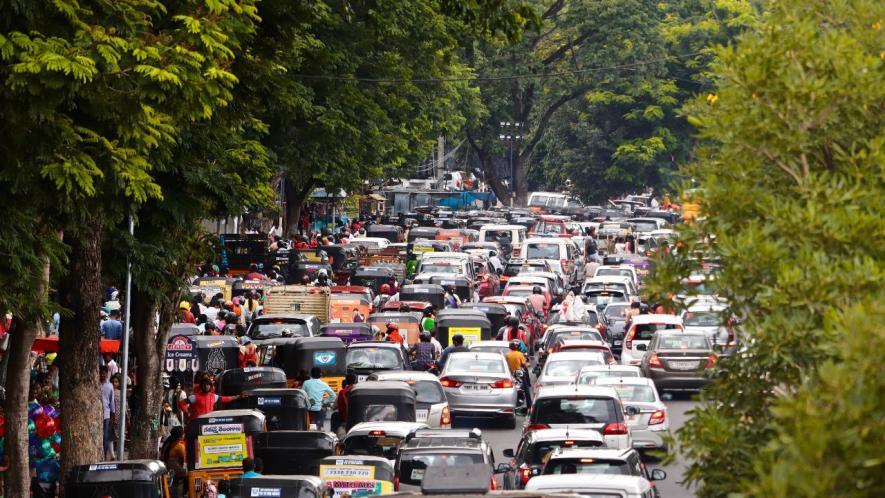
Image Courtesy: Wikimedia Commons
Delhi’s chronic air pollution challenges are inseparably tied to how the city moves people and goods. The transport sector is a major and growing source of CO₂ and NOₓ emissions, shaped by a highly unequal mix of vehicle types, fuel technologies, and usage patterns. On one end are high-mileage commercial and freight vehicles running largely on diesel under relaxed emission norms; on the other is a rapidly expanding but still imperfect transition toward electric mobility, especially in the last-mile delivery segment. In what follows, we explain how different vehicle categories contribute to Delhi’s emissions profile and argue that effective de-carbonisation will depend on targeting the highest-emitting segments, rather than treating all vehicles alike.
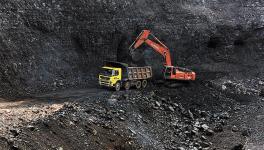
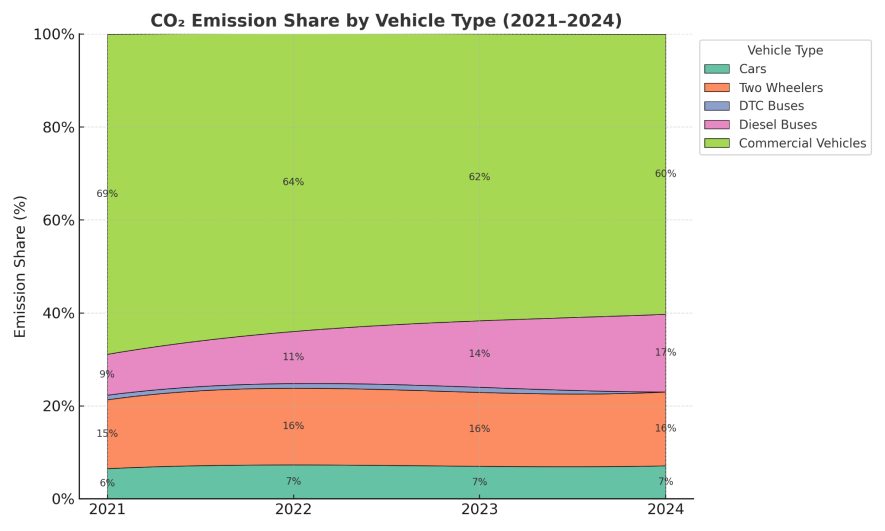
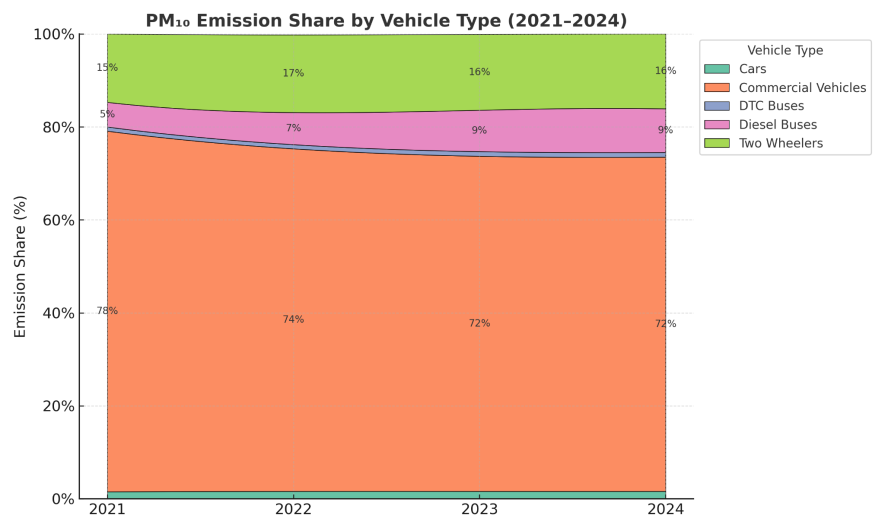
Commercial vehicles (CVs) are the dominant contributors to CO₂ emissions in Delhi, accounting for over 60–70% of annual transport-related emissions. Though they represent a smaller portion of the fleet, CVs (defined here to include tempos, trucks, mini buses, pick-up lorries, and goods carriers) operate longer hours, travel greater distances, and typically run on diesel, which has a higher emission factor than petrol. Many of these vehicles continue to operate under relaxed regulatory norms such as BS III and exhibit lower fuel efficiency. This operational profile explains their disproportionately high emissions footprint.
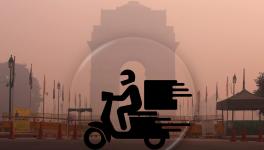
The Electric Vehicle Policy (2020), which mandates 100% electrification of delivery fleets by 2025, has led to a noticeable shift from petrol to electric vehicles in the two-wheelers last mile delivery segment,
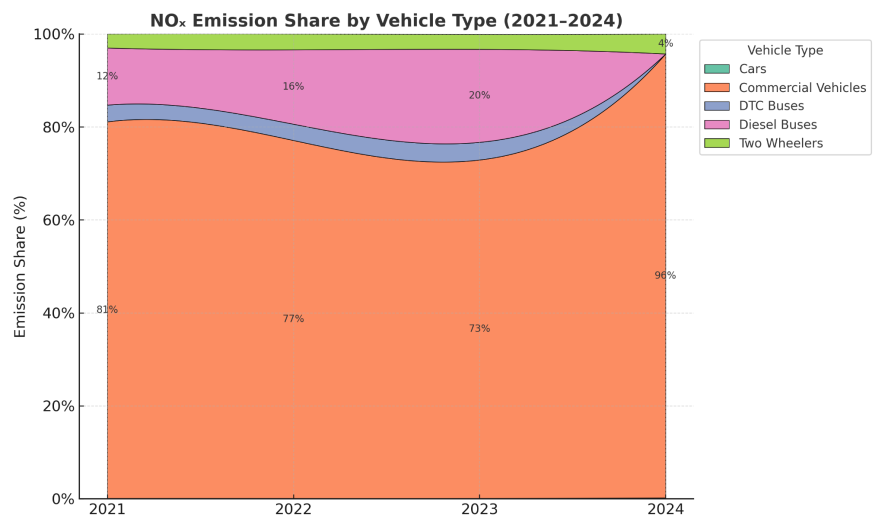
Commercial vehicles are also the leading emitters of NOx, followed by diesel buses. Within the broad category of commercial vehicles (CVs), heavy-duty vehicles (HDVs) are likely the dominant contributors to NOₓ emissions. These vehicles are typically long-haul trucks powered by older diesel engines—combine high engine loads, poor real-world emission control, and long annual vehicle kilometers travelled, resulting in disproportionately high NOₓ output.
The large magnitude of freight-based truck movement in Delhi is driven by a host of geographic, infrastructural and economic reasons. Delhi is a logistics hub of North India, sitting at the intersection of a series of national highways affording fast and convenient road connectivity. It connects Punjab, Haryana, Uttar Pradesh and the broader NCR region making it a transit node for goods moving across North India.
Estimates suggest that about three quarter of fruits and vegetables and almost half of fuel, iron and steel and foodgrains destined for other states traverse through Delhi (Goel and Guttikunda 2015). However the thrust for electrification of HDT (heavy duty trucks) has been neglected in policy design. For example, the Faster Adoption and Manufacturing of (Hybrid &) Electric Vehicles subsidy programme coverage in the second phase extends to two and three-wheelers, car and buses, but excludes HDT’s (Ministry of Heavy Industries 2021).
HDT’s have lagged in the transition to zero emissions both in terms of market development and policy support, leaving a significant policy gap that must be addressed. (ICCT 2024).
Emissions from private cars, by contrast, are volume-driven. Their per-vehicle emission load may be moderate, but the sheer size of the fleet, combined with rising vehicle kilometers traveled and private vehicle dependency—makes them a significant and growing contributor. This underscores the need to curtail car volumes and usage, through demand-side interventions like improved public transport and instruments like congestion pricing.
Emissions reduction strategies must prioritise high-mileage, high-emission segments, especially commercial freight and older diesel vehicles, which have a disproportionate impact on urban air quality. For Delhi to achieve sustained gains in both air quality and climate outcomes, regulation must evolve to reflect real-world vehicle usage.
The writers are researchers having interests in energy economics, transport economics and clean energy. They can be reached at: aiha2400869@st.jmi.ac.in and owaisibnihassan@gmail.com.
Get the latest reports & analysis with people's perspective on Protests, movements & deep analytical videos, discussions of the current affairs in your Telegram app. Subscribe to NewsClick's Telegram channel & get Real-Time updates on stories, as they get published on our website.