





Delhi: Crisis of Women & Child Safety in an Unequal Society

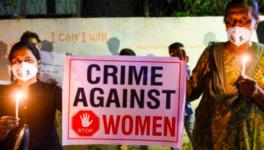
The recent rape cases in Delhi have shocked us to the core. A woman allegedly gang-raped inside a moving bus in the national capital, a three-year-old child allegedly assaulted within a school environment, repeated reports of sexual violence against minors appearing with such frequency that the country has almost learnt to consume them as routine news. One headline replaces another; one outrage dissolves into the next.
What is terrifying is not merely the brutality of these crimes, but their frequency. After every candle march, every televised debate, every promise of “women’s empowerment” and “zero tolerance”, there is another such crime. Meanwhile, women continue to navigate this society with fear woven into the ordinary rhythm of life; fear while travelling, fear while studying, fear while working, fear while simply existing.
More than a decade after the Nirbhaya case forced the Indian State to promise sweeping reforms, another woman is allegedly assaulted, in the same way, inside a moving bus in Delhi. Children continue to face violence even within institutions meant to protect them. This repetition is not accidental. It reflects a deeper crisis of governance, institutional decay and social indifference that no amount of political rhetoric can conceal.
Yet, at the very same time, we are constantly shown figures supposedly demonstrating rising women’s workforce participation, expanding inclusion and women-led development. We celebrate statistical improvements produced through changing definitions and measurement practices that increasingly classify precarious, unpaid and subsidiary labour as employment. Whereas the plain truth is that no society can meaningfully claim women’s empowerment while simultaneously failing to punish violence against women.
The crisis becomes even more disturbing when one examines the gap between reported crimes and actual punishment. India reports tens of thousands of rape cases every year, yet conviction rates have historically remained shockingly low. In many years, more than 70% of accused persons effectively escape conviction. Behind these numbers lies an entire machinery of institutional failure; delayed investigations, hostile policing, endless judicial pendency, intimidation of survivors, social pressure to withdraw complaints and the crushing psychological violence of navigating courts for years.
Figure 1: Reported Rape Cases and Approximate Convictions in India, 2004–2023
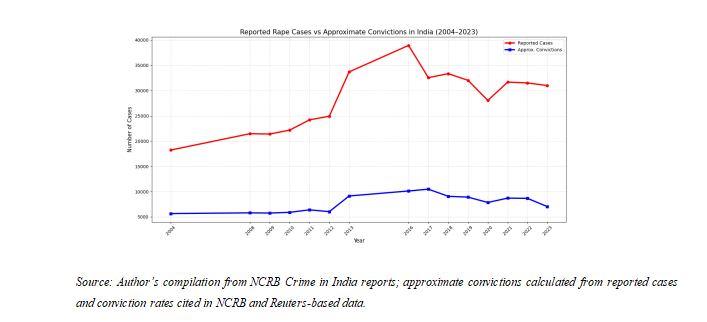
These figures shame the nation. For two decades, India has witnessed persistently high levels of sexual violence while conviction rates remain abysmally low. The issue, therefore, is not merely that a crime occurs, but that the criminal justice system repeatedly fails to punish it swiftly and credibly. A State that cannot guarantee women safety, dignity and justice cannot meaningfully claim to empower them, regardless of how many times it redefines inclusion statistically.
The deeper problem lies in the nature of governance itself. Women’s safety has increasingly been reduced to spectacle; CCTV announcements, symbolic legislation, carefully staged outrage and periodic policing drives after horrific incidents. But safety cannot be manufactured through spectacle after violence has already taken place. It requires functioning public institutions before violence occurs; safe public transport, accountable policing, strong forensic systems, accessible legal aid, dignified employment, social security and judicial systems capable of delivering swift punishment.
Instead, what we increasingly witness is the coexistence of statistical celebration and lived insecurity. Governments speak the language of women-led development while women continue to disappear from public spaces after dark out of fear. We are told that participation is rising while insecurity itself functions as an invisible tax on every woman’s mobility, education and labour force participation.
The burden of this insecurity is not experienced equally. Women rendered more vulnerable because of socio-economic location face disproportionately greater challenges. The privileged can partially privatise safety through gated housing, private vehicles and expensive institutions. The poor cannot. Their insecurity becomes normalised within everyday urban life.
Equally horrifying is the growing violence against children. The repeated reports of sexual assault against minors reveal not merely individual criminality but the collapse of institutional responsibility itself. A society that cannot protect children even within schools and supervised environments cannot claim to possess functioning governance structures.
The category “crimes against children” includes both male and female minors, and the larger reality is that violence in unequal societies invariably falls most heavily upon the vulnerable. Boys under 18 are often no less vulnerable to abuse, exploitation and institutional abandonment than girls. Yet a substantial proportion of sexual offences under POCSO (Protection of Children from Sexual Offence) Act and related laws continue to target girl children, exposing the deeply gendered nature of violence within a broader landscape of social vulnerability and institutional failure.
The explosion in crimes against children reveals a society undergoing a deeper moral and institutional breakdown. The rise from roughly 18,700 reported crimes against children in 2005 to nearly 1.87 lakh cases by 2024 cannot be dismissed merely as improved reporting. Even where reporting has improved, the inability of institutions to deliver swift justice, prevent abuse and protect children within homes, schools and neighbourhoods points toward a profound collapse of governance.
More disturbingly, even the apparent rise in convictions does not necessarily indicate timely justice. Much of India’s child-protection system remains paralysed by enormous pendency under POCSO courts, delayed investigations and years-long trials. The consequence is that legal processes themselves increasingly become another form of violence inflicted upon survivors and their families.
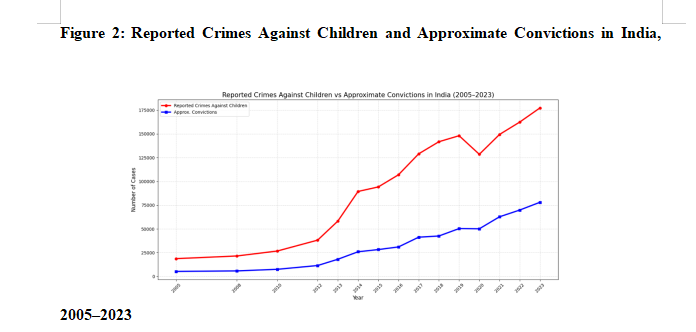
Source: Author’s compilation using NCRB Crime in India reports, CRY/NCRB analysis and NCRB-linked reporting. Approximate convictions are indicative and derived from reported conviction-rate trends.
Ultimately, the crisis of women’s safety in India is not merely a question of crime. It is a question of what kind of society and state we are becoming. No economy can meaningfully bring women into public and productive life while simultaneously allowing fear, impunity and institutional indifference to govern everyday existence. Regardless of how many statistical categories are revised or definitions expanded, a society that cannot guarantee women safety, dignity and justice cannot meaningfully claim progress.
The writer is Associate Professor at Zakir Husain Delhi College, University of Delhi. The views are personal.
Get the latest reports & analysis with people's perspective on Protests, movements & deep analytical videos, discussions of the current affairs in your Telegram app. Subscribe to NewsClick's Telegram channel & get Real-Time updates on stories, as they get published on our website.